The Short Answer: 12 Tasks, $385 to $1,450
A proper 100-hour outboard service in Miami includes 12 specific tasks and runs $385 to $1,450 in 2026 depending on engine make and HP. That price gap is wide because a single 90hp four-stroke takes about 2.5 hours of labor, while twin 350s on a center console can stretch past 7 hours with twice the parts. Either way, the checklist itself does not change. Skip a step and you shorten engine life. Hit every step and your outboard runs another 100 hours without surprises.
Miami outboards hit the 100-hour mark faster than almost anywhere else in the country. Salt water, summer heat, ethanol fuel sitting in tanks during storm season, and idle time at no-wake zones from Government Cut down to Stiltsville all stack stress on internal components. This guide walks through exactly what a thorough 100-hour boat service looks like, what each step costs in real 2026 dollars, and what we catch early when the cover comes off.
What 100-Hour Service Actually Means
Manufacturers tie service intervals to engine hours, not calendar time. The 100-hour mark is the first major service after break-in, and it is where most preventable failures get caught. Yamaha, Mercury, Suzuki, and Honda all publish similar 100-hour schedules. The differences are small. The big variable is condition, which is why a service in Miami often surfaces issues that the same engine would not show in freshwater Michigan at the same hour count.
Roughly 30 percent of 100-hour services in South Florida reveal early impeller wear that would have failed within 50 more hours. Around 22 percent show fuel system contamination tied to ethanol phase separation. About 18 percent uncover loose or corroded battery terminals that were not visible from the helm. These are the failures that strand boats offshore, and the 100-hour service is designed to find them before they do.
The 12 Tasks Included Step by Step
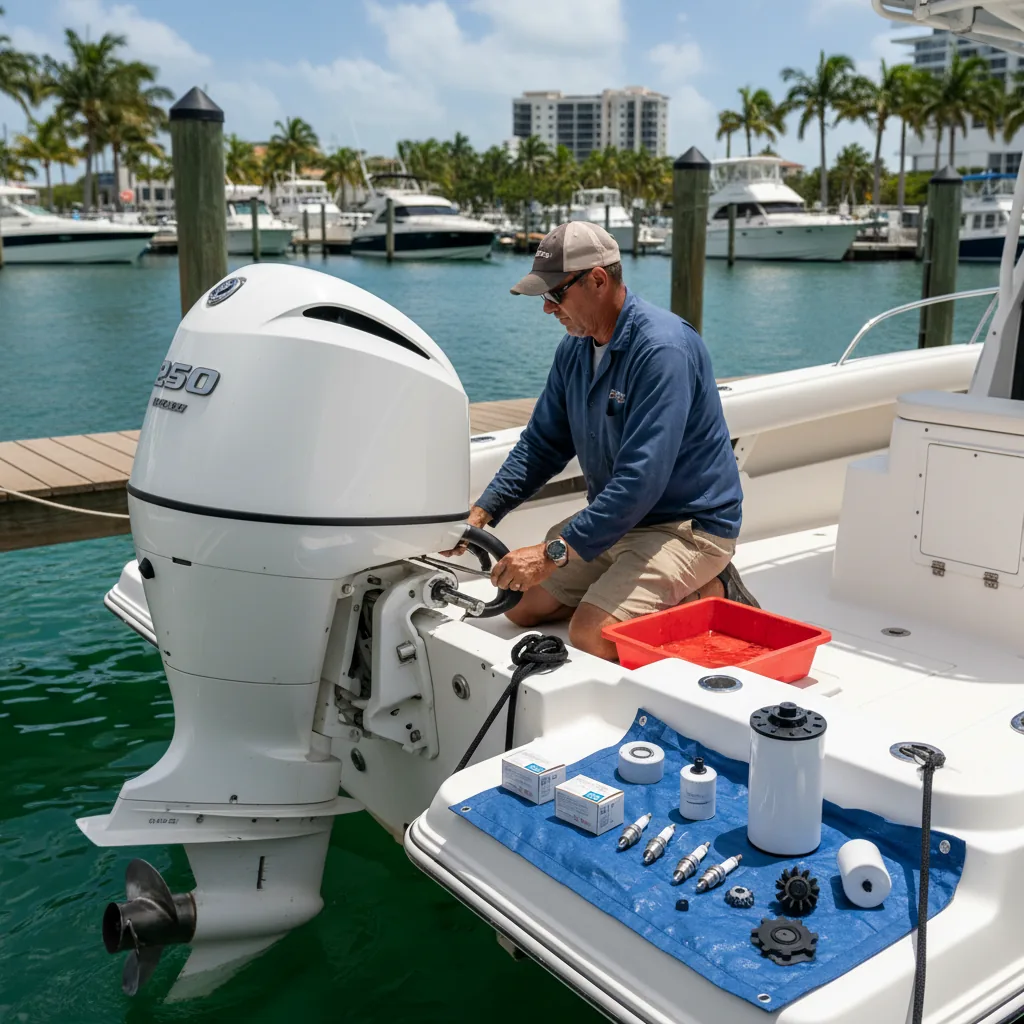
Below is the full task list every certified marine technician should run through. Times reflect a single outboard in the 100 to 250hp range serviced dockside by a mobile marine mechanic.
Step 1: Engine Oil and Filter Replacement. Drain the crankcase, replace the oil filter, and refill with the manufacturer-specified weight. Time: 25 minutes. Parts: 5 to 7 quarts of marine 10W-30 or 10W-40 plus one OEM filter.
Step 2: Lower Unit Gear Oil Service. Drain through the bottom plug and inspect before refilling. Milky oil means water intrusion which we catch here before the gears pit. Time: 20 minutes. Parts: 22 to 32 oz of OEM gear lube and two crush washers. Lower unit repair at this stage costs hundreds, not thousands.
Step 3: Water Pump Impeller Inspection. Pull the lower unit, inspect vanes, replace if bent or hardened. Time: 45 minutes. Parts: water pump kit with impeller, housing, and gaskets.
Step 4: Spark Plug Replacement. Read electrodes for fouling, install new OEM plugs gapped to spec. Time: 20-35 minutes. Parts: one plug per cylinder, typically iridium.
Step 5: Fuel Filter and Water Separator Service. Replace the inline filter and canister water separator. The bowl almost always shows water and rust in Miami. Time: 15 minutes.
Step 6: Anode Inspection and Replacement. Check every sacrificial anode on the lower unit, trim tabs, and bracket. Replace any past 50 percent consumed. Time: 20 minutes.
Steps 7 Through 12: Linkage, Battery, Steering, Prop, Scan, Test
Step 7: Throttle and Shift Linkage Adjustment. Lubricate cable ends, check free play, adjust idle and WOT stops. Time: 15 minutes.
Step 8: Battery and Charging System Test. Load-test the starting battery, clean terminals, verify alternator output under load. Time: 15 minutes. For deeper electrical issues we bring in our boat electrician service.
Step 9: Steering System Lubrication. Grease tilt tube, steering ram, and pivot points. Saltwater intrusion seizes hydraulic steering rams and the repair runs $1,200 plus. Time: 15 minutes. Severe binding gets routed to boat steering repair.
Step 10: Propeller Removal and Hub Inspection. Pull the prop, check splines for fishing line, inspect the rubber hub for slip. Monofilament wraps shred lower unit seals, and we find line on roughly 40 percent of Miami props. Time: 20 minutes. Damaged props go to our propeller repair shop.
Step 11: OEM Diagnostic Scan. Plug into the engine ECM and pull all stored fault codes, even pending ones not actively triggering an alarm. Time: 20 minutes. See OEM diagnostics for what each code means.
Step 12: Final Run Test and Compression Check. Run the engine on the hose or in gear, verify pee stream temperature, listen for unusual sounds, pull compression readings on each cylinder. Compression numbers establish a baseline for the next service. Time: 25 minutes.
Cost by Engine Class in 2026 Miami
| Engine Class | Labor Hours | Parts Range | Total Service |
|---|---|---|---|
| 50-90hp single | 2.5 | $135-$185 | $385-$525 |
| 100-200hp single | 3.5 | $220-$310 | $595-$745 |
| 250hp+ single | 4.5 | $285-$395 | $745-$925 |
| Twin 200-300hp | 6.0 | $440-$620 | $1,090-$1,280 |
| Twin 350hp+ or triple | 7.5 | $565-$770 | $1,265-$1,450 |
Mobile service in Miami runs a flat dock-call fee of $0 to $85 depending on marina location, with no upcharge for slip access in Miami, Coconut Grove, or Key Biscayne. Engines under hardtops or in cramped engine wells can add half an hour because access matters more than horsepower for total time on the job.
What We Catch Early at the 100-Hour Mark
The reason this service pays for itself is the failures it surfaces before they strand a boat. Across our service log from the last 18 months in South Florida, here is what 100-hour visits actually find: roughly 30 percent show impeller wear severe enough to recommend immediate replacement, about 22 percent reveal fuel water contamination from ethanol blends, around 18 percent show loose, corroded, or undersized battery cables, approximately 15 percent surface a stored ECM fault code the owner had not noticed, about 12 percent show anode depletion past the 50 percent threshold, and roughly 8 percent reveal early lower unit seal weep that becomes a major failure within one season.
Those are not theoretical numbers. Those are real Miami boats, mostly between Government Cut and Haulover Inlet, that came in running fine and left with a problem prevented. Boats running the offshore stretch to Bimini or down to the Keys benefit even more, since a failure 30 miles out is a tow bill that easily exceeds the service cost.
Why Miami Outboards Hit 100 Hours Faster
The same engine that takes three calendar years to reach 100 hours in the Great Lakes can hit it in eight months here. Year-round running, no winter storage, and hot ambient temperatures all compress the timeline. Saltwater raises corrosion rates by a factor of five compared to freshwater. Ethanol absorbs ambient humidity faster in subtropical air, which is why outboard engine repair calls spike during hurricane season when boats sit with half-full tanks.
There is also the idle-heavy nature of Biscayne Bay running. Slow zones, no-wake channels, and waiting in line at Government Cut all rack up engine hours without putting on miles. That kind of operation glazes cylinder walls and loads up plugs faster than offshore cruising. The 100-hour service exists to reset all of that before it becomes permanent damage. Skipping it to save a few hundred dollars is the most expensive decision a Miami boat owner can make.
Book Your 100-Hour Service Before You Hit the Threshold
The 12-step checklist above is what separates a real 100-hour service from a quick oil change with a fancy invoice. Every step matters, every step has a time and a part attached, and every step gets documented before we leave the dock. If your hour meter is approaching 100, 200, 300, or any multiple, get on the schedule before the next offshore run. Call (305) 290-2701 or schedule a 100-hour service and we will arrive at your slip with the parts, tools, and diagnostic gear to complete the full checklist in a single visit.
Frequently Asked Questions
How long does a 100-hour outboard service take in Miami?
A single 100 to 250hp outboard takes about 3 to 4 hours dockside. Twins run 6 to 7.5 hours. Mobile service means no haul-out time, so the whole job finishes in one visit at your slip.
What is the real cost of a 100-hour service for a 200hp outboard?
Expect $595 to $745 total in 2026 Miami pricing for a single 100 to 200hp engine, including all 12 checklist tasks, parts, and labor. Twin 200hp engines run $1,090 to $1,280 combined.
Can I do the 100-hour service myself?
Oil changes and anode swaps yes. Water pump impeller, OEM diagnostic scans, and compression testing require specialized tools and software. Missing any of the 12 steps voids most engine warranties.
What happens if I skip the 100-hour service?
Impeller failure, fuel system contamination, and lower unit seal damage compound silently. Roughly 30 percent of skipped services lead to a major repair within 50 more engine hours, costing 4 to 8 times the original service.
Do I need a 100-hour service if I only run my boat occasionally?
Yes. Saltwater corrosion, ethanol fuel breakdown, and rubber component aging happen on calendar time too. Most manufacturers require service every 100 hours or 12 months, whichever comes first.