



Marine fenders take a beating. Every vessel that pulls into a dock, every shift in tide, every gust of wind pushing a hull against a pier—all of it translates into force that these protective barriers must absorb. When fenders fail to hold their shape, the consequences ripple outward. Docks sustain damage. Vessels get scratched or dented. Repair bills stack up. The question isn't whether fenders will deform over time, but why it happens and what we can do to prevent it.
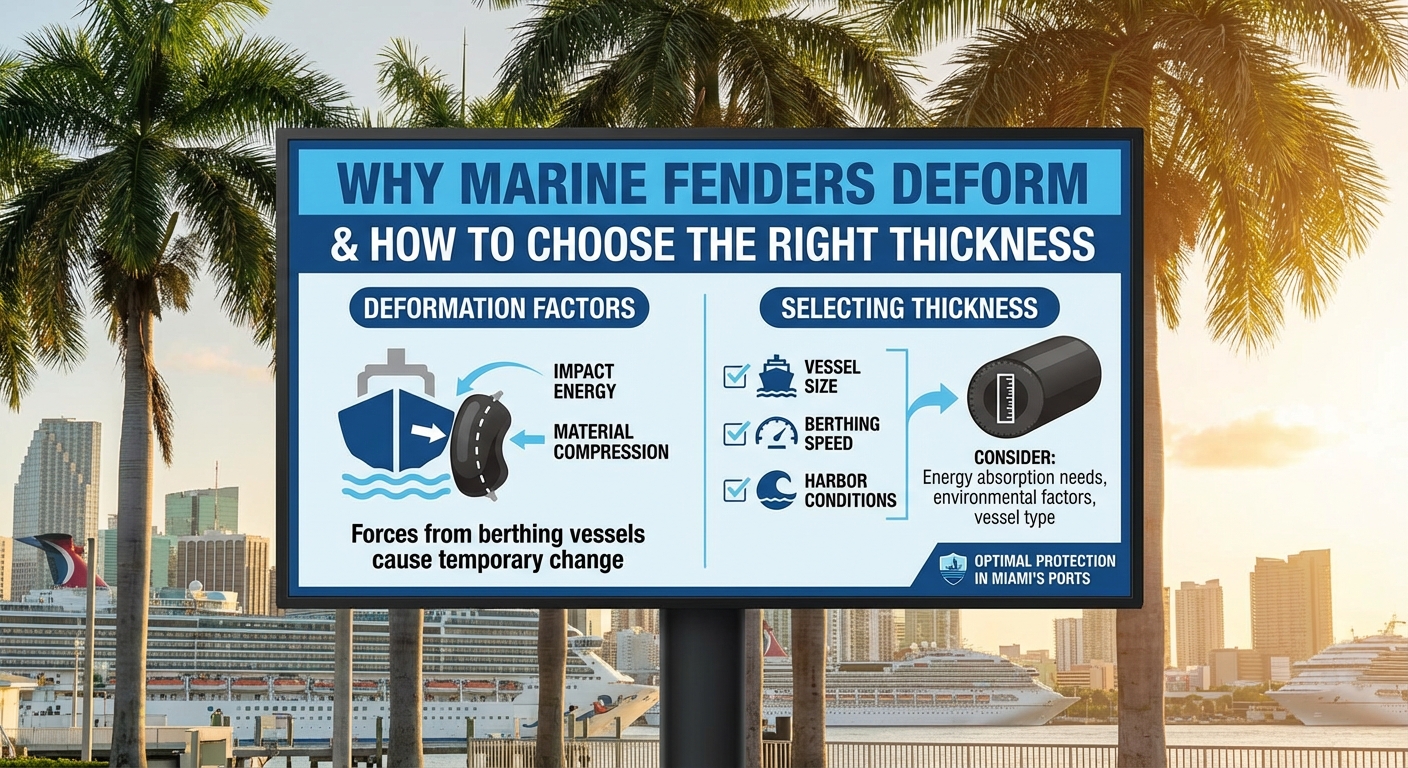
Right now, choosing the right fender thickness is the only thing that matters. Get it wrong, and you're replacing equipment every few seasons. Get it right, and your investment pays dividends for years. We've spent considerable time analyzing fender performance across different marine environments, and the patterns are clear. Deformation isn't random—it's predictable, preventable, and entirely within your control if you understand the mechanics at play.
Compression Happens Every Single Time
Every berthing event is a test. The vessel approaches, momentum builds, and when hull meets fender, energy has to go somewhere. That energy gets absorbed through compression—the fender squeezes, flexes, and ideally returns to its original shape. But here's here's the reality: not all compressions are created equal. A gentle approach in calm water is one thing. A heavy vessel coming in hot during rough seas is another entirely.
The material itself has limits. Rubber, foam, polyurethane—whatever the composition, there's a threshold beyond which the molecular structure starts to break down. Each compression cycle introduces micro-tears, stress points, and weak spots that accumulate over time. Think of it like bending a paperclip back and forth. The first few bends? No problem. Keep going, and eventually it snaps. Fenders work the same way, except the timeline stretches across thousands of berthing events instead of seconds.
What accelerates this process isn't just frequency—it's intensity. A fender rated for a certain energy absorption level will perform beautifully within spec. Push it beyond that threshold repeatedly, and deformation becomes inevitable. The material compresses past its elastic limit, and instead of bouncing back, it stays compressed. That's when you start seeing permanent indentations, flattened sections, and reduced effectiveness.
The Environment Doesn't Play Fair
Saltwater is relentless. UV radiation is merciless. Temperature swings are brutal. Marine fenders exist in one of the harshest operating environments imaginable, and every single environmental factor works against material integrity. Saltwater penetrates porous materials, accelerating degradation from the inside out. UV rays break down polymer chains, making rubber brittle and prone to cracking. Heat causes expansion, cold causes contraction, and the constant cycling weakens structural bonds.
We've observed fenders in tropical climates versus northern harbors, and the degradation patterns differ dramatically. In hot, sunny environments, UV damage dominates—fenders develop surface cracks and lose flexibility faster. In colder regions, the freeze-thaw cycle creates internal stress that manifests as deformation over time. Neither environment is forgiving, but understanding which factors dominate in your location helps predict failure modes and plan accordingly.
Chemical exposure adds another layer of complexity. Fuel spills, cleaning agents, industrial runoff—all of these can interact with fender materials in ways that compromise performance. Some compounds cause swelling, others cause hardening, and a few trigger rapid deterioration. The fender that looks fine on the surface might be compromised at the molecular level, waiting for the next heavy impact to reveal the damage.
Installation Mistakes Compound Over Time
A perfectly engineered fender installed incorrectly will fail faster than a mediocre fender installed properly. We've seen it repeatedly. The mounting points matter. The spacing matters. The angle matters. When fenders aren't secured with adequate support, they flex in ways they weren't designed to handle. Uneven load distribution creates stress concentrations that accelerate deformation in specific areas while leaving other sections underutilized.
Insufficient backing is a common culprit. Fenders need solid support behind them to distribute impact forces effectively. Mount them against weak or flexible structures, and the fender absorbs not just the vessel's energy but also compensates for the dock's movement. That's double duty the material wasn't designed for, and it shows up as premature deformation and failure.
Spacing between fenders creates another variable. Too far apart, and vessels impact areas between fenders, defeating the entire purpose. Too close together, and individual fenders can't compress properly, leading to overloading and accelerated wear. The optimal configuration depends on vessel size, dock geometry, and typical berthing patterns—but getting it wrong guarantees problems down the line.
Material Selection Sets the Baseline
Not all fender materials respond to stress the same way. Rubber offers excellent energy absorption and durability but can be heavy and expensive. Foam provides lightweight protection and good compression characteristics but may not withstand repeated heavy impacts as well. Polyurethane delivers impressive resilience and chemical resistance but comes with a higher price tag. Each material has a performance envelope, and operating outside that envelope invites deformation.
The material's hardness rating—measured in Shore Shore durometer—directly influences how it responds to impact. Softer materials compress more easily, absorbing energy through greater deformation. Harder materials compress less but can handle higher loads without permanent damage. The trick is matching the hardness to the application. A small recreational marina needs different characteristics than a commercial shipping terminal handling massive cargo vessels.
We've tested various materials under controlled conditions, and the results are instructive. High-quality rubber compounds maintain their shape through thousands of compression cycles when used within rated parameters. Cheaper alternatives show measurable deformation after just hundreds of impacts. The upfront cost difference might seem significant, but the lifecycle cost tells a different story. Replacing fenders every two years instead of every ten years erases any initial savings multiple times over.
- Rubber compounds offer proven durability in harsh marine environments
- Foam materials provide lightweight solutions for smaller vessels and lower-impact applications
- Polyurethane delivers superior resilience and chemical resistance for demanding conditions
- Composite materials combine benefits of multiple materials but require careful specification
- Material hardness must match expected impact forces and vessel characteristics
Thickness Isn't Just About Size
Thicker doesn't automatically mean better. It means different. A thicker fender can absorb more energy through greater compression distance, but only if the material properties support it. Add thickness to a low-quality material, and you've just created a bigger piece of equipment that will still deform prematurely. The relationship between thickness and performance is direct only when material quality remains constant.
The physics are straightforward. Energy absorption capacity increases with both material volume and compression distance. A thicker fender has more material to distribute stress through and more distance to compress before reaching its limit. But there's a point of diminishing returns. Beyond a certain thickness, you're adding weight, cost, and installation complexity without proportional performance gains.
Vessel displacement drives thickness requirements more than any other single factor. A fifty-foot yacht requires fundamentally different protection than a thousand-foot container ship. The energy involved in berthing scales with mass and velocity, and fender thickness must scale accordingly. Underspec the thickness, and you're guaranteeing deformation and potential damage. Overspec it, and you're wasting resources on protection you don't need.
Berthing Velocity Changes Everything
Speed kills—or at least, it kills fenders. The energy a fender must absorb increases with the square of velocity. Double the approach speed, and you've quadrupled the energy that needs dissipation. This mathematical reality means that even small increases in berthing velocity demand significantly more fender capacity. A fender adequate for slow, controlled approaches will deform rapidly under faster impacts.
We've analyzed berthing patterns across different facility types, and the velocity variations are substantial. Recreational marinas typically see gentle approaches with experienced operators taking their time. Commercial terminals deal with larger vessels, tighter schedules, and sometimes less-than-ideal conditions that force faster approaches. The fender specifications that work perfectly in one environment fail catastrophically in the other.
Environmental conditions influence berthing velocity whether operators want them to or not. Strong currents, high winds, and rough seas all make controlled approaches more difficult. A fender system designed only for calm-weather operations will face regular overloading during adverse conditions. Planning for worst-case scenarios rather than typical conditions is the difference between fenders that last and fenders that fail.
- Approach velocity directly determines energy absorption requirements
- Environmental conditions force higher berthing speeds regardless of operator skill
- Commercial operations typically involve higher velocities than recreational facilities
- Fender systems must accommodate worst-case scenarios, not just average conditions
- Energy absorption needs scale exponentially with velocity increases
Dock Structure Influences Fender Performance
The dock itself is part of the energy absorption system. A rigid concrete pier behaves completely differently than a floating dock with flexible connections. When a vessel impacts a fender on a rigid structure, the fender absorbs essentially all the energy. On a floating or flexible dock, the structure itself moves and absorbs some energy, reducing the load on the fender. This fundamental difference changes fender requirements dramatically.
Rigid structures demand more from fenders because there's nowhere else for energy to go. The fender compresses, and if it can't absorb all the energy within its compression range, something breaks—either the fender deforms permanently, or the vessel sustains damage, or the dock structure itself fails. There's no give in the system beyond what the fender provides, so the fender must be specified accordingly.
Floating docks introduce complexity. They move with tides, waves, and vessel impacts, which can be beneficial or problematic depending on design. A well-engineered floating system reduces peak loads on fenders by allowing the entire structure to move slightly. A poorly designed system creates unpredictable load patterns that can actually accelerate fender deformation. The fender thickness and material selection must account for the dock's movement characteristics, not just the vessel's impact energy.
Tidal Range Creates Hidden Challenges
Tides change everything about how fenders perform. In areas with significant tidal range, the contact point between vessel and fender shifts vertically throughout the day. A fender positioned perfectly at high tide might be completely wrong at low tide. This vertical movement means fenders often take impacts at angles they weren't designed for, creating stress concentrations and accelerating deformation.
The solution isn't just longer fenders—it's smarter fender placement and potentially multiple fender lines at different heights. We've seen facilities in areas with twenty-foot tidal ranges where single-line fender systems fail repeatedly because vessels contact different parts of the fender depending on tide state. The fender sections that see the most use deform first, creating uneven protection and requiring premature replacement.
Tidal current adds another dimension. Strong currents during tide changes push vessels against fenders with sustained force rather than momentary impact. This constant pressure creates a different type of stress than berthing impacts—more like a sustained load test than a shock absorption test. Fenders must resist both impact deformation and sustained compression deformation, which requires careful material selection and adequate thickness.
Load Distribution Prevents Premature Failure
A>A single fender taking all the load will fail faster than multiple fenders sharing the load. This seems obvious, but we consistently see installations where fender spacing or placement creates uneven load distribution. The result is predictable: some fenders deform rapidly while others show minimal wear. The system fails not because the fenders are inadequate, but because the installation doesn't use them effectively.
Proper load distribution requires understanding vessel hull geometry and typical berthing patterns. Vessels don't contact docks uniformly along their length—there are high-load points at the bow, stern, and sometimes midship depending on hull shape. Fender placement should concentrate protection at these high-load points while still providing coverage along the entire berthing face.
The number of fenders simultaneously in contact during berthing determines individual fender loading. If a vessel typically contacts three fenders during approach, each fender needs to handle roughly one-third of the total energy. If poor placement means only one fender makes initial contact, that single fender takes the full load and will deform accordingly. Thickness specifications must account for how many fenders will actually share the load in real-world conditions.
Maintenance Extends Service Life
Fenders aren't install-and-forget equipment. Regular inspection catches deformation early, before it becomes critical. We've developed inspection protocols that identify early warning signs—surface cracking, uneven compression patterns, mounting hardware loosening, and material hardening. Catching these issues early allows intervention before complete failure occurs.
Cleaning matters more than most people realize. Salt buildup, biological growth, and chemical residues all accelerate material degradation. A simple wash-down schedule removes contaminants before they penetrate the material and cause internal damage. Salt buildup, biological growth, and chemical residues all accelerate material degradation. UV protectants can extend service life in sunny climates by slowing the breakdown of polymer chains. These maintenance steps cost almost nothing compared to premature fender replacement.
Rotation and repositioning can balance wear patterns. If certain fenders consistently take higher loads due to prevailing winds or current patterns, rotating them with less-used fenders distributes wear more evenly across the system. This extends the overall system life and prevents the situation where a few heavily deformed fenders compromise protection while the rest remain in good condition.
Specification Requires Real Data
Guessing at fender requirements guarantees problems. Proper specification starts with actual data about vessel characteristics, berthing patterns, and environmental conditions. What's the largest vessel that will use the facility? What's the typical approach velocity? What's the maximum approach velocity during adverse conditions? What's the tidal range? What are the prevailing wind and current patterns?
These questions have specific answers that drive specific fender requirements. A facility serving vessels up to one hundred tons needs fundamentally different protection than one serving vessels up to ten thousand tons. The thickness, material, and configuration must match the actual use case, not some generic standard that may or may not apply.
We've seen facilities over-engineer fender systems at great expense, and we've seen facilities under-engineer them with predictable results. The sweet spot is specification based on real operational data with appropriate safety factors. Engineering standards provide formulas for calculating required energy absorption capacity based on vessel displacement, berthing velocity, and other factors. Using these formulas with accurate input data produces fender specifications that actually work.
- Vessel displacement and dimensions drive baseline fender requirements
- Maximum berthing velocity under adverse conditions sets energy absorption needs
- Tidal range and current patterns influence fender placement and configuration
- Dock structure type affects how much energy fenders must absorb
- Safety factors account for unexpected conditions and operational variations
- Engineering standards provide proven calculation methods for fender specification
Cost Analysis Reveals True Value
The cheapest fender upfront is rarely the cheapest fender over time. We've run lifecycle cost analyses comparing different fender options, and the results consistently favor higher-quality materials and appropriate thickness even when initial costs are higher. A fender system that lasts fifteen years costs less per year than one that needs replacement every three years, even if the initial investment is double.
Deformation-related failures carry hidden costs beyond replacement expenses. Vessel damage claims, dock repairs, operational disruptions, and emergency replacements all add up. A properly specified fender system that resists deformation prevents these downstream costs. The return on investment from doing it right the first time shows up across multiple budget categories, not just the fender line item.
Replacement logistics factor into total cost as well. Changing out fenders requires dock downtime, specialized equipment, and labor. Facilities with limited weather windows or high utilization rates face significant opportunity costs when fenders need replacement. Extending service life through proper initial specification and thickness selection reduces how often these disruptive replacement projects occur.
The Performance Horizon Is Getting Closer
Material science keeps advancing. New compounds offer better resilience, longer service life, and improved resistance to environmental degradation. The fender options available today outperform what was available a decade ago, and the trajectory continues upward. Facilities planning fender installations now have access to materials that will maintain performance longer and resist deformation better than previous generations.
This creates an opportunity. Facilities that specify modern, high-performance fender systems now will see that investment pay dividends for years. Those that stick with outdated materials or inadequate thickness to save money upfront will face accelerated replacement cycles and higher total costs. The gap between best-in-class and adequate-for-now keeps widening as material technology improves.
The next decade belongs to facilities that prioritize performance
Let’s Safeguard Your Dock for the Long Haul
When it comes to protecting your boat and dock, the right fender setup is more than a detail—it’s your frontline defense against costly surprises. If you’re ready to make sure your marine equipment stands up to the elements and the test of time, let’s talk. Call us at 305-290-2715 or Request Boat Repair or Service and we’ll help you get the right solution in place.


.png)