



Dead batteries don't care where you are. On land, you call a friend or flag down a stranger. On the water, your options shrink fast. The question isn't whether it's inconvenient—it's whether the same fix that works in your driveway will work at the dock. Jumpstarting a boat battery follows similar logic to jumpstarting a car, but the execution demands more attention. Marine environments introduce variables that don't exist in parking lots, and the stakes climb when you're dealing with electrical systems surrounded by water. The short answer is yes, you can jumpstart a boat battery like a car. The longer answer is that doing it right requires understanding what makes marine batteries different and why shortcuts can cost you more than time.
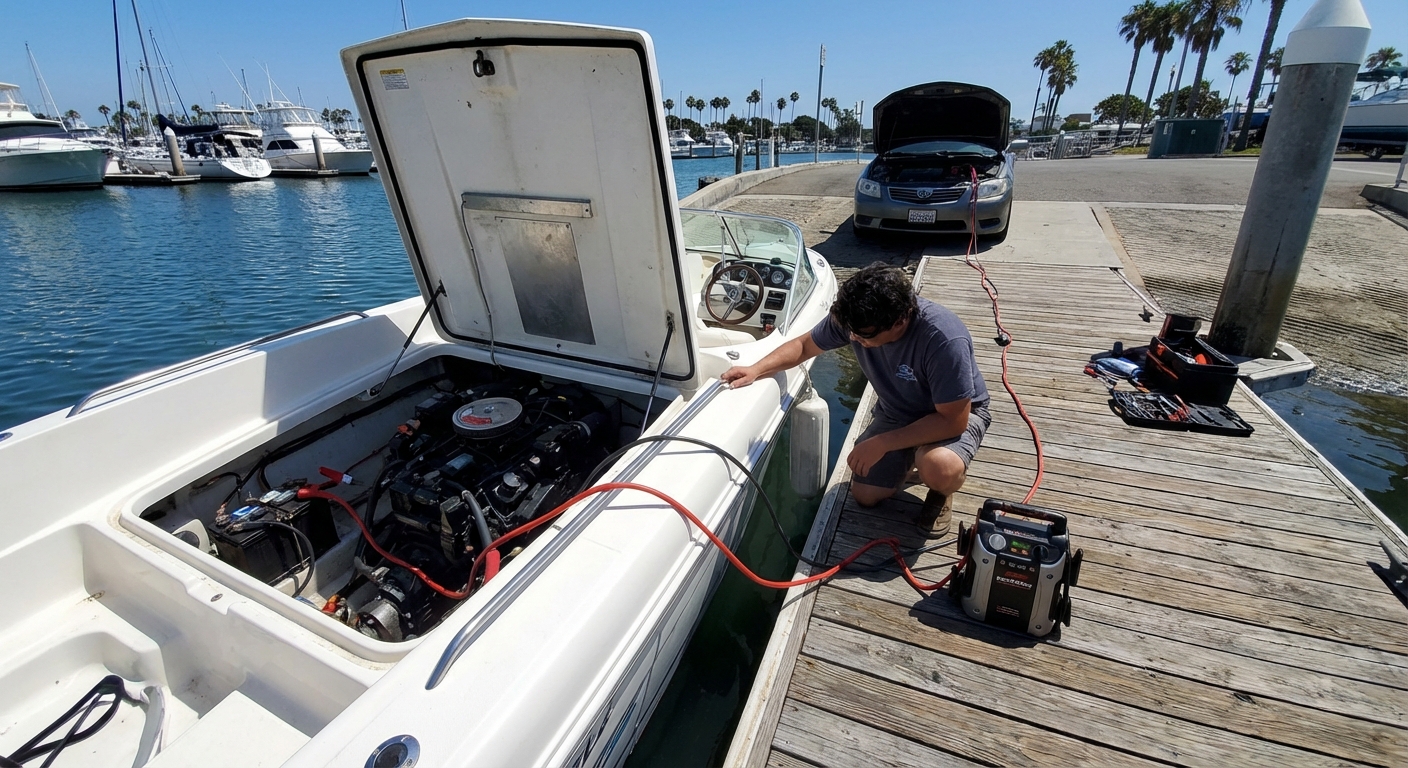
We've spent years working at the intersection of systems that either perform or fail, and batteries fall squarely in that category. A dead battery isn't just an inconvenience—it's a breakdown in execution. The difference between getting back on the water and sitting dead in the slip comes down to knowing what you're working with and acting on that knowledge without hesitation. This isn't about theory. It's about what works when conditions aren't perfect and you need results now.
Marine Batteries Aren't Just Car Batteries in a Hull
Car batteries exist to do one thing well: deliver a massive jolt of power for a few seconds to turn over an engine. Once the engine runs, the alternator takes over and the battery goes back to standby. Marine batteries operate in a different world. Some are starting batteries, built for that same burst of power. Others are deep-cycle batteries, designed to discharge slowly over hours while powering electronics, lights, and accessories. Many boats run dual-purpose batteries that try to do both, and some larger vessels use separate battery banks for starting and house power.
The voltage is usually the same—12 volts in most recreational boats—but the construction and chemistry differ. Deep-cycle batteries have thicker plates and are built to handle repeated discharge and recharge cycles without degrading. Starting batteries sacrifice longevity for raw cranking amps. This matters when you're jumpstarting because connecting the wrong type of power source to the wrong type of battery can cause damage or, worse, create a safety hazard. The system may look the same on the surface, but the tolerances and expectations are different. Execution here means knowing what you're connecting before you clip the first cable.
Jumper Cables Work, But the Environment Doesn't Forgive Mistakes
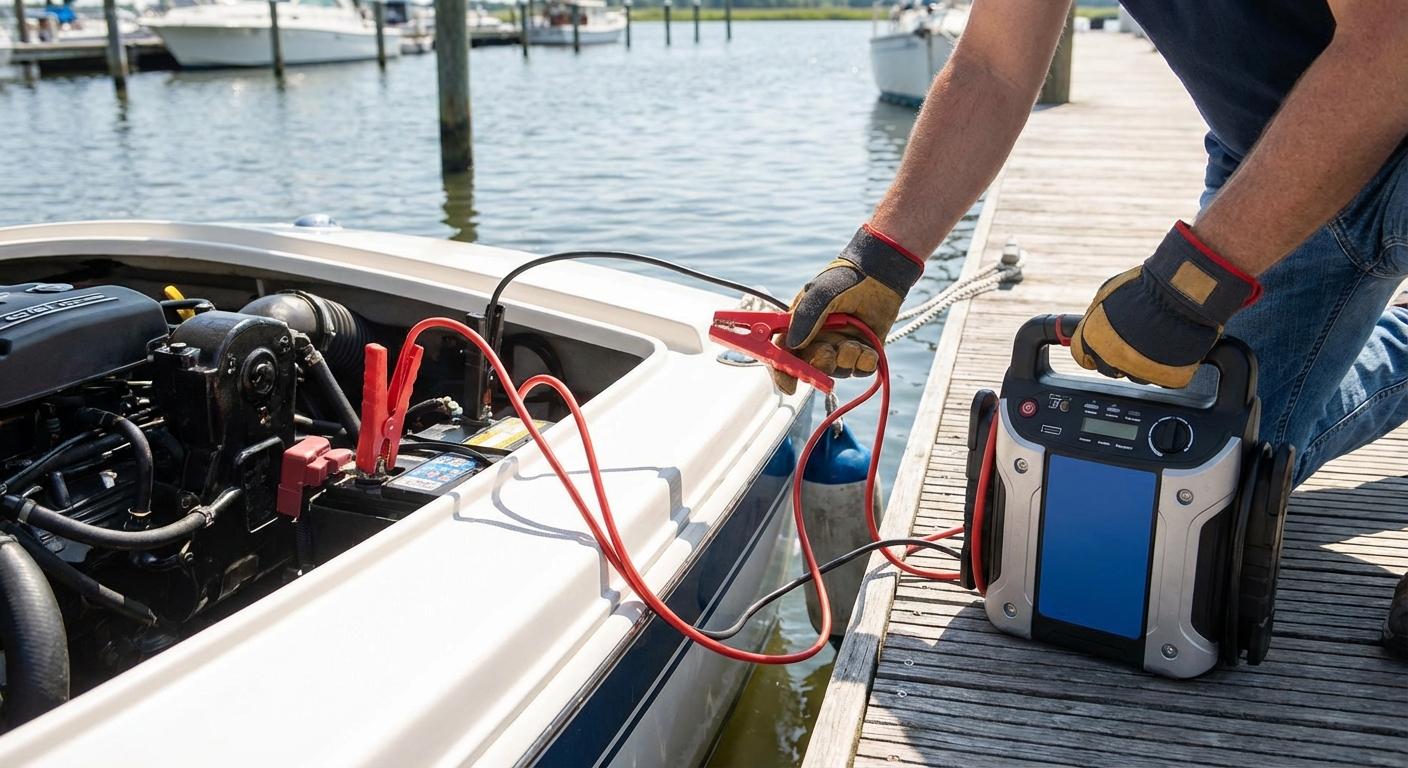
Standard automotive jumper cables will work on a 12-volt marine battery, assuming both batteries share the same voltage. The process mirrors what you'd do in a parking lot: positive to positive, negative to ground, start the donor, then crank the dead engine. But boats introduce complications that cars don't face. Water and electricity don't mix, and even a small amount of moisture on terminals or cables can create arcing, shorts, or shocks. Boats also tend to have batteries tucked into compartments that are harder to reach, meaning you might need longer cables or a portable jump pack just to make the connection.
Another factor is the charging system. Boats often have smaller alternators than cars, and some older models don't charge batteries as aggressively. If you jumpstart a deeply discharged marine battery and then rely on the boat's alternator to bring it back to full charge, you might be setting yourself up for another dead battery an hour later. The jumpstart gets you running, but it doesn't solve the underlying problem if the battery is old, sulfated, or the charging system isn't keeping up. Execution means understanding that the jumpstart is a temporary fix, not a permanent solution.
The Right Sequence Prevents Sparks and Damage
Connecting jumper cables in the wrong order is one of the fastest ways to create a dangerous situation. Batteries contain sulfuric acid and emit hydrogen gas, which is highly flammable. A spark near the battery can ignite that gas, causing an explosion. The correct sequence minimizes that risk by ensuring the final connection—the one most likely to spark—happens away from the battery itself.
Here's the sequence that works:
- Shut down all electronics and accessories on both vessels to prevent voltage spikes when the connection is made.
- Attach the red positive cable to the positive terminal of the dead battery first, then connect the other end to the positive terminal of the good battery.
- Attach the black negative cable to the negative terminal of the good battery, then connect the other end to a clean metal ground on the engine block or frame of the dead boat—not the battery terminal.
- Start the engine on the donor boat or vehicle and let it run for several minutes to begin charging the dead battery.
- Attempt to start the dead engine. If it doesn't turn over after a few tries, wait longer and try again rather than cranking repeatedly, which can overheat the starter.
- Once the dead engine starts, remove the cables in reverse order: negative from the engine ground, negative from the good battery, positive from the good battery, positive from the dead battery.
This sequence isn't arbitrary. It's designed to keep the most volatile moment—the final connection—away from the battery where hydrogen gas concentrates. Skipping steps or reversing the order can turn a routine jumpstart into a trip to the emergency room or a call to your insurance company.
Portable Jump Starters Eliminate the Need for a Donor
Relying on another boat or a car to jumpstart your battery works, but it's not always practical. Marinas can be crowded or empty depending on the day, and flagging down another boater isn't always an option. Portable marine jump starters solve this problem by putting the power source in your hands. These units are compact, rechargeable, and designed to deliver enough cranking amps to start most marine engines without needing a second vehicle.
The best portable jump starters offer several advantages over traditional jumper cables:
- They're self-contained, so you don't need to find another boat or vehicle to provide power.
- They include built-in safety features like reverse polarity protection and spark-proof clamps.
- Many models double as USB power banks, allowing you to charge phones or other devices in an emergency.
- They're small enough to store in a hatch or under a seat without taking up valuable space.
- They eliminate the risk of damaging another vehicle's electrical system by drawing too much current.
We've seen too many situations where a dead battery turned into a multi-hour ordeal because the right tool wasn't on board. A portable jump starter is one of those pieces of gear that sits unused for months until the moment it becomes the most important thing you own. Execution means having it charged and ready before you need it, not scrambling to buy one after you're already stranded.
Wet Conditions Amplify Every Risk
Jumpstarting a battery in a driveway is one thing. Doing it on a boat surrounded by water is another. Moisture increases the risk of electrical shock, and saltwater is even worse because it conducts electricity far more effectively than freshwater. Even a small amount of spray or condensation on terminals can create a path for current to flow where it shouldn't, leading to shorts, sparks, or injury.
Before attempting a jumpstart on a boat, take a few extra seconds to assess the environment. Wipe down battery terminals and cable clamps with a dry cloth. Make sure you're not standing in water or leaning against wet metal surfaces. If the bilge is full or the battery compartment is damp, address that first. Pumping out standing water and drying the area isn't overkill—it's the difference between a successful jumpstart and a trip overboard or worse.
Ventilation also matters. Hydrogen gas is heavier than air and can accumulate in enclosed spaces like battery compartments. Open hatches and compartments to allow airflow before you start connecting cables. If the compartment smells like rotten eggs—a sign of sulfuric acid or gas buildup—wait for it to dissipate before proceeding. Rushing through this step because you're eager to get back on the water is how accidents happen.
Battery Maintenance Beats Emergency Fixes
Jumpstarting a battery is a reactive move. It gets you out of a jam, but it doesn't prevent the next one. Batteries fail for predictable reasons: corrosion on terminals, sulfation from sitting discharged, age-related capacity loss, or charging systems that don't keep up with demand. Addressing these issues before they strand you is the smarter play.
Regular maintenance doesn't require specialized tools or hours of work. A few simple habits keep batteries performing longer:
- Clean terminals every few months with a wire brush and a mixture of baking soda and water to remove corrosion.
- Check voltage with a multimeter before and after trips. A fully charged 12-volt battery should read around 12.6 volts at rest.
- Keep batteries charged during storage with a trickle charger or battery maintainer, especially in cold weather.
- Inspect cables and connections for fraying, looseness, or damage that could cause voltage drops or shorts.
- Replace batteries proactively once they reach three to five years of age, depending on usage and type.
We've built systems around the idea that prevention compounds faster than reaction. A battery that's maintained doesn't fail at the worst possible moment. A charging system that's checked regularly doesn't leave you guessing why your boat battery keeps dying. Execution in this context means treating maintenance as part of the routine, not something you do after a problem surfaces.
When the Battery Won't Take a Charge
Sometimes a jumpstart works, and sometimes it doesn't. If you've connected the cables correctly, waited several minutes, and the engine still won't turn over, the problem might be deeper than a simple dead battery. Sulfation—a buildup of lead sulfate crystals on the battery plates—can prevent a battery from accepting a charge. Physical damage to the battery, such as cracked cases or internal shorts, can also render it useless no matter how much power you throw at it.
In these cases, jumpstarting won't help. The battery needs to be replaced, or at minimum, tested with a load tester to determine whether it's salvageable. Continuing to crank the starter with a bad battery can overheat the starter motor, drain the donor battery, and waste time that could be spent solving the real problem. Knowing when to stop trying and call for a replacement is part of execution. Persistence is valuable, but only when it's applied to problems that can actually be solved.
Dual Battery Systems Change the Game
Many boats use dual battery systems with a switch that allows you to run off Battery 1, Battery 2, or both simultaneously. This setup provides redundancy—if one battery dies, you can switch to the other and still start the engine. It also allows you to isolate the starting battery from the house battery, ensuring you always have enough power to crank the engine even if you've drained the house battery running electronics all day.
If your boat has a dual battery system and one battery dies, you don't necessarily need to jumpstart anything. Simply switch to the other battery and start the engine. Once running, the alternator will begin charging both batteries (assuming the switch is set to "Both"). This is one of the cleanest solutions to a dead battery because it doesn't require cables, a donor vehicle, or any additional equipment. The system is designed to handle this exact scenario.
However, dual battery systems only work if both batteries are maintained. If you've neglected both and they're both dead, you're back to needing a jumpstart or a portable jump pack. The redundancy is only as good as the discipline behind keeping both batteries in working condition.
Voltage Mismatches Will Destroy Equipment
Most recreational boats run on 12-volt systems, but some larger vessels use 24-volt or even 36-volt systems, especially for trolling motors or house banks. Attempting to jumpstart a 12-volt battery with a 24-volt source—or vice versa—will cause immediate and catastrophic damage. The excess voltage will fry electronics, melt wiring, and potentially cause the battery to overheat or explode.
Before connecting anything, verify the voltage of both batteries. This information is usually printed on a label on the battery itself. If you're unsure, use a multimeter to measure the voltage before proceeding. This takes seconds and prevents thousands of dollars in damage. There's no shortcut here. Guessing or assuming both systems match is how boats end up with fried electrical systems and insurance claims.
Professional Help Isn't Weakness
If you're uncomfortable jumpstarting a battery, or if the situation feels unsafe—wet conditions, hard-to-reach terminals, uncertainty about voltage—there's no shame in calling for help. Marine towing services, mobile marine mechanic service providers, and marina staff deal with dead batteries constantly and have the tools and experience to handle it safely. The cost of a service call is negligible compared to the cost of injury, equipment damage, or a boat fire.
We've seen too many situations where someone tried to push through a problem they didn't fully understand, only to make it worse. Execution includes knowing when to act and when to step back and bring in someone who can do it right the first time. Confidence is valuable, but overconfidence is expensive.
The Real Competition Is Preparation
Jumpstarting a boat battery like a car is possible, but only if you've prepared for it. The cables need to be on board. The portable jump starter needs to be charged. The terminals need to be clean. The voltage needs to match. The environment needs to be dry. Each of these factors is within your control, but only if you address them before the battery dies.
Most boaters think their competition is other boaters with better gear or more experience. The real competition is the version of yourself that didn't check the battery before leaving the dock, didn't pack the jump starter, didn't clean the terminals, and didn't verify the charging system was working. That version loses every time. The version that executes on the small details—the ones that don't feel urgent until they are—wins.
Batteries fail. It's not a question of if, but when. The difference between a minor inconvenience and a ruined day comes down to whether you've built systems that account for failure. Jumpstarting a boat battery works the same way jumpstarting a car does, but the margin for error is smaller and the consequences are bigger. Treat it that way, and you'll never be the one sitting dead in the water waiting for someone else to bail you out.
If you're dealing with persistent battery issues, troubleshooting electrical problems on your boat can help identify underlying causes. Understanding what to do when your marine battery dies offshore prepares you for worst-case scenarios. For comprehensive support, consider finding a reliable mobile boat repair service in Miami that can respond quickly. Regular year-round boat maintenance in Miami prevents many battery-related failures before they happen. When you need expert help, our team at Boat Repair Miami FL is ready to assist with all your marine electrical needs.
Let’s Get You Back on the Water
We know how frustrating it is when your boat won’t start, especially after you’ve done everything right. If you’re tired of battery headaches or just want peace of mind before your next trip, let’s tackle the problem together. Give us a call at 305-290-2701 or Request Boat Repair or Service—we’re here to make sure your next outing goes off without a hitch.


.png)