



Florida Boat Repair: The Ultimate Guide
You're ten miles offshore when your outboard starts overheating, the temperature alarm screaming over the sound of the waves. Or you turn the key on tournament morning and hear nothing but a click from your starter. Maybe you've discovered soft spots in your transom after a hard docking, or your engine's been losing power for weeks and you can't figure out why. Boat repairs aren't just inconveniences. They affect your time on the water, your safety, and protecting what you've invested in your boat.
Florida has over 900,000 registered recreational boats according to the Florida Fish and Wildlife Conservation Commission, more than any other state in the nation. With year-round saltwater exposure, intense UV radiation, and constant use, you need reliable boat repair from Jacksonville to Key West. Understanding your repair options - from outboard motor specialists to mobile marine mechanics to full-service yacht shops - helps you maintain your vessel properly and avoid expensive breakdowns that sink weekends and drain bank accounts.
This isn't just about comparing mobile mechanics to shop-based service. This is everything you need to know about boat repair in Florida: engine work on outboards and inboards, electrical system troubleshooting, hull and fiberglass restoration, structural repairs, maintenance intervals, detailing services, pricing, and how to choose qualified mechanics with the right certifications.
Whether you own a 19-foot center console or a 60-foot yacht, whether you're dealing with a Mercury outboard that won't start or a diesel inboard with cooling problems, this guide covers everything you would ever need to know about boat repair options throughout Florida.
Table of Contents
Understanding Boat Repair Services: What's Covered and Why It Matters
When boat owners talk about "boat repair," they're rarely discussing one type of service. It covers dozens of specialized repairs across multiple systems, each requiring different knowledge, tools, and certifications. The marine mechanic who's an expert at diagnosing fuel injection problems on a Yamaha F250 outboard might not have the knowledge required to rebuild a diesel inboard's heat exchanger or repair osmosis blisters in a fiberglass hull. Understanding what boat repair services actually cover helps you find the right specialist in Florida for your specific problem.
Major Boat Repair Categories
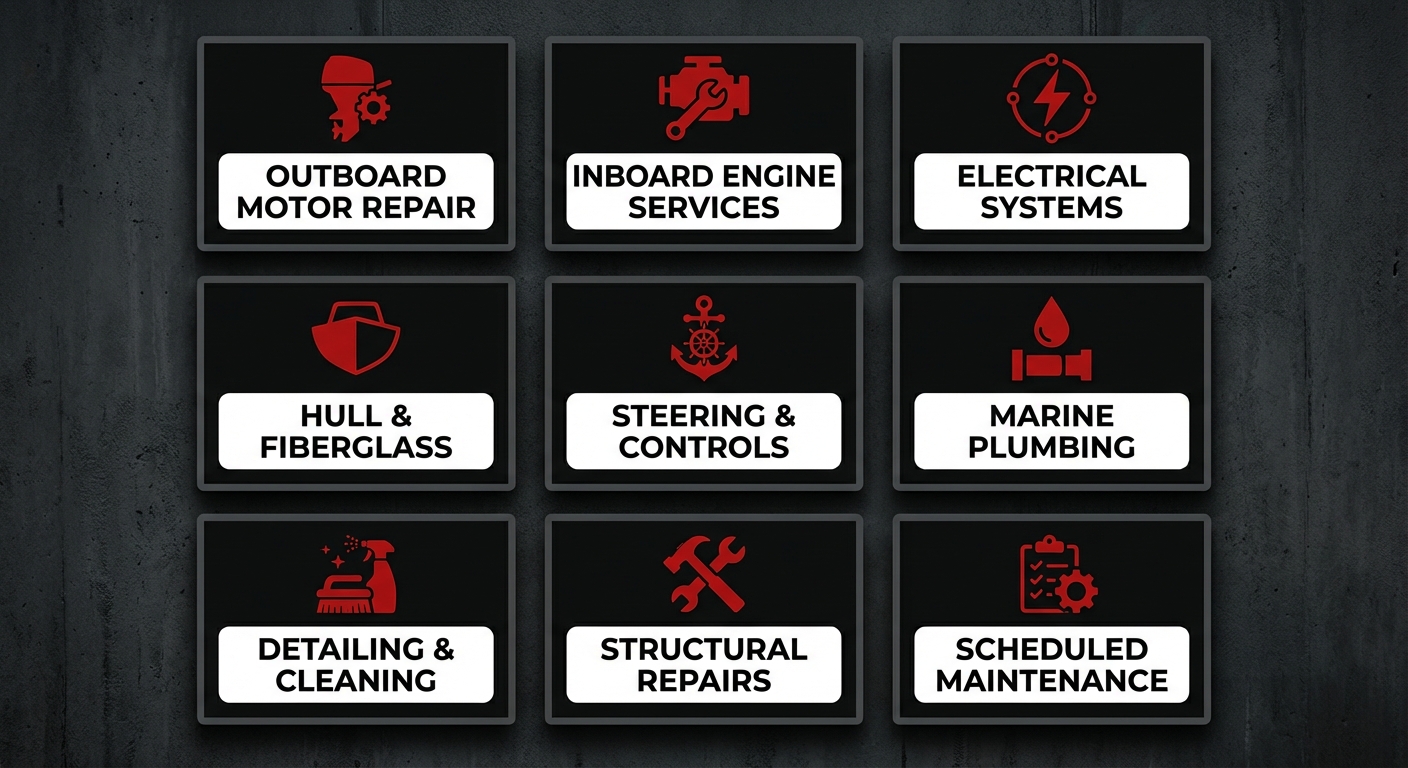
Boat repair work generally falls into these primary categories, though they frequently overlap:
Engine and propulsion systems: Includes outboard motors (two-stroke and four-stroke), inboard engines (gasoline and diesel), stern drives (also called inboard/outboards), jet drives, and all associated components: fuel systems, cooling systems, ignition systems, exhaust systems, and control systems. These represent the largest category of boat repair work.
Electrical and electronics: Covers 12-volt DC house systems, 120-volt AC shore power systems, battery banks and charging systems, navigation electronics (GPS, chartplotters, radar, fishfinders), communication systems (VHF radio, AIS), lighting systems, and all wiring throughout the vessel.
Hull and structural work: Includes fiberglass repair, gelcoat restoration, transom replacement, stringer repair or replacement, deck core replacement, through-hull fitting service, and addressing osmosis blisters. These repairs often need specialized fiberglass skills and proper curing environments.
Plumbing and fluid systems: Includes freshwater systems, raw water washdown systems, livewell and baitwell systems, bilge pumps and automatic float switches, air conditioning systems (on larger vessels), and marine sanitation devices.
Steering and control systems: Includes hydraulic steering, cable steering, power steering on larger vessels, throttle and shift cables, engine controls, and trim tab systems.
Cosmetic and detailing services: Cover washing and waxing, upholstery cleaning and repair, canvas and enclosure work, teak maintenance, metal polishing, and non-skid deck restoration.
Why Specialized Marine Knowledge Matters
Boats aren't cars, and the marine environment creates unique challenges that general mechanics aren't trained to handle. According to NOAA research on marine corrosion, saltwater accelerates corrosion on every metal component at rates far exceeding freshwater environments, requiring different materials and protective measures specific to marine applications. Boats operate in a constantly moving, vibrating environment that loosens connections and stresses components differently than land-based equipment. The marine electrical environment combines 12-volt DC systems (for house loads) with 120-volt AC shore power systems, creating potential for dangerous ground faults and galvanic corrosion. Through-hull fittings penetrate the barrier between water and the interior of your boat, and improper installation or service can literally sink your vessel.
Modern outboards and inboards use proprietary electronic control systems that require manufacturer-specific diagnostic software. A Mercury technician's scan tool won't properly diagnose a Yamaha engine, and vice versa. This is why manufacturer certifications matter more in marine repair than in automotive work. The U.S. Coast Guard maintains safety standards for many marine systems, and proper repairs must meet these requirements to ensure your boat remains seaworthy and legally compliant.
Boat Repair vs. Boat Service vs. Boat Maintenance
These terms get used interchangeably, but they describe totally different activities:
Boat repair means fixing something that's broken, failed, or malfunctioning. Your starter won't engage, your engine overheats, your trim tabs stopped working. These are repairs addressing specific failures. Boat repairs address specific failures rather than preventative maintenance.
Boat service refers to scheduled maintenance performed at regular intervals, like 100-hour service or annual service. This includes oil changes, filter replacements, spark plug changes, impeller inspections, and systems checks designed to prevent failures before they happen.
Boat maintenance describes ongoing preventative care between service intervals: washing your boat after each use, checking fluid levels, inspecting zincs, testing your bilge pump, keeping batteries charged. Understanding optimal maintenance scheduling helps prevent breakdowns. This is owner-performed care that extends the time between professional service needs.
These overlap, and the best approach to boat ownership includes all three. Comprehensive boat service and repair programs combine all three approaches for maximum vessel reliability. Preventative maintenance reduces repair needs, regular service catches small problems before they become expensive failures, and following proper service intervals extends engine life. Quality repairs restore your boat to reliable operation.
Outboard Motor Repair and Service: From Diagnostics to Overhauls
Outboard motors power the majority of boats under 40 feet in Florida—from Tampa Bay center consoles and Naples bay boats to Islamorada flats boats and Jacksonville offshore rigs. Understanding outboard repair and maintenance helps you recognize problems early, communicate effectively with mechanics, and make informed decisions about repair versus replacement when major issues arise.
Common Outboard Motor Problems
Most outboard repairs fall into a handful of recurring issues that marine mechanics see constantly:
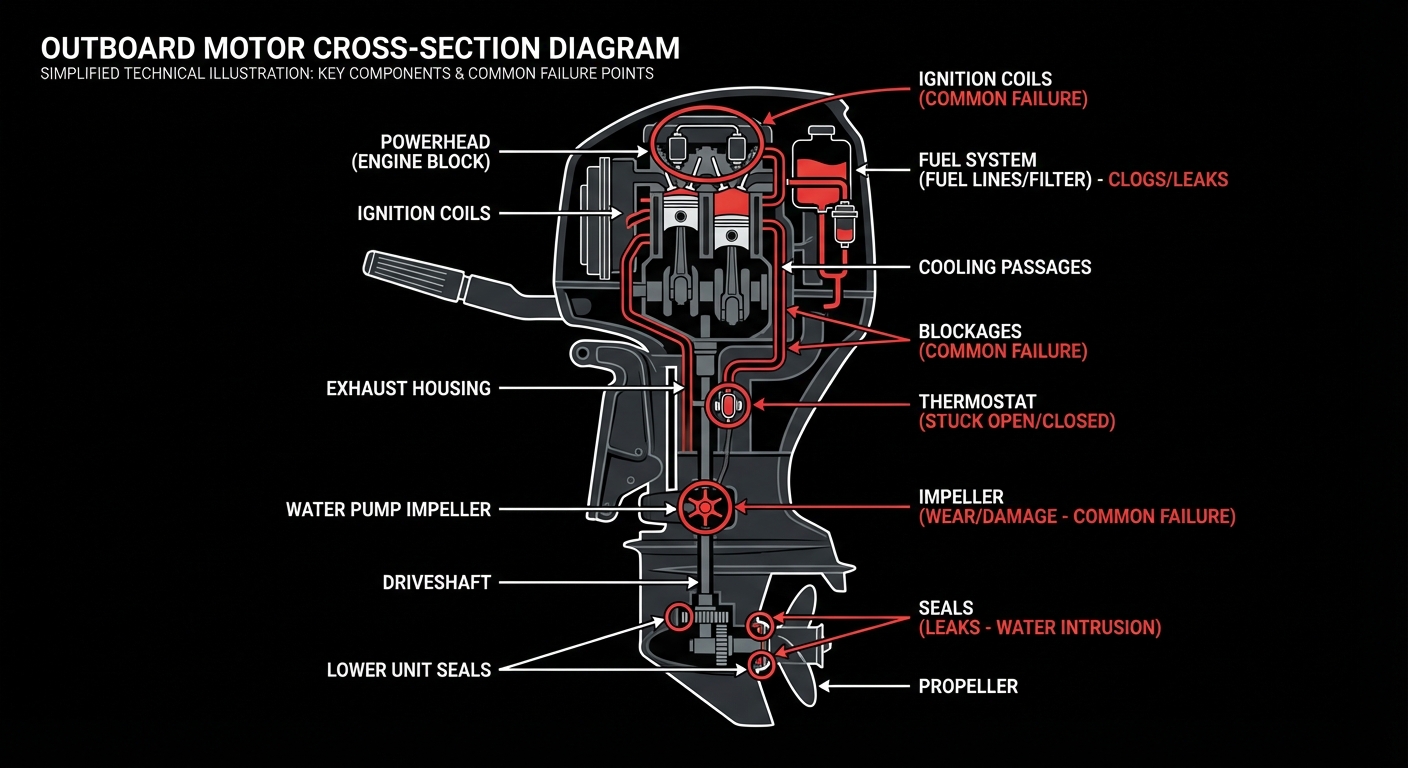
Overheating: Usually results from failed thermostats, worn water pump impellers, or clogged cooling passages from salt buildup. The telltale stream from your outboard should be steady and strong. If it's weak or intermittent, you're heading for an overheat condition. Ignoring overheating can warp cylinder heads or seize pistons, turning a $400 repair into a $4,000 powerhead replacement.
Hard starting or no-start conditions: These stem from fuel delivery problems (clogged filters, failing fuel pumps, contaminated fuel), ignition system failures (spark plugs, ignition coils, CDI boxes), battery issues including persistent battery drain, or faulty starter motors and solenoids. Proper no-start troubleshooting identifies the root cause quickly. Modern fuel-injected outboards are generally reliable starters, so persistent hard-starting means a developing problem that won't fix itself.
Loss of power at cruise: Often points to fuel restrictions (clogged fuel filters, failing vapor separator), fouled spark plugs, restricted air intake, or in two-strokes, carbon buildup in power valves or exhaust ports. If your outboard used to plane easily with four people aboard but now struggles with two, you have a power loss issue that needs diagnosis.
Rough idle or misfires: These usually mean problems with fuel injectors (on EFI engines), ignition coils delivering weak spark, carbon buildup on valves (four-strokes), or failing ECM components. These issues often start intermittently and worsen over time.
Alarms and warning lights: These monitor oil pressure, engine temperature, battery voltage, and other critical parameters on modern outboards. Never ignore these warnings. They exist to prevent catastrophic damage. An oil pressure alarm might mean a failing sensor (a $200 fix) or actual low oil pressure from a failing oil pump (a $2,000+ repair if it damages bearings).
Lower unit leaks: Failed seals allow gear oil to escape and water to enter, destroying expensive gears and bearings. If you notice milky gear oil (water contamination) or oil leaking from your propeller shaft, address it immediately before it becomes a complete lower unit rebuild.
Corrosion damage: Saltwater exposure accelerates when sacrificial anodes (zincs) deplete completely, allowing corrosion to attack aluminum components and internal cooling passages. Check zincs every few months in saltwater. When they're 50% depleted, replace them.
Two-Stroke vs. Four-Stroke Outboard Repair
The maintenance and repair approach differs between two-stroke and four-stroke outboards. Two-stroke engines mix oil with fuel (either through premix or oil injection systems), have simpler designs with fewer parts, and produce more power per pound but at the cost of higher emissions and fuel consumption. Most two-stroke outboards were phased out in the early 2000s due to EPA emissions standards, though Evinrude's E-TEC direct injection two-strokes continued until the brand's discontinuation in 2020.
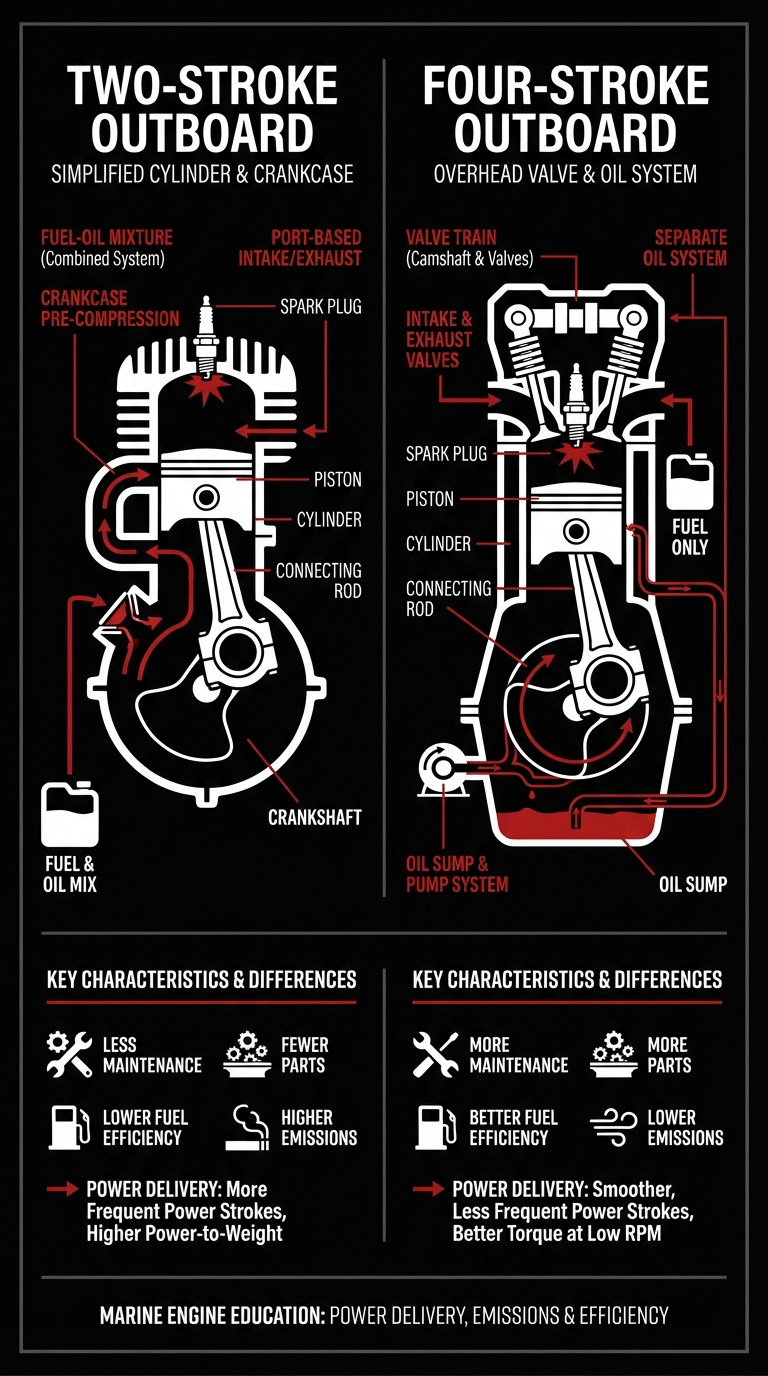
Four-stroke outboards run on straight gasoline with separate oil systems, similar to car engines. They have valve trains (camshafts, rocker arms, valve springs), oil filters that require regular changes, and generally run quieter and cleaner than two-strokes. The EPA's marine engine emission standards pushed the industry toward four-strokes, making them standard on nearly all new boats.
Repair differences matter too. Four-stroke outboards require valve adjustments on some models (Honda, older Yamahas), have timing chains or belts that can fail, and develop oil leaks from valve cover gaskets and crankshaft seals but they're generally more reliable long-term. Two-strokes need power valve cleaning and adjustment, their oil injection systems can fail (leading to catastrophic seizure), and they require more frequent spark plug replacement due to oil in the combustion chamber. Parts costs are roughly similar, but labor for four-stroke internal work typically runs higher due to more complex disassembly.
Major Outboard Motor Brands and Service
Five brands dominate the outboard market, each with unique characteristics and service considerations:
Mercury/Mariner holds the largest market share with outboards from 2.5 to 600 horsepower. Their Verado line offers sophisticated features like supercharging and joystick controls. Mercury has the widest dealer and service network across Miami, Fort Lauderdale, Tampa, Orlando, and every major Florida city, making parts and certified mechanics easiest to find. However, their proprietary diagnostic software means only Mercury-trained technicians can properly troubleshoot complex problems.
Yamaha built its reputation on reliability, especially with the four-stroke F-series. Their VMAX SHO performance outboards compete with Mercury's Verado line. Yamaha's integrated digital controls and Command Link systems offer extensive engine data but need Yamaha's diagnostic software for proper service.
Suzuki makes lighter-weight four-strokes with excellent fuel economy. Their DF series outboards, especially the DF300 and DF350, gained market share by offering competitive power with less weight than Mercury or Yamaha equivalents. Suzuki's dealer network is smaller but growing.
Honda pioneered four-stroke outboard technology and maintains a reputation for ultra-quiet operation. Their marine division is smaller than the automotive side, so dealer networks are less extensive. Honda owners tend to be fiercely loyal, valuing reliability over the latest features.
Evinrude (discontinued) held onto two-stroke technology with E-TEC direct injection engines that met EPA standards while maintaining two-stroke simplicity. BRP discontinued the brand in 2020, but hundreds of thousands remain in service. Parts availability continues through BRP's support network, though long-term parts supply remains a problem for newer E-TEC owners.
Manufacturer certification matters because diagnostic software is proprietary. A Yamaha-certified technician has access to Yamaha's service bulletins, wiring diagrams, and diagnostic protocols that generic scan tools can't replicate. For complex problems like misfires under load, intermittent alarms, or communication errors between engine modules, you need to find a technician certified on your specific brand.
Outboard Repair vs. Replacement Decisions
Every outboard eventually reaches the point where repair costs approach or exceed replacement value. Making this decision rationally rather than emotionally is how you'll save money long-term.
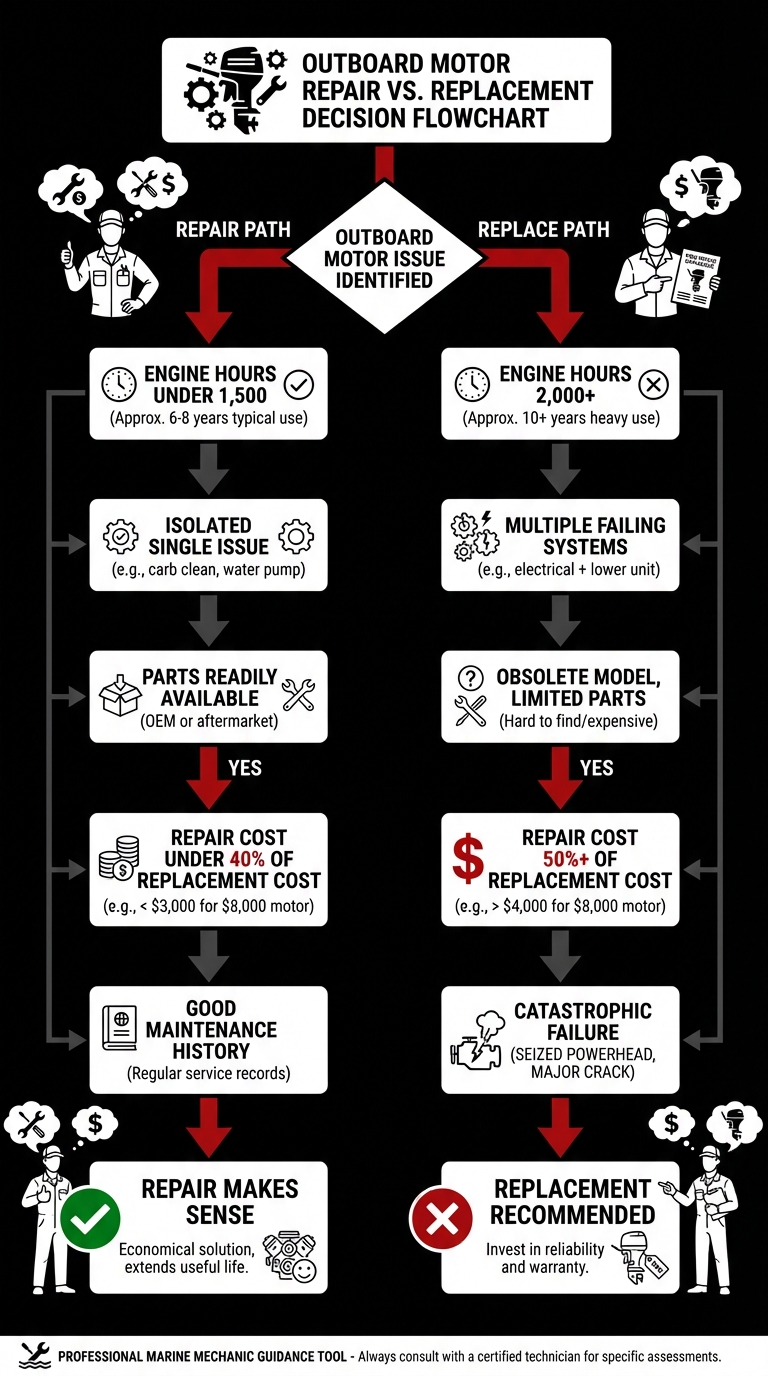
Repair makes sense when: Your engine has fewer than 1,500 hours, the problem is an isolated component failure (fuel pump, starter, trim motor), parts remain readily available, the repair costs less than 40% of replacement value, you've maintained it properly with regular service. Understanding the typical repair process helps you make informed decisions when no other major systems show wear. A $1,200 lower unit rebuild on a well-maintained 800-hour Yamaha F250 makes perfect sense when a replacement costs $22,000.
Replacement makes sense when: You've exceeded 2,000 hours with multiple failing systems, you've suffered catastrophic internal damage (seized powerhead, cracked block), you own an obsolete model with limited parts availability, repair costs exceed 50% of replacement value, or you want upgraded features and reliability that justify the investment. A 2,500-hour two-stroke outboard needing a powerhead rebuild, lower unit overhaul, and wiring harness replacement adds up to $8,000-$10,000 in repairs. Spending that on an old engine that might need more work next season makes less sense than investing in a new four-stroke with warranty coverage and modern reliability.
In one instance, a 28-foot Contender owner running out of Haulover noticed his Yamaha F250 running warmer than normal at cruise. The telltale stream looked weak and inconsistent. He called an emergency boat repair service that specialized in Yamaha outboards and met him at his dock that afternoon. The mechanic diagnosed a failed water pump impeller, a common wear item on outboards. The rubber impeller vanes wear out from sand particles and corrosion, reducing water flow through the cooling system. The mechanic replaced the impeller, inspected the cooling passages for salt buildup or debris, and pressure-tested the cooling system to confirm proper flow. Ninety minutes after the mechanic arrived, the repair was complete for $425 including parts and labor. Engine temperatures returned to normal, and the owner was back fishing that same afternoon. He caught his first sailfish of the season that evening - a repair that saved his day on the water.
Mobile Outboard Repair vs. Shop-Based Service
Most outboard motor repairs in Florida can be completed on-site with mobile service. Water pump impellers, fuel system repairs, electrical diagnostics, starter replacement, trim and tilt motor service, spark plug changes, and lower unit oil changes all happen comfortably at your dock or boat ramp. Mobile mechanics carry common parts in their trucks and can source specialized parts for next-day installation.
Shop-based service becomes necessary for powerhead removal and internal engine work, major lower unit rebuilds requiring bearing and gear shimming, cylinder head resurfacing, and any repair requiring the engine to be removed from the boat. Some complex diagnostics also benefit from shop environments where engine testing equipment and multiple technicians can collaborate on difficult problems.
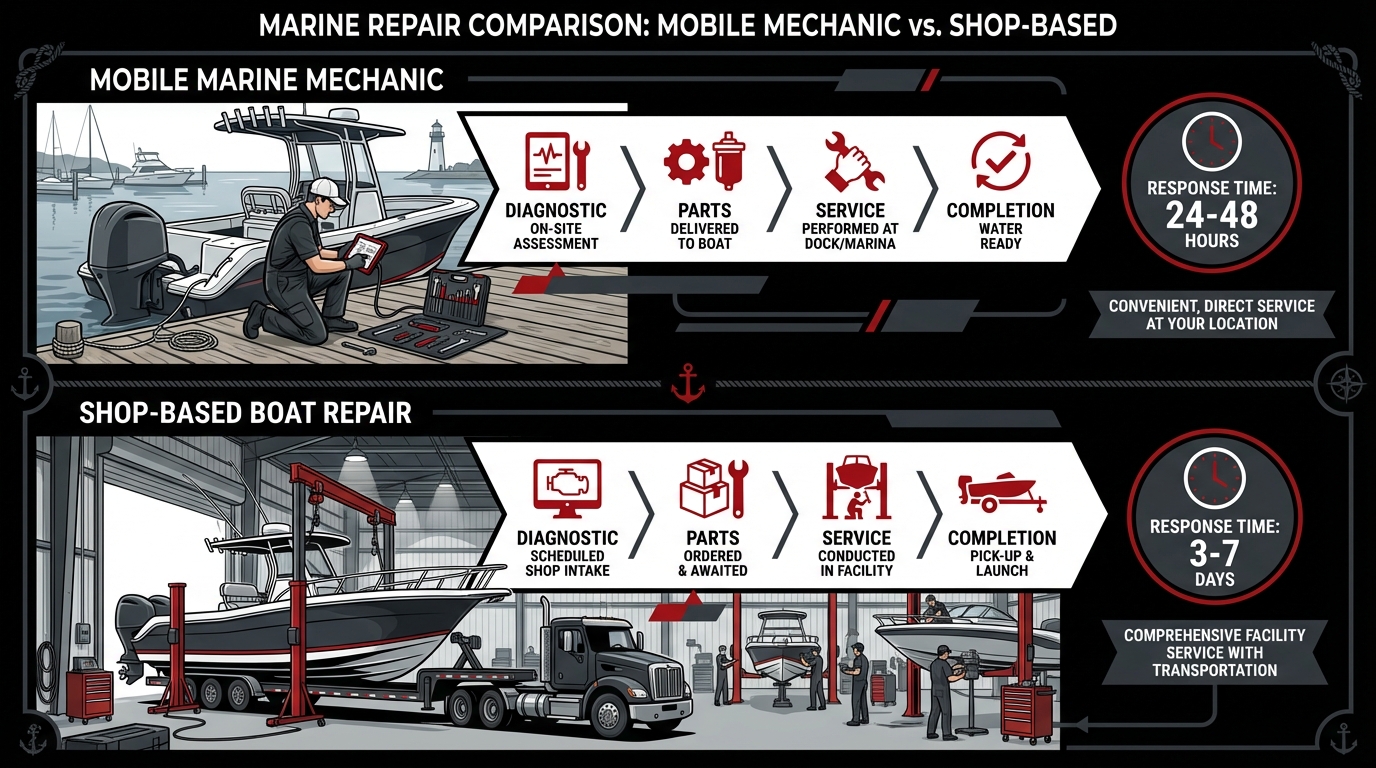
A smart approach is to use mobile mechanics for diagnostics, routine service, and moderate repairs. If the diagnosis reveals major internal work, the mobile mechanic can arrange transport to a shop while you maintain a single point of contact rather than starting over with a new service provider.
Inboard Engine Repair and Marine Propulsion Systems
Inboard engines power larger boats, sportfish yachts, cruisers, and many performance boats. These engines live inside the boat rather than hanging off the transom, integrated into the hull with additional systems for cooling, exhaust, and propulsion. Understanding inboard engine repair helps owners of larger boats in Florida maintain reliable operation and recognize when problems require professional intervention.
Inboard vs. Outboard: Key Differences
Location defines the fundamental difference. Inboard engines mount inside the hull, typically under the cockpit or in a dedicated engine room, driving the propeller through a shaft that exits through the hull bottom. Outboards mount externally on the transom with their own self-contained propulsion unit. This location difference creates cascading effects on every other system.
Cooling systems differ significantly. Outboards use raw water cooling, pumping seawater directly through the engine block. Most inboards use closed cooling systems (freshwater circulating through the engine, cooled by seawater running through a heat exchanger) or raw water cooling similar to outboards but with more complex plumbing. Closed cooling extends engine life but adds complexity and maintenance requirements.
Access matters daily. Outboards tilt up for easy propeller inspection, lower unit service, and trailering. Inboards require you to enter the bilge or engine room, remove covers or hatches, and work in confined spaces. Some repairs that take 30 minutes on an outboard take three hours on an inboard purely due to access challenges.
Steering differs completely. Outboards steer by rotating the entire engine, turning the propeller to change direction. Inboards use rudders mounted behind the propeller, controlled by cables or hydraulic systems. Stern drives combine both approaches with an inboard engine connected to an outboard-style lower unit that both propels and steers.
Common Inboard Engine Problems
Inboard engines share some issues with outboards but develop unique problems from their installation and operating environment:
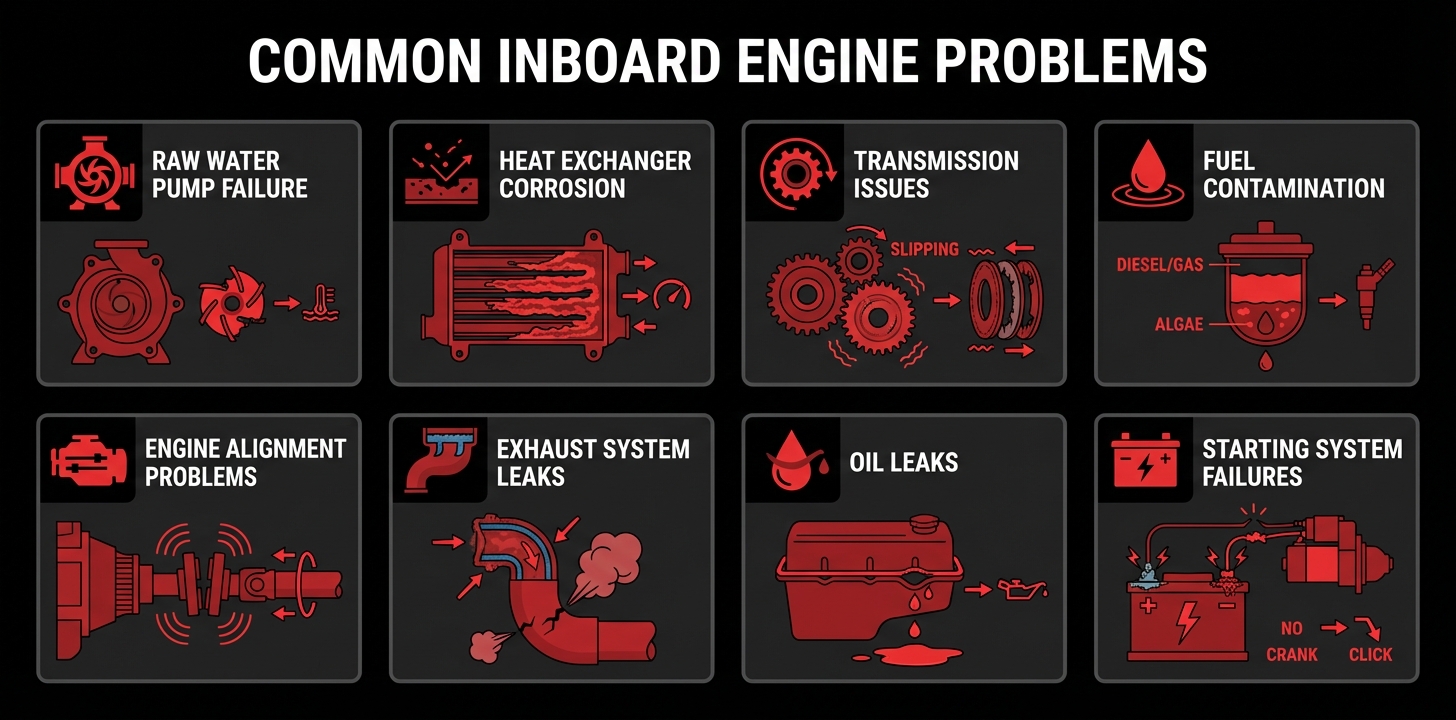
Raw water pump failures stop water flow to the engine or heat exchanger, leading to fast overheating. These pumps use rubber impellers that deteriorate from heat, chemicals, and debris. Replace impellers every 300-500 hours even if they appear functional. Impeller fragments can clog cooling passages and cause expensive damage.
Heat exchanger corrosion or clogging reduces cooling efficiency in closed-cooling systems. Salt buildup inside heat exchanger tubes restricts water flow, while external corrosion from stray electrical current can perforate the tubes, allowing saltwater to mix with engine coolant. A failing heat exchanger causes gradually increasing engine temperatures.
Transmission issues include slipping (engine RPM increases but boat speed doesn't), hard shifting, clunking noises during shifts, or transmission fluid leaks. Marine transmissions (Velvet Drive, ZF, Twin Disc) endure constant load changes and require proper maintenance and adjustment. Transmission problems often start subtle and worsen very quickly if ignored.
Fuel system contamination from algae growth, water intrusion, or sediment causes rough running, loss of power, and starting problems. Diesel engines particularly suffer from biological growth in fuel tanks when boats sit unused. The fuel filters clog quickly, starving the engine. Proper fuel management includes the use of biocides and regular filter changes.
Engine alignment problems develop when engine mounts wear or shift, causing vibration, accelerated shaft seal wear, and bearing damage in the transmission or shaft coupling. Proper alignment requires specialized tools and knowledge, not a DIY repair.
Exhaust system leaks or corrosion allow dangerous carbon monoxide into the cabin or engine room, create loud exhaust noise, and indicate failing components that can sink your boat if exhaust water leaks back into the engine. Any exhaust leak requires immediate attention.
Diesel vs. Gasoline Inboard Engines
Diesel inboards dominate yachts 35 feet and larger, offering superior torque, better fuel economy, longer service life between rebuilds (5,000-8,000 hours vs. 3,000-5,000 for gas), and lower fire risk from non-volatile fuel. However, diesel engines cost more initially, have more expensive parts, and require specialized knowledge for proper service. Common diesel issues include injector problems, glow plug failures, turbocharger maintenance, and fuel system air leaks.
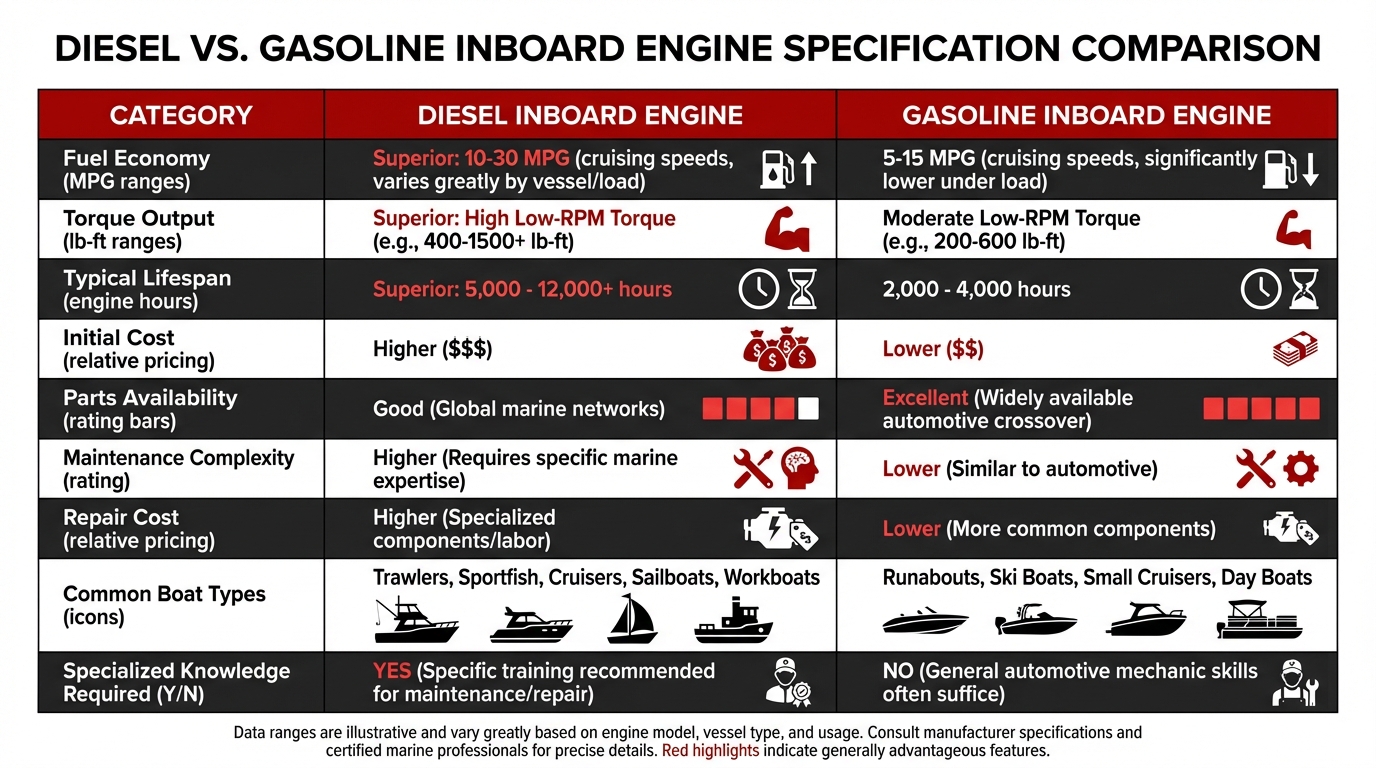
Gasoline inboards remain popular on sportfish boats and cruisers under 40 feet due to lower initial cost, simpler maintenance, easier parts availability, and better performance for most applications. Modern fuel-injected gas inboards run cleaner and more efficiently than older carbureted versions. Fire risk exists with gasoline but proper engine room ventilation and safety systems help mitigate these concerns.
Repair knowledge also varies between diesel and gas. Diesel mechanics need to understand injection timing, compression ratios, glow plug systems, and turbocharger operation. Gas mechanics work with ignition systems (spark plugs, distributors or coil packs, ignition timing) that don't exist on diesels. Choose a mechanic in Florida with specific experience on your engine type.
Stern Drive (I/O) Repair Considerations
Stern drives, also called inboard/outboards, combine an inboard engine with an outboard-style lower unit. The engine mounts inside the hull, but the drive unit tilts and turns like an outboard. Popular brands include Mercruiser (by far the market leader), Volvo Penta, and formerly OMC Cobra drives.
Stern drives develop unique problems. Bellows (rubber boots) protecting the gimbal assembly crack with age, allowing water to flood the bilge. Gimbal bearings wear out, causing clunking noises and rough operation. Shift cables corrode and bind, making shifting difficult or impossible. The lower unit requires the same gear oil service as outboard lower units, and water pump impellers need regular replacement.
Proper stern drive service includes alignment checks and bellows inspection during every service interval. Neglecting bellows inspection risks a catastrophic water leak that can sink your boat. Most bellows should be replaced every five to seven years regardless of appearance because rubber deteriorates with time even if it looks acceptable.
In a recent real world scenario, a 45-foot Hatteras sportfish owner in Tampa Bay noticed his coolant level dropping steadily in the starboard Caterpillar diesel. He added coolant twice over two weeks before calling for professional diagnosis. The shop-based diagnostic revealed a cracked heat exchanger from saltwater corrosion, a common failure on high-hour diesel engines. Heat exchangers eventually corrode from the constant saltwater exposure, and this particular engine had exceeded 3,000 hours without heat exchanger replacement. The shop ordered an OEM Caterpillar heat exchanger (two-day delivery time) and replaced it along with new gaskets and a complete raw water pump service while the cooling system was opened. Three days later and $2,800 poorer, the owner had his boat back with engine temperatures running normally and no more coolant loss. The repair cost stung, but it beat the $30,000 for a replacement engine if he'd ignored the problem until the engine overheated severely.
When Inboard Repair Requires Shop Facilities
Mobile marine mechanics can handle significant boat engine repair work on inboards: fuel system service, cooling system work, electrical repairs, belt and hose replacement, and fluid changes. However, certain repairs demand shop facilities: engine removal for major internal work, transmission rebuilds, shaft and strut alignment, hull penetration repairs, and any work requiring the boat to be hauled out of the water. Major yacht facilities in Fort Lauderdale, Stuart, and Tampa specialize in large diesel inboard work, while shops in Orlando, Sanford, and Kissimmee focus more on freshwater bass boat and pontoon service.
Larger yachts require mobile specialist teams or dedicated yacht service facilities rather than traditional marine repair shops. These vessels have complex integrated systems (generators, HVAC, watermakers, stabilizers) that require specialized knowledge beyond basic engine repair. If you own a yacht over 45 feet in Florida, seek out mechanics with yacht systems experience rather than general marine mechanics.
Electrical Systems, Hull Repair, and Structural Work
Beyond engines, boats require specialized repair services for electrical systems, hull integrity, and structural components. These systems failures can be just as debilitating as engine problems, and in some cases more dangerous. Electrical fires sink boats. Hull damage sinks boats faster. Understanding these repair categories helps you recognize problems early and choose properly qualified specialists in Florida.
Marine Electrical System Repair
Marine electrical systems combine complexity with a hostile environment. Boats typically run dual-voltage systems: 12-volt DC for house loads (lights, pumps, electronics, refrigeration) and 120-volt AC shore power for air conditioning, battery chargers, and household appliances when docked. In Florida, saltwater air accelerates corrosion on every connection, wire routing runs through bilges and wet spaces, and constant vibration loosens connections over time. The American Boat and Yacht Council (ABYC) sets standards for marine electrical systems, but not all boats meet these standards, especially older vessels or those with owner-modified wiring.
Common electrical issues plague boats constantly. Batteries drain overnight even with battery switches off, indicating parasitic draws from faulty bilge pump float switches, improperly wired stereos, or corroded connections creating resistance paths. Corroded terminals and connections cause voltage drop, making lights dim and electronics malfunction. Shorts and blown fuses often result from chafed wiring where cables rub against sharp edges during wave action. Battery switches and isolators fail mechanically, preventing proper battery isolation or selection.
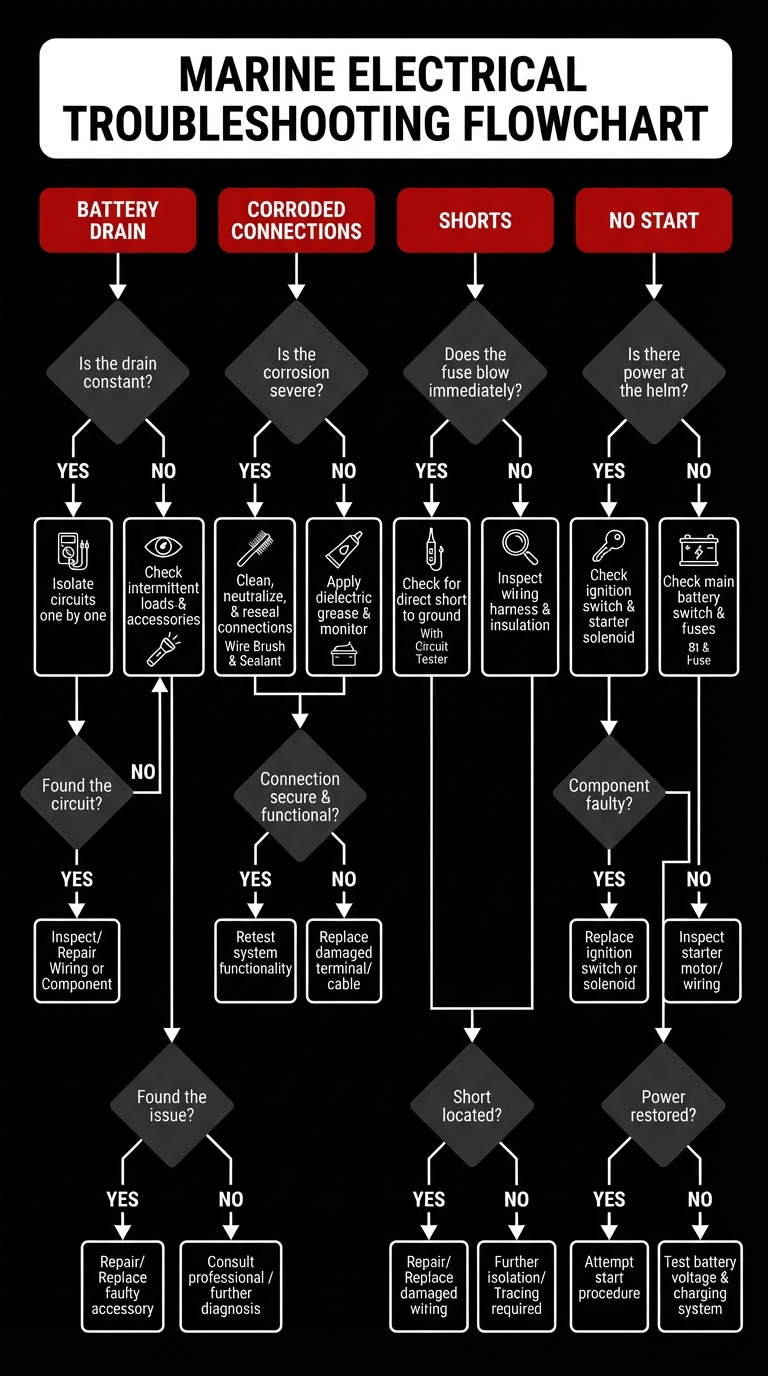
Shore power problems create both frustration and danger. Reverse polarity (hot and neutral wires swapped at the dock pedestal) can energize your boat's metal fittings, creating shock hazard. Ground faults from damaged shore power cables risk fire and electrocution. Galvanic corrosion accelerates when dissimilar metals in the water connect through your boat's electrical system, eating away at props, shafts, and through-hull fittings.
Electronics failures like chartplotters going blank, VHF radios with static and fishfinders showing interference often trace back to power supply issues (voltage spikes, inadequate wire gauge, poor grounds) rather than the electronics themselves. Bilge pumps fail from corroded float switches or seized motors, potentially sinking your boat if water enters faster than manual pumping can remove it.
Why certified boat electrician specialists matter: ABYC standards dictate proper wire sizing, circuit protection, grounding and bonding, and wire routing to prevent chafe and water damage. Marine-grade wire uses tinned copper (regular copper corrodes rapidly in saltwater air) and proper insulation. Connections require heat-shrink tubing and marine-grade terminals, not crimp connectors from hardware stores. Proper fusing and circuit protection prevents wires from overheating and starting fires. An car electrician lacks the marine-specific knowledge to properly troubleshoot and repair boat electrical systems safely.
For example, a recent 32-foot center console owner docked in Key Largo fought a persistent battery drain problem. He replaced both batteries within three months, yet they continued to die overnight even with the battery switch off. Frustrated and out $400 in batteries, he called a mobile marine electrician. The technician used a multimeter to measure parasitic draw with everything supposedly off and found significant current drain. By systematically isolating circuits, he traced the draw to the bilge pump circuit. The float switch was corroded internally and stuck in the "on" position, running the bilge pump continuously even though no water was present. The corroded float switch had allowed enough leakage current to drain the batteries slowly over 24 hours. Replacing the float switch and inspecting all other circuits for similar corrosion took about 90 minutes and cost $275 including parts. The batteries now hold charge perfectly, the bilge pump operates only when needed, and the owner understands the importance of checking float switches annually in saltwater environments.
Fiberglass and Gelcoat Repair
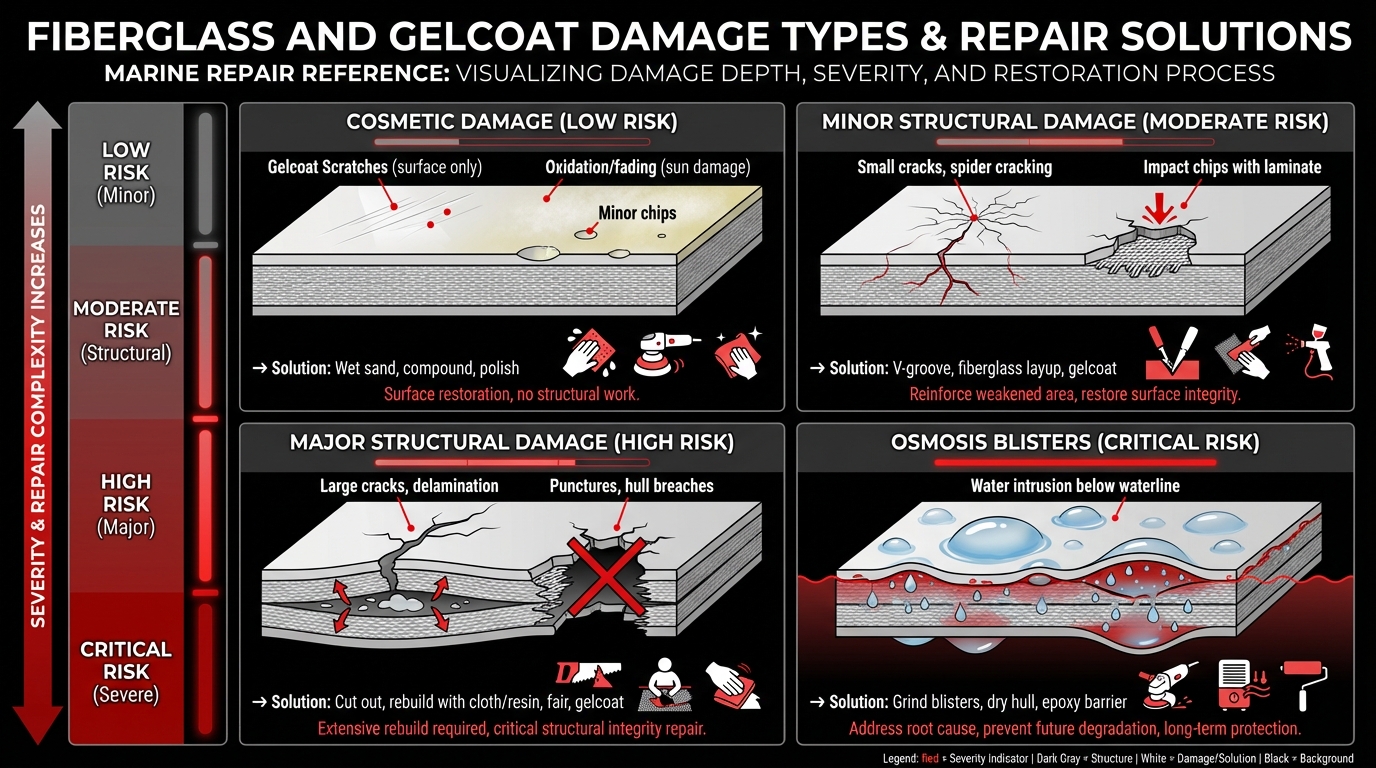
Fiberglass hulls dominate recreational boating due to their strength-to-weight ratio, moldability, and resistance to rot, but fiberglass still sustains damage from impacts, flexing, UV exposure, and improper manufacturing or repair. Understanding damage types helps you communicate with repair specialists in Florida and make informed decisions about repair urgency and scope.
Cosmetic damage affects only the gelcoat surface layer. Scratches from dock contact, oxidation from UV exposure, fading from sun and saltwater. These issues look bad but don't compromise structural integrity. Repairs involve wet sanding to level the surface, compounding to remove haze, and polishing to restore gloss. More significant gelcoat scratches require filling with color-matched gelcoat paste before sanding and buffing.
Minor structural damage includes small cracks, spider cracking (fine crack networks from stress or flexing), and impact chips that penetrate into the fiberglass laminate beneath the gelcoat. These require proper repair to prevent water intrusion and crack propagation. The repair process involves grinding out the damaged area in a V-groove, building up fiberglass cloth layers with resin, fairing the surface smooth, and applying color-matched gelcoat.
Major structural damage from collisions, groundings, or heavy impacts involves large cracks, delamination (fiberglass layers separating), or complete penetration through the hull. These repairs require cutting out all damaged material, rebuilding with proper fiberglass layup techniques, and ensuring proper bonding to surrounding structure. Major damage requires professional repair because improper techniques leave weak spots that can fail catastrophically.
Osmosis blisters develop below the waterline when water penetrates the gelcoat and reacts with uncured resin in the laminate, creating pressure pockets that push up the gelcoat in small bubbles. Severe osmosis weakens the hull structure. Treatment requires grinding out affected areas, drying the hull completely (sometimes weeks of drying time), and sealing with epoxy barrier coats to prevent water reentry.
Professional fiberglass repair services matter because proper repairs require specific skills most boat owners lack. DIY repair attempts often create more problems than they solve. Color-matching gelcoat to surrounding areas (which have faded from UV exposure over years) requires experience and often multiple attempts. Proper fiberglass layup uses correct glass-to-resin ratios. Too much resin creates heavy, weak repairs; too little resin leaves dry spots that allow water intrusion. Fairing and finish quality separate professional work from amateur patches. Most importantly, correctly assessing whether damage is cosmetic or structural prevents you from ignoring dangerous cracks while wasting money on purely cosmetic issues.
A 24-foot bay boat owner in Fort Myers noticed extensive spider cracking across his bow deck - fine crack networks radiating from stress points. The cracks had appeared gradually over two seasons, initially dismissed as purely cosmetic. However, the deck felt slightly soft in the affected areas when stepped on firmly. He considered tackling this as a DIY project but decided to consult a fiberglass specialist first. The technician assessed the situation: the spider cracking indicated underlying laminate stress from UV exposure and deck flex, and the soft spots meant the core material beneath the fiberglass skin had begun to delaminate. This wasn't just cosmetic. The repair involved grinding out affected gelcoat, reinforcing the underlying laminate with additional fiberglass layers to stiffen the deck, drying out and resealing the core material, and applying fresh gelcoat in multiple stages to build up proper thickness. The technician color-matched the gelcoat to surrounding areas (accounting for UV fade), then wet-sanded through progressively finer grits and buffed to a high gloss. $950 later and five days of work, the deck looked factory-new, felt solid underfoot, and had proper structural integrity restored. The owner learned that ignoring spider cracks can turn a $1,000 repair into a $5,000 deck replacement if the core continues deteriorating.
Hull and Structural Repair
Beyond surface-level fiberglass work, boats develop serious structural issues that require extensive repair or component replacement. These problems often hide until they've progressed significantly, making pre-purchase inspections critical for used boat buyers and regular inspections important for existing owners.
Transom rot affects boats with plywood or foam core transoms when water intrudes through cracks, poorly sealed through-hull fittings, or around outboard mounting bolts. The core material absorbs water, softens, and loses structural integrity. Symptoms include soft spots when you press on the transom, cracks radiating from outboard mounting points, or the outboard mounting bolts loosening repeatedly. Transom replacement requires removing the outboard, cutting away exterior fiberglass skin, replacing rotten core material, and reglassing properly. These repairs typically cost $3,000-$8,000 depending on boat size and require shop facilities.
Stringer damage includes the longitudinal structural supports running from bow to stern that carry engine loads and distribute hull stresses. Stringers can rot from water intrusion, crack from improper engine installation, or delaminate from the hull. Stringer failure causes deck sagging, hull flexing, and engine alignment problems. Repair requires extensive access through deck hatches or sole panels, sometimes cutting away deck sections to reach damaged stringers.
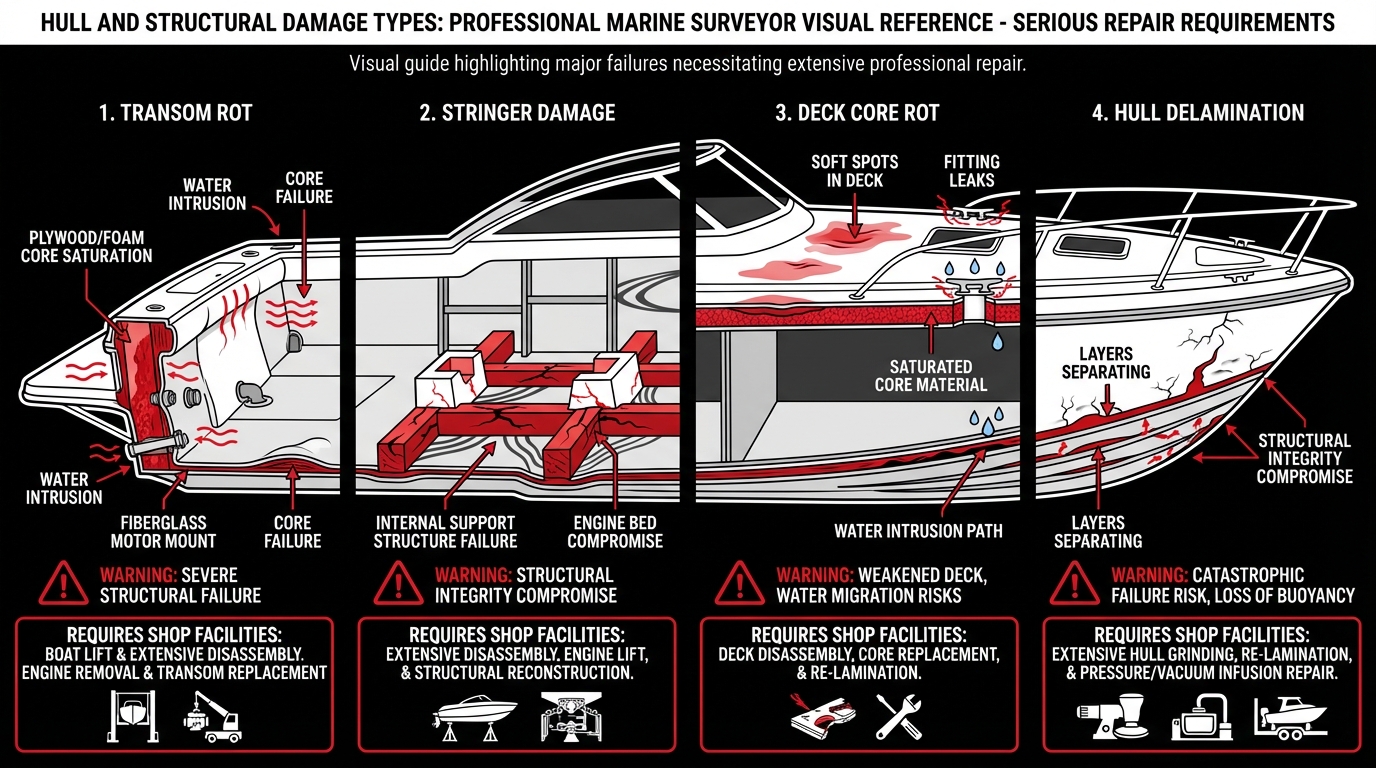
Deck core rot creates soft spots in decks when coring material (plywood, balsa, or foam) becomes water-saturated from leaking deck fittings, hatches, or windshield mounts. Test for soft deck cores by walking your deck and feeling for areas that flex more than surrounding sections. Small areas can be repaired by drilling access holes, drying the core, injecting epoxy, and resealing. Large areas require removing deck skin, replacing core material, and reglassing.
Hull delamination occurs when fiberglass layers separate from each other or from the core material, creating hollow-sounding areas when tapped and visible flexing under load. Delamination usually results from manufacturing defects (improper resin saturation, contaminated surfaces during layup) or impact damage that breaks internal bonds. Serious delamination requires cutting out affected areas and rebuilding with proper layup techniques.
These structural repairs almost always require shop-based service with the boat out of water, proper temperature and humidity control for resin curing, and multiple days or weeks of work. Mobile mechanics in Florida can identify structural problems and provide referrals to qualified fiberglass specialists, but the actual repair work happens in controlled shop environments. Pre-purchase inspections by qualified marine surveyors catch hidden structural problems before you buy, potentially saving tens of thousands in repair costs or allowing negotiation of purchase price to account for needed work.
Boat Maintenance, Detailing, and Preventative Service Programs
Preventative maintenance costs less than repairs, yet many boat owners from Pensacola to Key West wait for failures before scheduling service. Florida's year-round boating season and saltwater environment make regular maintenance essential rather than optional. Understanding proper maintenance intervals and what's included in comprehensive service helps you keep your boat reliable and protects your investment value.
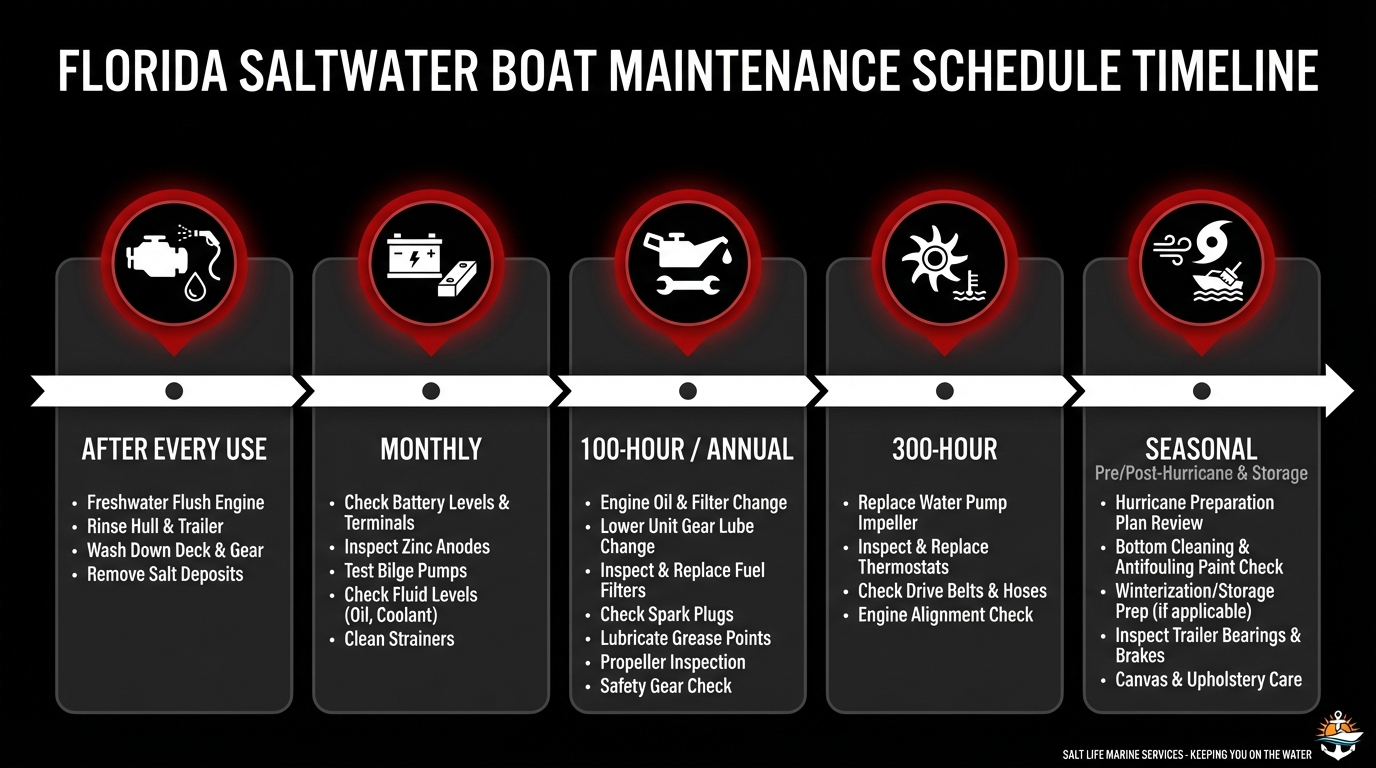
100-Hour and Annual Service Intervals
Most engine manufacturers recommend service every 100 hours of operation or annually, whichever comes first. Weekend boaters might accumulate only 50-75 hours per year, while serious anglers, charter operators, or cruising enthusiasts can log 200-400 hours annually. Regardless of hours, annual service addresses issues that develop from time rather than just use: rubber components deteriorate, corrosion advances, fluids absorb moisture, and connections loosen from vibration.
Complete 100-hour boat service typically includes:
Engine oil and filter changes that remove contamination, acids, and water that accumulate in oil. Marine engines work harder than automotive engines. Sustained high RPM operation, constant load changes, and exposure to moisture make frequent oil changes critical for longevity.
Lower unit or outdrive gear oil changes that remove metal particles worn from gears and bearings, and allow inspection for water contamination that indicates seal failure. Milky gear oil means water intrusion. Catch this early and you replace seals; ignore it and you rebuild the entire lower unit.
Fuel filter replacements prevent contamination from reaching fuel injectors or carburetors. Marine fuel sits in tanks longer than automotive fuel and accumulates more water from temperature cycling and vented fuel systems. Replace both inline filters and engine-mounted filters.
Water pump impeller inspection and replacement prevents overheating. Rubber impellers wear from sand and debris, and their vanes crack with age even if hours are low. Many mechanics replace impellers automatically during service rather than inspect and reuse - the $40 part costs far less than the $3,000 head gasket job from overheating.
Spark plug replacement on four-stroke engines maintains efficient combustion and easy starting. Fouled or worn plugs reduce power and fuel economy. Two-stroke engines require more frequent plug replacement due to oil in the combustion chamber.
Battery testing and charging system checks prevent the frustration of dead batteries. Load testing reveals batteries that show adequate voltage when disconnected but fail under starting load. Charging system checks confirm your alternator or stator properly charges batteries during operation.
Zinc inspection and replacement protects expensive metal components from galvanic corrosion. Sacrificial anodes corrode instead of your engine components, but only if they're present and functional. In Florida's aggressive saltwater—whether you're boating in Sarasota's Gulf waters, Fort Myers harbors, or Key West's reef channels—zincs can deplete in 3-6 months of regular use. Check them every service interval and replace when 50% depleted.
Belt and hose inspection catches deterioration before failure. Belts drive critical components like alternators and power steering; hose failure can dump coolant or fuel. Squeeze hoses to feel for soft spots or cracks, and look for belt cracking or glazing.
Steering and throttle cable lubrication maintains smooth, easy operation. Stiff steering or sticky throttles indicate cables that need lubrication or replacement. Seized cables can prevent you from controlling your boat.
Trim and tilt system checks ensure outboards or stern drives adjust properly. Listen for labored operation or slow movement indicating worn pumps or low hydraulic fluid.
Safety equipment inspection verifies fire extinguishers are charged, flares aren't expired, life jackets are serviceable, and required equipment is aboard and functional. The Coast Guard's boating safety requirements mandate specific equipment based on boat size. Service time is a good opportunity to verify compliance.
A 38-foot center console owner in Jacksonville with twin Yamaha F300 outboards scheduled his annual service before an extended Bahamas crossing. He contacted a mobile marine mechanic who arrived at his dock with all necessary parts: oil, filters, spark plugs, impellers, and zinc anodes for both engines. Over four hours, the mechanic performed complete 100-hour service on both engines including oil and filter changes, lower unit gear oil service, fuel filter replacement, water pump impeller replacement, spark plug changes, and complete systems checks. He pressure-tested the fuel system for leaks, checked battery banks and charging systems, inspected steering and throttle cables, and tested trim systems. The total cost was $1,850 for both engines including all parts and labor, expensive but reasonable for comprehensive service of twin 300-horsepower outboards. The owner crossed the Gulf Stream to the Bahamas three days later with complete confidence. Both engines ran flawlessly for the 500-mile roundtrip, performing exactly as expected because they'd received proper preventative maintenance rather than waiting for problems to develop offshore.
Seasonal Maintenance for Florida Boating
Florida doesn't have traditional winter like northern states, but seasonal considerations still matter. "Winterization" in tropical climates doesn't mean freezing protection. It means off-season preparation if you store your boat during summer's heat or hurricane season, or intensive pre-season service if you've let the boat sit unused.
Hurricane season preparation (June through November) includes checking dock lines for chafe and proper size, removing or securing electronics that could be damaged by water intrusion or theft, disconnecting batteries to prevent drain and corrosion, performing complete freshwater flush of engines and systems, and ensuring bilge pumps function with fully charged batteries if leaving the boat in water. According to NOAA's National Hurricane Center guidance, proper boat preparation and securing before tropical storms significantly reduces damage to boats and marina infrastructure. Many Florida boat owners haul out and store on trailers during active hurricane threats rather than risk storm surge and wind damage at docks.
Summer heat impacts stress batteries (heat accelerates sulfation and water loss), deteriorates rubber hoses and belts faster, degrades upholstery and canvas from intense UV exposure, and accelerates fuel degradation. Check batteries monthly during summer for proper water levels, inspect hoses for softening or cracks, and use quality fuel stabilizers if the boat sits more than a few weeks between uses.
Year-round saltwater exposure demands more frequent zinc checks (every month or two rather than just at service intervals), regular bottom cleaning if stored in water (growth accumulates quickly in warm water), and constant vigilance against corrosion on all metal fittings, outboard bolts, and electrical connections. Rinse everything with freshwater after every use. This single habit prevents more corrosion problems than any other maintenance task.
Boat Washing, Detailing, and Cosmetic Maintenance
Regular washing removes salt, prevents oxidation on gelcoat and metal, and allows early detection of developing problems like cracks or loose fittings. Basic washing after every use takes 20 minutes and saves hours of corrective work later. Detailed boat cleaning services include washing, waxing, interior detailing, upholstery cleaning, teak maintenance, and metal polishing.
Professional detailing creates a protective barrier against UV damage, makes future cleaning easier, and dramatically improves resale value. Waxing should happen 2-3 times per year in Florida's intense sun. Quality marine wax with UV inhibitors protects gelcoat from oxidation and fading. Upholstery treatment with marine-grade protectants prevents mildew growth, cracking, and fading. Teak requires either oil treatment to maintain natural color or allowing it to weather to gray naturally. Choose one approach and stick with it consistently.
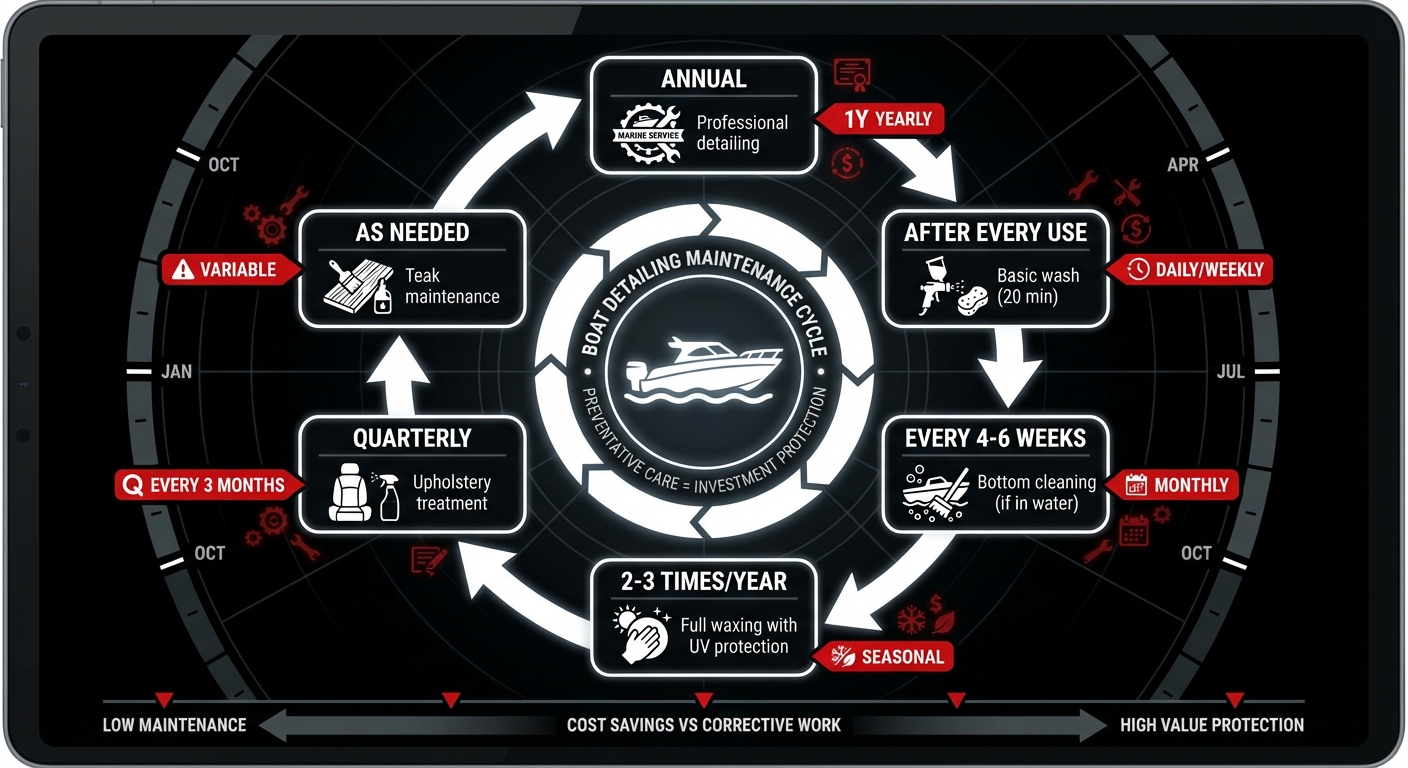
Bottom cleaning removes growth that increases drag and fuel consumption while providing opportunity to inspect through-hull fittings, props, shafts, and zincs. For boats stored in water—whether in Cape Coral canals, St. Petersburg marinas, or Miami yacht clubs—bottom cleaning every 4-6 weeks maintains performance in Florida's warm waters. Haul-out bottom painting with anti-fouling paint extends time between cleanings but requires proper application on a clean, dry hull.
Cosmetic maintenance isn't vanity, it's investment protection. A well-maintained boat retains 15–20% more value than an equivalent boat showing neglect. Oxidized gelcoat, stained upholstery, and corroded fittings signal to potential buyers that other maintenance was probably neglected too. In South Florida’s salt-heavy environment, upkeep extends beyond the boat itself — docks, lifts, and surrounding surfaces often require routine care, including pressure cleaning services, to keep corrosion and staining from spreading. Keep your boat looking good and it will be worth more when you sell or trade.
Choosing Qualified Marine Mechanics: Mobile, Shop, and Marina Options
Not all marine mechanics offer equal expertise, certification, or service quality. Understanding what separates a qualified boat mechanic from general marine technicians helps you find specialists in Florida who can properly diagnose and repair your specific boat and engine. Service model, mobile versus shop-based, versus marina service departments all affect convenience, cost, and the types of repairs they can handle. Making informed choices about who works on your boat prevents the frustration of incorrect diagnoses, incomplete repairs, and unnecessary expenses.
Manufacturer Certifications and Training
Manufacturer certifications matter more in marine repair than automotive service because marine engines use proprietary diagnostic systems that require brand-specific software and training. Mercury, Yamaha, Suzuki, and Honda each developed closed diagnostic systems that generic scan tools can't fully access. Finding a Mercury-certified mechanic in Orlando or a Yamaha specialist in Jacksonville ensures proper diagnostic capability. A Mercury-certified mechanic has attended factory training courses, passed certification exams, maintains access to Mercury's technical service bulletins and wiring diagrams, and can connect to Mercury's diagnostic software for complete engine data access and programming.
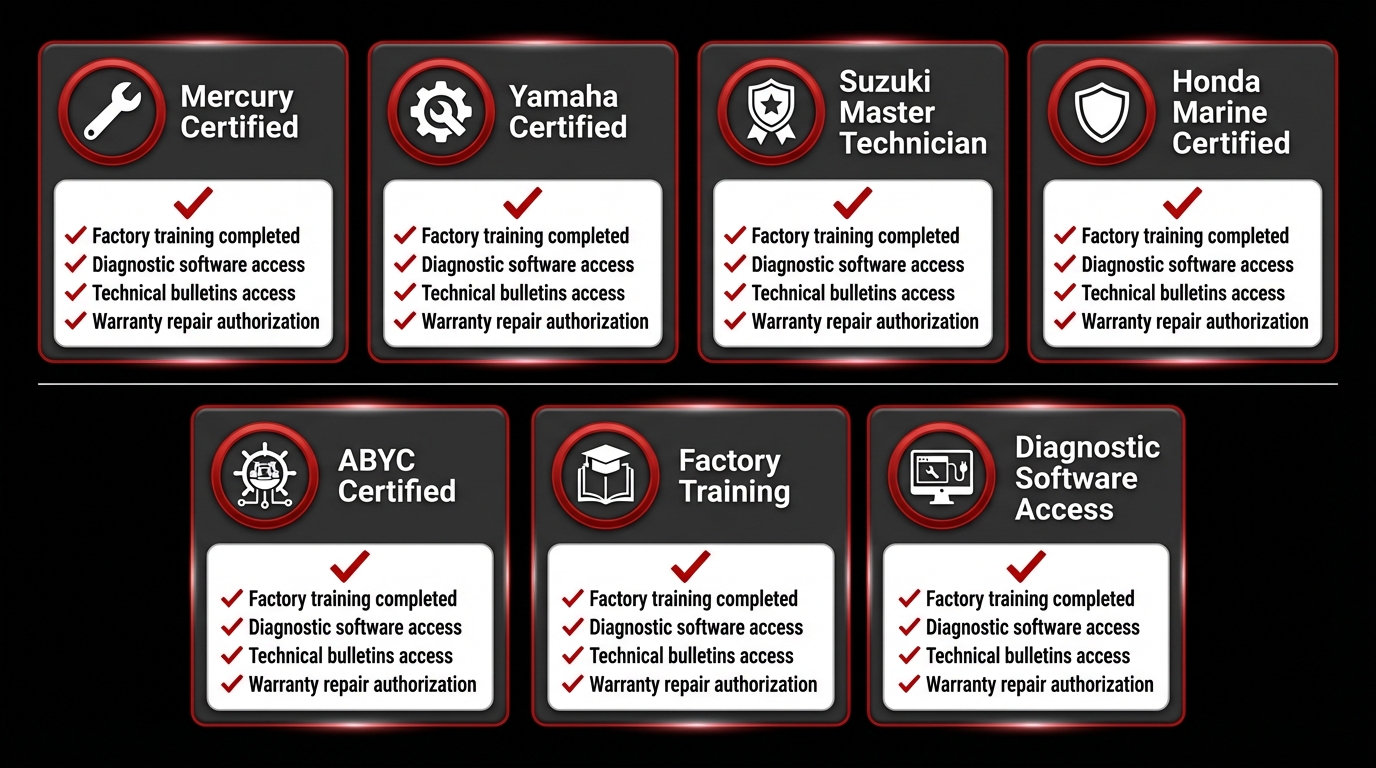
Mercury Certified technicians receive training on Mercury and Mariner engines, from 2.5-horsepower kickers to 600-horsepower Verados. Certification levels exist. Basic certification covers routine service and common repairs, while master technician status requires advanced training on complex systems like superchargers, digital throttle and shift, and joystick controls. Mercury's network is the largest, making certified mechanics easiest to find.
Yamaha Certified mechanics specialize in Yamaha outboards and related systems. Yamaha's extensive training program covers their F-series four-strokes, VMAX performance outboards, and integrated control systems like Command Link and Helm Master. Yamaha certification means access to Yamaha Diagnostic Software (YDS) required for reading engine data and programming control modules.
Suzuki Master Technician designation indicates advanced training on Suzuki outboards including their DF series four-strokes, fuel injection systems, and digital controls. Suzuki's dealer network is smaller but growing, and certified technicians receive factory support for complex diagnostics.
Honda Marine Certified technicians focus on Honda's four-stroke outboards, known for quiet operation and reliability. Honda's marine division is smaller than automotive, so certified marine mechanics are less common but highly valued by Honda owners.
ABYC (American Boat and Yacht Council) Certification isn't manufacturer-specific but indicates training in marine systems standards. ABYC certifications exist for marine electrical systems, marine corrosion, diesel engines, gasoline engines, and marine systems. ABYC-certified technicians understand proper marine standards for electrical wiring, bonding and grounding, fuel systems, and other critical systems beyond just engines.
Why certifications matter in practice: Modern outboards and inboards use electronic control modules that manage fuel injection, ignition timing, engine protection systems, and integration with digital displays and controls. When a check engine light appears or an alarm sounds, the diagnostic process requires connecting manufacturer-specific software to read fault codes, view real-time data streams, and sometimes reprogram modules. Generic scan tools might read basic codes but miss critical data. A certified Mercury technician diagnosing an intermittent misfire can see individual cylinder contributions, fuel trim data, and ignition timing that reveals the failing component. An uncertified mechanic might replace parts hoping to fix the problem making it expensive and unreliable.
Mobile Marine Mechanics vs. Shop-Based Repair
Service location significantly affects convenience, cost, and repair capabilities. Understanding the strengths and limitations of each model helps you choose appropriately for different situations.
Mobile marine mechanic advantages: The mechanic comes to your boat at your dock, boat ramp, or home if on a trailer. This eliminates trailering costs, towing fees, and waiting for shop scheduling. For boats kept in water at docks or marinas, mobile service means no haul-out expense and no downtime from transportation. Emergency repairs happen faster because a mobile boat mechanic in Florida can respond same-day for urgent problems while shop scheduling might take days or weeks during busy season. You watch the work being done, ask questions, and learn about your boat's systems. Your boat remains immediately usable after repair rather than sitting at a shop waiting for pickup. Mobile mechanics service locations statewide—from Pensacola and Destin marinas down through Tampa, Sarasota, and Fort Myers to the Keys and everywhere in between.
Mobile boat repair limitations: Repairs requiring heavy equipment (engine hoists, large power tools, welding equipment) exceed what mechanics can carry in service trucks. Weather affects outdoor work - heavy rain or extreme heat can delay mobile service. Parts must be sourced and delivered rather than pulled from shop inventory, potentially adding a day to multi-part repairs. Major internal engine work, structural fiberglass repairs requiring controlled curing environments, and any service requiring the boat out of water exceeds mobile capabilities. Mobile service typically costs more per hour ($120-150 vs. $95-130 for shop-based) to account for travel time and equipment overhead, though you save trailering or towing costs.
Shop-based repair advantages: Full facilities include lifts, engine hoists, pressure washers, welding equipment, paint booths for gelcoat work, and climate-controlled environments for proper resin curing. Large parts inventories mean common components are in stock rather than waiting for delivery. Multiple technicians can collaborate on complex problems or handle multiple tasks simultaneously. Any repair complexity level can be addressed. Labor rates run slightly lower than mobile service ($95-130/hour typical) without travel fees.
Shop-based limitations: Transportation costs money. Trailer your boat or pay for towing service. Scheduling delays mean you wait for an available slot in the shop queue, potentially days or weeks during peak season. Your boat sits out of service during transport, repair, and waiting for pickup. Less convenient for minor repairs that could be handled quickly on-site. Quality varies significantly between shops because some employ highly skilled certified technicians while others hire less-qualified mechanics and charge the same rates.
Marina service departments offer convenience if you're already docked there but vary widely in quality and cost. Well-run marina service departments employ certified technicians and offer competitive pricing. Others subcontract repairs to outside mechanics or charge premium rates for mediocre work. Marina mechanics may push upgrades or additional services you don't need. Before using marina service, ask about technician certifications, get written estimates, and check reviews from other boaters.
How to choose the right service model: Use on-site boat repair with mobile mechanics for diagnostics, routine service and maintenance, fuel system repairs, electrical work, cooling system service, minor mechanical repairs, and emergency breakdowns. Choose shop-based repair for major engine overhauls, structural fiberglass repairs, bottom painting requiring haul-out, transmission rebuilds, and complex multi-day jobs requiring specialized equipment. A smart approach combines both: mobile mechanics for initial diagnosis and routine work, with referral to shop facilities when the diagnosis reveals work exceeding mobile capabilities.
| Comparison Factor | Mobile Marine Mechanic | Shop-Based Repair |
|---|---|---|
| Response Time | Same day to 48 hours typical | 3-7 days wait for scheduling |
| Repair Location | Your dock, ramp, or home | Shop facility (requires transport) |
| Equipment Access | Portable tools and equipment | Full shop tools, lifts, hoists |
| Best Use Cases | Diagnostics, routine service, minor to moderate repairs, emergencies | Major overhauls, structural work, bottom painting, transmission rebuilds |
| Transportation Cost | None (mechanic comes to you) | $200-500+ for towing or trailering |
| Labor Rate | $120-150/hour (includes travel time) | $95-130/hour (no travel fees) |
| Weather Dependency | Outdoor work (rain/heat delays possible) | Climate-controlled environment |
| Boat Availability | Immediately usable after repair | Out of service during transport + repair |
A tournament angler in Islamorada woke up at 5:30 AM to prepare for the start of a three-day offshore fishing tournament. Walking to his boat, he started the engines to warm them while loading gear. His port Yamaha F250 immediately triggered the overheat alarm despite cold engine temperatures. With tournament start at 7:00 AM and $12,000 in prize money at stake, he had 90 minutes to solve the problem or miss the tournament. He called an emergency mobile marine mechanic who lived nearby and specialized in Yamaha outboards. The mechanic arrived by 6:15 AM with diagnostic tools and common parts. He connected to the engine with Yamaha Diagnostic Software and checked fault codes and real-time data. The diagnosis revealed an oil pressure sensor reading zero despite the engine showing normal oil pressure mechanically. The sensor had failed. Not uncommon on saltwater outboards with high hours. The mechanic carried replacement oil pressure sensors for common Yamaha models in his truck stock. He replaced the sensor, cleared fault codes from the ECM, verified proper oil pressure readings, and test-ran the engine. Forty-five minutes after arriving, the mechanic confirmed the repair was complete. Total cost: $475 for emergency call-out plus parts. The captain made the 7:00 AM tournament start, finished third overall in the three-day event, and took home prize money that more than covered the emergency repair and his entire tournament entry. Emergency mobile service with a certified Yamaha technician saved his weekend and potentially earned him $12,000.
Pricing Factors for Boat Repair Services
Understanding what drives boat motor repair costs helps you budget appropriately and recognize fair pricing versus overcharging. Rates vary somewhat by location—Miami and Naples typically run higher than Orlando or Jacksonville—but certification and expertise matter more than hourly rates. Several factors influence the final bill:
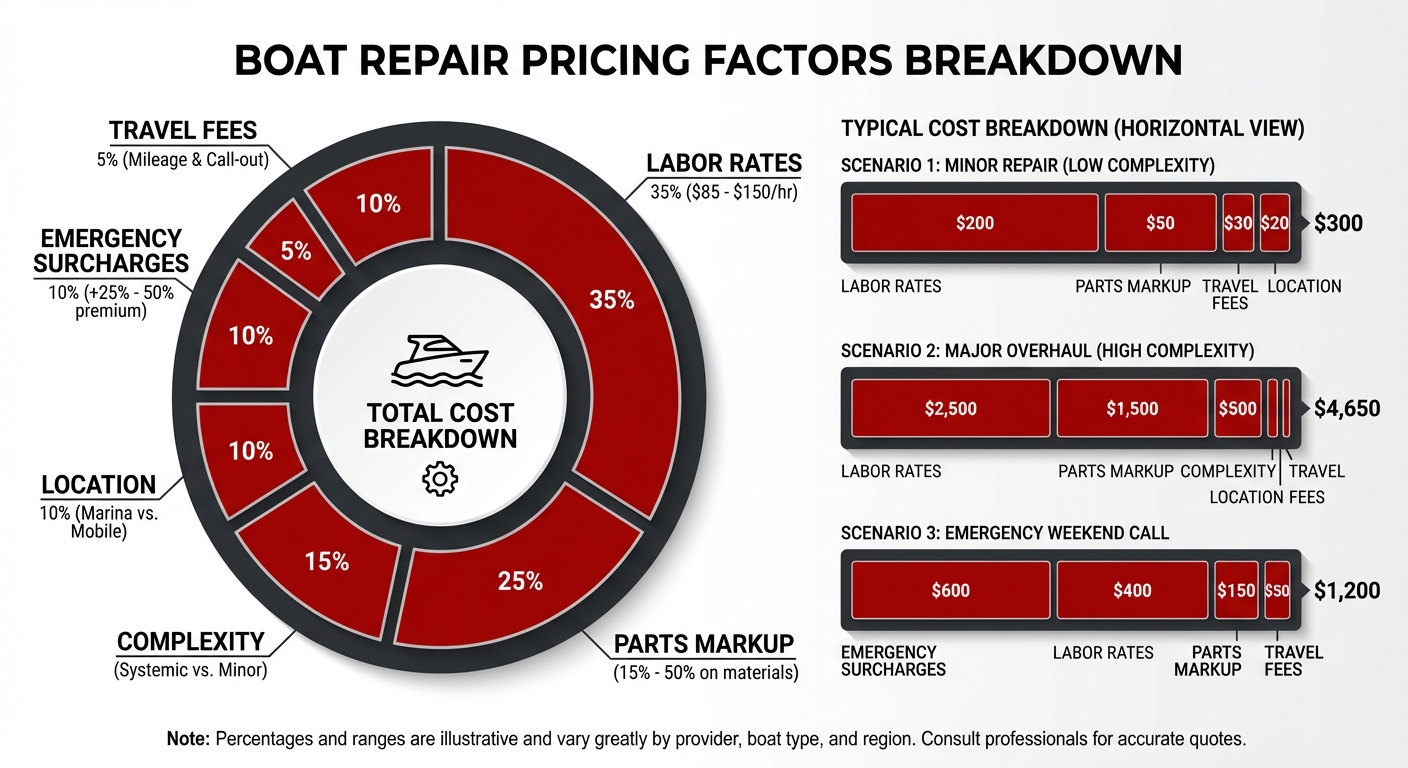
Labor rates range from $95 to $150 per hour across Florida, varying by region (urban areas higher than rural), shop facilities (yacht service centers charge more than general marine shops), and specialization (diesel specialists and electronics experts command premium rates). Mobile service typically runs $10-20 more per hour than shop-based to account for travel time. Understanding mobile mechanic pricing helps you budget appropriately.
Travel fees for mobile mechanics typically range from $50 to $150 depending on distance from their base location. Within 20 miles might incur no travel fee or minimal charge; remote locations in the Keys, Everglades, or Panhandle can add substantial travel costs. Emergency service outside normal hours costs more so expect 1.5x to 2x standard rates for after-hours or weekend emergency calls.
Parts markup is standard industry practice. Marine shops typically mark up parts 15-30% over retail cost to cover ordering, stocking, warranty handling, and profit margin. OEM (original equipment manufacturer) parts cost more than aftermarket alternatives but guarantee proper fit and function. Yamaha factory parts cost more than generic equivalents, but serious mechanics prefer OEM parts for critical engine components.
Diagnostic fees range from $150 to $250 and cover the time spent identifying problems. Many shops apply diagnostic fees toward repair costs if you approve the work. However, diagnostic fees are non-refundable if you decline repairs or take your boat elsewhere. Some mobile mechanics include limited diagnostics in the service call fee but charge separately for extensive troubleshooting.
Complexity and time drive total costs more than anything else. Replacing a starter motor might take 30 minutes on one boat but three hours on another due to access challenges. Tracing an intermittent electrical short could take 15 minutes or five hours depending on how elusive the problem is. Always ask for estimates based on expected time rather than flat rates. Unexpected complications almost always happen, especially on older boats.
Typical price ranges for common repairs in Florida (2025):
- Diagnostic service: $150-250
- Oil change (single outboard): $150-300
- Water pump impeller replacement: $200-400
- Lower unit service (gear oil change): $150-300
- Fuel pump replacement: $400-800
- Starter motor replacement: $350-700
- Complete 100-hour boat motor service (single outboard): $450-750
- Battery replacement: $150-400 (depending on battery type)
- Fuel system cleaning: $300-600
- Cooling system service: $250-500
- Major powerhead work: $3,000-8,000+
Get written estimates before authorizing expensive work. Reputable mechanics provide detailed estimates listing parts, labor hours, and total expected cost. Be wary of mechanics who refuse written estimates or pressure you to authorize work immediately without proper explanation of the problem and repair plan. Ask about warranty on parts and labor. Quality shops guarantee their work for 30-90 days. Finally, remember that choosing the cheapest option often costs more in the long run. A properly certified mechanic who charges $140/hour but fixes it right the first time beats an uncertified mechanic at $95/hour who misdiagnoses and makes you pay twice. In major boating centers like Tampa, Fort Myers, West Palm Beach, and Jacksonville, you'll find both highly qualified certified mechanics and cheaper uncertified options—choose based on expertise, not just price.
Boat Repair Services by Vessel Type: Center Consoles to Yachts
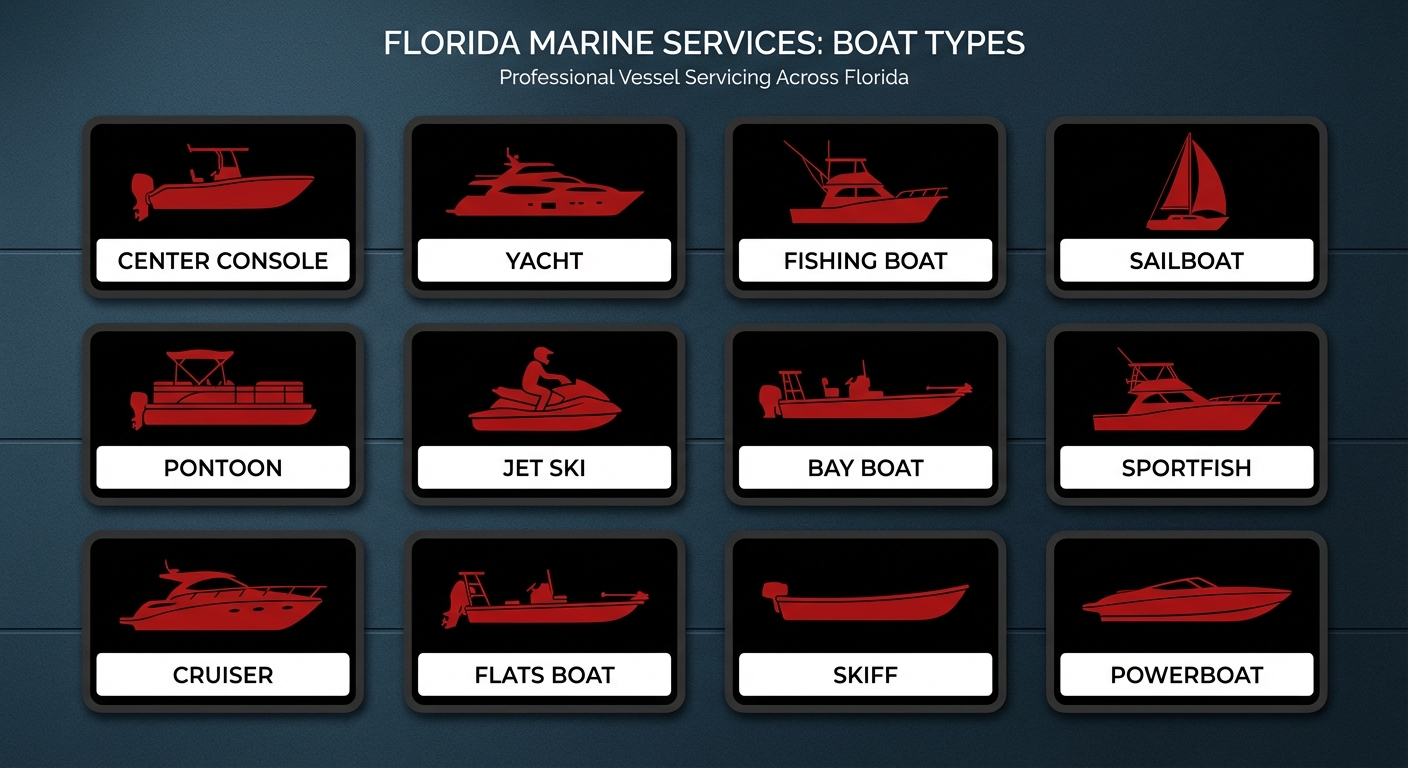
Different boat types have unique repair needs driven by their construction, systems, and usage patterns. Understanding vessel-specific considerations helps you seek appropriate specialists in Florida and recognize which repairs are standard versus unusual for your boat type.
Center Console Fishing Boats
Center consoles dominate Florida's recreational fishing market—from 17-foot Clearwater bay boats to 30-foot Stuart tournament rigs to 40-foot Miami offshore monsters. Common repairs include outboard motor service (the vast majority run outboards, either single or twins), T-top and hardtop maintenance including LED light failures and canvas tears, livewell and baitwell system problems from pump failures or plumbing leaks, electrical issues from constant use of fishfinders and electronics, and gelcoat damage from sun exposure and dock contact. Most center console repairs can be completed with mobile service since the boats are relatively simple mechanically and the outboards are accessible. The biggest maintenance focus is saltwater exposure. Rinse everything thoroughly after every use.
Yachts and Cruisers
Vessels over 35 feet typically have complex systems beyond basic propulsion. Generator service and repair becomes essential since many systems require AC power. Air conditioning, battery chargers, refrigeration, and entertainment systems depend on functional generators. HVAC systems need regular maintenance including cleaning coils, replacing filters, and checking refrigerant charge. Watermaker maintenance keeps freshwater production reliable on extended cruises. Complex electrical systems include large battery banks, inverters, shore power management, and sophisticated monitoring systems. Teak and cosmetic maintenance requires specialized knowledge of proper teak treatments, varnish work, and yacht-quality finish standards. Yacht owners in Fort Lauderdale, West Palm Beach, Naples, and other yacht centers often need mobile specialist teams or dedicated yacht service facilities rather than general marine mechanics. Don't expect a mechanic who primarily works on 25-foot center consoles to properly service a 60-foot yacht's integrated systems.
Fishing Boats and Sportfish Boats
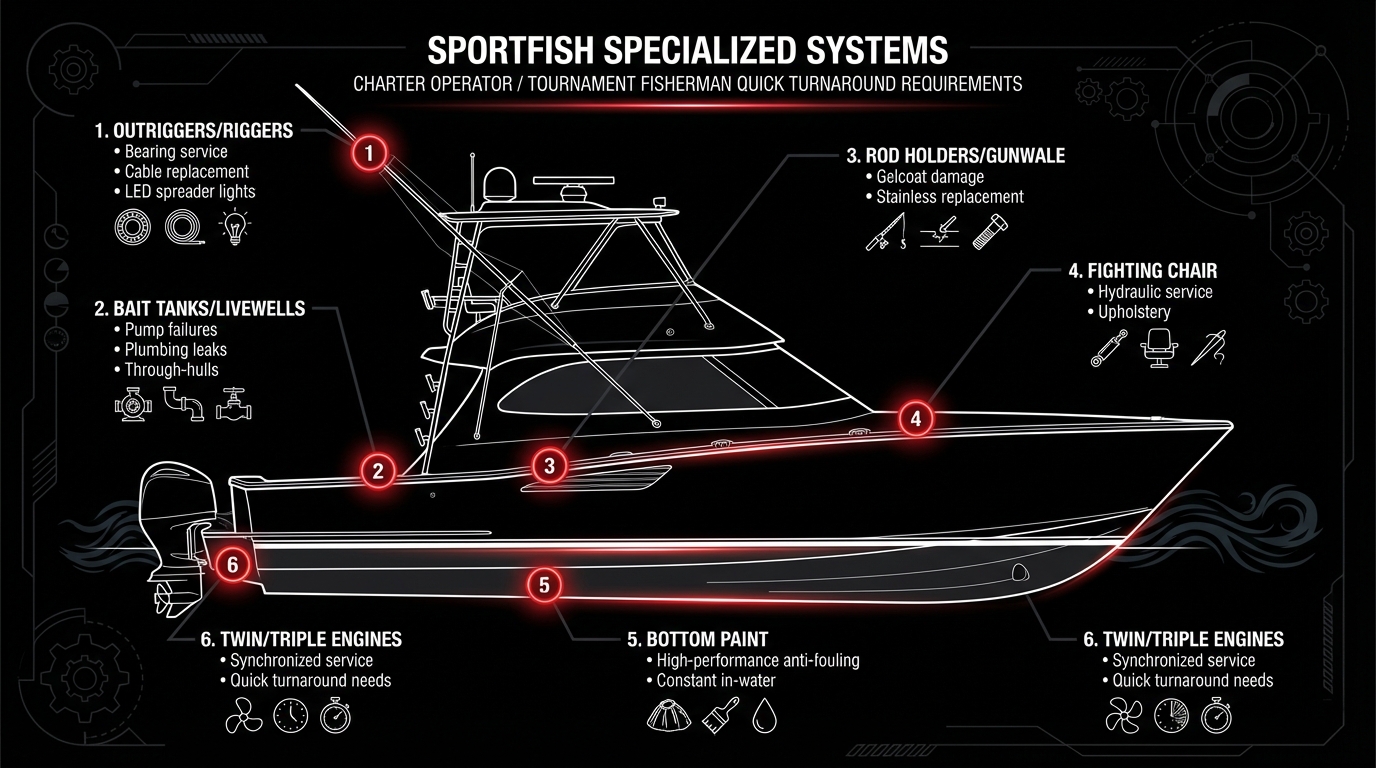
Dedicated fishing boats, particularly offshore sportfish boats from 30 to 65 feet, endure heavy use and require specialized repairs beyond basic engine service. Outrigger and rigger systems need bearing service, cable replacement, and electrical work for LED spreader lights. Bait tanks and livewell systems run constantly during fishing and develop pump failures, plumbing leaks, and through-hull fitting issues. Rod holders and gunwale damage from heavy rods and thrashing fish require gelcoat repair and stainless steel component replacement. Fighting chairs need hydraulic service and upholstery work. Bottom painting with high-performance antifouling paint is essential since sportfish spend significant time in the water. These boats often need quick turnarounds between trips. Charter operators and tournament fishermen can't afford extended downtime, making responsive service critical.
Sailboats
Sailboats have unique systems that most powerboat mechanics don't understand. Rigging inspection and replacement involves checking stays, shrouds, turnbuckles, and chainplates for corrosion and fatigue. Rig failure at sea is dangerous and expensive. Mast and boom maintenance includes electrical work for lights and instruments, fitting service for sheets and halyards, and structural integrity inspection. Sail repair and service from tears, UV damage, and blown seams requires specialized sail loft work. Auxiliary diesel engines need the same service as powerboat diesels but are often harder to access in cramped engine spaces. Through-hull fittings are more numerous on sailboats (cockpit drains, head discharge, engine cooling water intake) and require regular inspection. Seek marine mechanics with sailboat experience rather than assuming powerboat mechanics can handle sailboat systems.
Pontoon Boats
Pontoon boats use different construction than fiberglass boats, creating unique repair needs. Pontoon tube integrity rarely fails but leaks are serious when they occur. Repairing pontoon tubes requires specialized welding and pressure testing. Deck flooring often uses plywood-based construction that can rot from water intrusion around fittings or from improperly sealed seams. Outboard engines on pontoons are typically smaller (25-150 HP) and simpler than high-performance outboards on center consoles, making service straightforward. Canvas and Bimini tops are essential on pontoons for sun protection and suffer damage from wind and UV exposure more than most boats. Pontoon boats are relatively simple mechanically, and most repairs stay inexpensive compared to more complex vessels.
Personal Watercraft (Jet Skis)
PWC repair differs significantly from boat repair. Jet pump service replaces propeller work because PWCs use impellers inside pump housings to create thrust. Pump damage from sand or debris requires disassembly, inspection, and sometimes impeller replacement. Closed-loop cooling systems recirculate coolant through heat exchangers rather than using direct raw water cooling, requiring different service procedures. High-revving engines need more frequent maintenance than boat engines like oil changes, spark plugs, and wear items deteriorate faster at sustained high RPM. Hull wear from beaching on sand requires gelcoat repair more frequently than boats. Most automotive or general marine mechanics don't have PWC-specific knowledge. Look for shops specializing in personal watercraft for proper service.
Whether you're running center consoles through the Keys, fishing sportfish boats out of Palm Beach, cruising yachts along the Gulf Coast, or exploring shallow water on a pontoon boat in inland lakes, qualified marine mechanics service all vessel types throughout Florida's diverse waterways from Jacksonville to Key West.
Boat Repair Service Coverage Across Florida
Marine mechanics and boat repair services operate throughout Florida, from Pensacola's Gulf Coast down to Key West. Whether your boat is at a marina, your dock, on a trailer in your driveway, or anchored at your favorite sandbar, you can find qualified technicians in your area. Mobile mechanics will come to you, or you can use shop-based facilities—both options exist in every major Florida city and most coastal communities where people actually keep boats.
- Aventura
- Bal Harbour
- Big Pine Key
- Boca Raton
- Bonita Springs
- Boynton Beach
- Bradenton
- Brandon
- Cape Coral
- Captiva Island
- Clearwater
- Clearwater Beach
- Clermont
- Cocoa Beach
- Coconut Grove
- Coral Gables
- Daytona Beach
- Deerfield Beach
- Delray Beach
- Destin
- Dunedin
- Englewood
- Fernandina Beach
- Florida City
- Fort Lauderdale
- Fort Myers
- Fort Myers Beach
- Fort Pierce
- Fort Walton Beach
- Gainesville
- Hallandale Beach
- Hollywood
- Homestead
- Islamorada
- Jacksonville
- Jacksonville Beach
- Jensen Beach
- Jupiter
- Kendall
- Key Biscayne
- Key Largo
- Key West
- Kissimmee
- Lake Worth
- Largo
- Leesburg
- Lighthouse Point
- Longboat Key
- Marco Island
- Marathon
- Melbourne
- Miami
- Miami Beach
- Naples
- Navarre
- New Smyrna Beach
- Niceville
- North Miami Beach
- Orange Park
- Orlando
- Palatka
- Palm Bay
- Palm Beach
- Palm Beach Gardens
- Panama City
- Panama City Beach
- Pensacola
- Plant City
- Pompano Beach
- Ponte Vedra Beach
- Port Charlotte
- Port Orange
- Port St. Lucie
- Punta Gorda
- Riviera Beach
- Safety Harbor
- Sanford
- Sanibel Island
- Sarasota
- Sebastian
- Siesta Key
- St. Augustine
- St. Petersburg
- Stuart
- Sunny Isles Beach
- Surfside
- Tallahassee
- Tampa
- Tarpon Springs
- Titusville
- Venice
- Vero Beach
- West Palm Beach
- Winter Park
No matter where you keep your boat in Florida—Panhandle marinas, Tampa Bay, the Keys, or anywhere in between—you can find certified marine mechanics who know how to properly diagnose and repair your specific engine and systems. The trick is finding mechanics with the right manufacturer certifications and experience for your boat, not just picking the closest shop.
Frequently Asked Questions About Boat Repair Services in Florida
How much does boat motor repair usually cost in Florida?
Boat motor repair costs range from $200 for simple fixes like impeller replacement or fuel filter changes to over $5,000 for major work like powerhead rebuilds or lower unit overhauls. Most common repairs fall in the $300-800 range.
Here's what affects your final cost:
- Parts prices vary between brands and OEM versus aftermarket options
- Labor time depends on problem complexity and boat access
- Mobile service costs $10-20 more per hour than shop-based but saves towing fees
- Engine brand matters since some manufacturers have more expensive parts
- Emergency calls for same-day service usually cost 1.5x to 2x standard rates
Outboard repairs often cost less than equivalent inboard work due to better accessibility. Always request written estimates before authorizing major repairs. Many marine mechanics offer free diagnostics with repair or charge $150-250 for standalone diagnostics that apply toward repair costs if you approve the work.
The cheapest quote doesn't always save money. Improperly diagnosed or incorrectly repaired problems cost more when you fix them twice. When searching for a boat motor mechanic near me, prioritize certification and experience over the lowest hourly rate.
Can mobile boat mechanics fix most issues, or will I need to go to a shop?
Mobile mechanics can handle about 70-80% of common boat repairs:
- Engine diagnostics with manufacturer-specific scan tools
- Fuel system repairs including pump replacement and injector cleaning
- Electrical system troubleshooting and wiring repairs
- Cooling system service including water pump impellers and thermostats
- Starter and alternator replacement
- Lower unit service and seal replacement
- Minor fiberglass and gelcoat repairs
- All routine maintenance like oil changes and filter replacement
Shop-based facilities are necessary for:
- Major engine removal and internal overhaul work
- Transom or stringer structural replacement
- Major fiberglass repairs requiring controlled temperature and humidity for proper curing
- Bottom painting which requires hauling the boat out of water
- Transmission rebuilds on inboard-powered vessels
- Multi-day complex repairs requiring specialized shop equipment
Most boat owners build a relationship with a mobile mechanic for routine service and moderate repairs, then accept referrals to shop facilities when diagnosis reveals work exceeding mobile capabilities. Mobile service offers faster response times and eliminates trailering costs, making it ideal for everything from emergency breakdowns to seasonal maintenance.
The key is finding a mobile mechanic who honestly tells you when shop-based service is the better choice rather than attempting repairs beyond their capabilities.
Do I need manufacturer-certified mechanics for my Mercury, Yamaha, or Suzuki outboard?
You should get manufacturer-certified mechanics for modern outboards, especially those built after 2000 with electronic fuel injection and computer controls. Certified mechanics attended factory training courses, passed certification exams, maintain access to proprietary diagnostic software that generic tools can't replicate, receive technical service bulletins about known issues and proper repair procedures, and have direct factory support for complex problems.
Modern outboards use sophisticated electronic control systems that manage fuel injection, ignition timing, engine protection systems, and integration with digital throttle controls and displays. Proper diagnosis requires manufacturer-specific software to read detailed fault codes, view real-time data streams, and sometimes reprogram control modules. Uncertified mechanics often guess at problems or replace parts hoping to fix issues they can't properly diagnose. Warranty repairs must be performed by factory-certified technicians or you risk voiding coverage.
For older carbureted outboards built before 2000, certification matters less since these engines use simpler mechanical systems that experienced mechanics can service without specialized tools. However, for modern EFI outboards, certification is essential for accurate diagnosis and reliable repairs. When interviewing mechanics, ask about their manufacturer certifications and training. It's not rude, it's smart boat ownership.
How often should I have my boat serviced in Florida's saltwater environment?
Florida's year-round boating and saltwater accelerate wear. You need more frequent service than freshwater boats in seasonal-use states.
Here are your service intervals:
- 100-hour or annual service (whichever comes first) - oil and filter changes, impeller inspection or replacement, spark plugs, fuel filters, gear oil service, zinc inspection, and systems checks
- After every single use - flush engines with freshwater (both outboards and inboard cooling systems) to remove salt deposits
- Monthly inspections if your boat stays in the water full-time - check zincs (sacrificial anodes deplete faster in saltwater), look for corrosion on electrical connections and engine components, test bilge pumps
- Every 300 hours or two years - deeper maintenance including spark plug replacement, fuel system cleaning, compression testing, detailed inspection of cooling passages and exhaust systems
- Before and after hurricane season (June through November) - preparation and damage assessment including securing the boat or hauling for storage, checking dock lines, post-storm inspection
- Before extended trips or tournaments - complete inspection, fluid checks, systems testing
Florida's constant saltwater exposure accelerates corrosion. Zinc depletion happens three to four times faster than freshwater, cooling systems scale more aggressively, and electrical connections corrode rapidly in salt air.
The single most important habit? Rinse everything with freshwater after every use. This 15-minute practice prevents more corrosion than any other maintenance task and costs nothing beyond water and time.
What's the difference between two-stroke and four-stroke outboard repair?
Two-stroke and four-stroke outboards have completely different designs that affect maintenance requirements and repair approaches.
Four-stroke outboards use the same basic design as car engines with separate oil systems, valve trains (camshafts, rocker arms, valve springs), and four distinct piston cycles (intake, compression, power, exhaust). They require regular oil and filter changes, valve adjustments on some models, timing chain or belt maintenance, and develop oil leaks from valve cover gaskets and crankshaft seals. However, four-strokes generally prove more reliable long-term with fewer catastrophic failures.
Two-stroke outboards mix oil with fuel (either through premix or oil injection systems), have simpler construction without valve trains, and complete their power cycle in two piston strokes instead of four. They require power valve cleaning and adjustment (on models equipped with power valves), oil injection system maintenance (failure causes catastrophic engine seizure), and more frequent spark plug replacement since oil residue fouls plugs faster. Two-strokes have fewer parts to fail but run at higher stress levels, making catastrophic failure more common when problems develop.
Repair costs? About the same. Labor time? Four-stroke internal work takes longer due to more complex disassembly. Fuel economy and emissions favor four-strokes. EPA emissions standards pushed the marine industry toward four-strokes, making them standard on nearly all boats built after 2005. If you own an older two-stroke, find a mechanic experienced with them since many younger technicians trained exclusively on four-strokes.
When should I repair my boat engine versus replace it entirely?
Don't make this decision emotionally. Evaluate these factors honestly:
Repair makes financial sense when:
- Your engine has under 1,500 operating hours and shows good compression and minimal wear
- The problem is an isolated component failure (fuel pump, starter) rather than multiple failing systems
- Parts remain readily available without long lead times or high costs
- Estimated repair cost stays below 40% of replacement value
- You've maintained it properly with regular service and documentation
- No other major systems show imminent failure
Replacement makes more sense when:
- You've exceeded 2,000 operating hours with multiple systems showing wear
- You've suffered catastrophic internal damage (seized powerhead, cracked cylinder head, major lower unit failure)
- Your engine is obsolete with limited parts availability
- Repair estimates approach or exceed 50% of replacement cost
- You want upgraded features (more horsepower, better fuel economy, modern controls, warranty coverage)
Here's the math: A $1,200 lower unit rebuild on a well-maintained 800-hour Yamaha F250 makes perfect sense when replacement costs $22,000. However, a 2,500-hour two-stroke Evinrude needing $4,000 powerhead rebuild, $2,500 lower unit overhaul, and $1,500 in wiring repairs totals $8,000 invested in an old engine approaching end of life. That same $8,000 could be a large down payment on a modern four-stroke with warranty that'll run trouble-free for 2,000 hours.
Get multiple opinions before expensive repairs. Ask mechanics to explain their recommendation, not just quote prices. Factor in your boat's value and ownership plans when deciding.
Can boat repair be done at my dock or do I need to trailer my boat?
Many repairs work fine at your dock with mobile service:
- Engine diagnostics using scan tools and manufacturer software
- Fuel system repairs including pump and filter replacement
- Electrical system troubleshooting and wiring repairs
- Cooling system service including impeller and thermostat replacement
- Starter motors and alternator service
- Lower unit gear oil service and seal replacement
- Battery testing and replacement
- Minor fiberglass and gelcoat repairs
- Rigging work and electronics installation
- All routine maintenance
Why mobile service wins: eliminates towing or trailering costs (often $200-500), avoids scheduling delays at shops (mobile mechanics often respond within 24-48 hours), keeps your boat in the water and immediately usable after repairs, and lets you watch the work and ask questions.
Shop facilities are required for:
- Major internal engine work requiring removal from the boat
- Structural fiberglass repairs needing controlled temperature and humidity for resin curing
- Bottom painting which requires hauling out and blocking the boat
- Transmission rebuilds on inboard-powered boats
- Major electrical rewiring requiring easier access than dockside provides
- Multi-day repairs where securing tools and parts at a dock creates security concerns
Weather matters. Heavy rain, extreme heat, or rough water conditions can delay outdoor dockside repairs.
The smart approach: use mobile mechanics for routine maintenance, diagnostics, and moderate repairs that save you trailering costs and downtime. If diagnosis reveals work exceeding dockside capabilities, accept their referral to shop facilities while maintaining them as your primary service provider for everything that can be done on-site.
What should I look for when choosing a boat mechanic near me?
Don't choose based on proximity and price alone. Evaluate these factors:
- Manufacturer certifications appropriate to your engine brand (Mercury Certified for Mercury outboards, Yamaha Certified for Yamaha, ABYC certification for systems knowledge). Ask directly about certifications and training rather than assuming.
- Experience with your specific boat type matters. A mechanic who primarily services 25-foot center consoles may lack the systems knowledge for 50-foot yachts. Diesel specialists may not understand outboard-specific issues.
- Insurance and licensing protect you from liability and indicate professional legitimacy. Ask for proof of liability insurance and verify any claimed licenses.
- Online reviews provide insight but read critically. Look for patterns rather than individual complaints. Very cheap shops often have great reviews until something goes wrong.
- Proper diagnostic equipment including manufacturer-specific scan tools and software is essential for modern engines. Generic tools can't properly diagnose fuel injection and computer-controlled systems.
- Clear communication matters. Good mechanics explain problems clearly without condescending language, provide written estimates before starting work, and don't pressure you to authorize repairs immediately.
- Parts sourcing policies (OEM versus aftermarket), warranty coverage on parts and labor (reputable shops guarantee work for 30-90 days), whether they subcontract work or perform it in-house.
- Availability and responsiveness indicate how they'll treat you when you need service. Mechanics who don't return calls promptly during the sales process won't improve after they have your money.
A properly certified, experienced mechanic charging $140/hour who correctly diagnoses and repairs your problem costs less in the long run than an uncertified mechanic at $95/hour who misdiagnoses, replaces unnecessary parts, and forces you to seek a second opinion and pay twice.
Ask fellow boaters at your marina for recommendations. Personal referrals from people who've used a mechanic multiple times provide more reliable information than online advertising or lowest quotes.
Are emergency boat repairs more expensive than scheduled service?
Yes. Emergency service costs 1.5 to 2 times standard rates.
Here's why the premium is justified:
- Mechanics immediately drop other scheduled work to respond to your urgent need
- After-hours and weekend work deserves compensation when they could be home with family
- Rush parts ordering through overnight delivery adds high shipping charges
- Travel to remote locations (sandbars, anchorages, offshore tow-in) involves more time and risk
Emergency service often saves money overall by preventing expensive secondary damage. Continuing to run an overheating engine destroys cylinder heads and gaskets, turning a $400 cooling system repair into a $4,000 engine teardown. Emergency service gets you back on the water for time-sensitive commitments like tournaments, charters, or family gatherings when canceling would cost more than the service premium.
Many mobile mechanics offer emergency response with explicit surcharges. You might pay $475 for emergency service where the same repair during business hours costs $300. That tournament fisherman whose port engine threw an alarm at 5:30 AM gladly paid the emergency premium to make his 7:00 AM start and ultimately win $12,000 in prize money.
Define "emergency" honestly when you call. A broken engine the morning of a prepaid offshore charter or tournament represents a true emergency worth premium pricing. A trim tab that quit? That can wait for normal scheduling. Most mobile mechanics appreciate honest communication about urgency.
Do boat repair shops in Florida specialize in certain brands or types of boats?
Yes. Many shops specialize instead of servicing everything. This matters when choosing a shop.
Common specializations:
- Outboard specialists often focus on particular brands. Some shops concentrate exclusively on Mercury products, Yamaha dealerships primarily service Yamaha engines, or multi-brand independents maintain certifications across several manufacturers.
- Diesel mechanics specialize in yacht and sportfish inboard diesels including Caterpillar, Cummins, Volvo Penta, and Yanmar engines. Diesel repair requires different knowledge than gasoline engine work.
- Yacht service facilities handle complex systems beyond basic propulsion including generators, HVAC, watermakers, stabilizers, and sophisticated electrical systems that exceed typical marine mechanic expertise.
- Fiberglass specialists focus on gelcoat repair, structural fiberglass work, and cosmetic restoration requiring artistic color-matching skills and proper layup techniques.
- Electronics installers specialize in navigation equipment, fishfinders, radar, communication systems, and integrated helm displays rather than mechanical repairs.
- Rigging shops outfit fishing boats with outriggers, rod holders, electronics boxes, and specialized equipment for tournament and offshore fishing.
- General marine mechanics can handle routine maintenance and common repairs across various boats, but specialists become essential for complex or high-value work.
Manufacturer dealers like Mercury dealerships offer the most complete service for their brand including warranty work, complex diagnostics with factory support, and access to technical service bulletins, but they may cost more than independent shops.
Match their specialty to your needs. Don't take a Mercury outboard to a shop that specializes in Caterpillar diesel yachts. Don't expect a general mechanic who works on 20-foot bay boats to properly service a 60-foot sportfish with complex tuna towers and hydraulic outriggers. Ask about their experience with your specific boat type and engine brand before committing.
What repairs should never be DIY on a boat?
Some repairs are too dangerous for DIY. Leave these to professionals:
- Fuel system work beyond basic filter changes - creates fire and explosion hazards from gasoline vapors. Fuel line replacement, fuel pump installation, and tank work require proper venting, grounding, and safety procedures.
- Major electrical system work - rewiring, shore power connections, and battery bank installation risks fires from improper wire sizing, electrocution from incorrect shore power wiring, and sinking from failed bilge pump circuits.
- Structural fiberglass repairs beyond minor gelcoat scratches - require proper layup techniques, correct glass-to-resin ratios, and proper curing conditions. Amateur structural repairs create weak spots that fail catastrophically, potentially sinking your boat.
- Internal engine work - powerhead disassembly, valve jobs, and internal bearing replacement requires specialized tools, precise measurements, and experience. Mistakes destroy expensive engines.
- Lower unit rebuilds - involve bearing preload adjustment, gear shimming, and seal installation requiring special tools and knowledge. Improper assembly results in gear failure and total lower unit destruction.
- Through-hull fitting installation below the waterline - literally safety-critical work. A poorly installed fitting or failed sealant causes uncontrolled flooding that sinks boats. Fast.
- Propane system work - creates explosion hazards if connections leak or pressure regulators fail. Professional installation and testing is essential.
Safe DIY repairs include:
- Oil and filter changes
- Exterior washing and waxing
- Spark plug replacement on accessible engines
- Battery testing and terminal cleaning
- Visual inspections of hoses and belts
- Minor cosmetic gelcoat work above the waterline
The dividing line is simple: if the repair affects safety systems (fuel, electrical, hull integrity, propane), requires specialized tools you don't have, or could cause more damage if done wrong, hire a pro. Your boat represents what you've invested, and your safety on the water depends on critical systems functioning properly. DIY pride isn't worth risking your life when professional expertise costs a few hundred dollars.
Understanding boat repair services in Florida means recognizing the specialized knowledge required across engine types, electrical and hull systems, different vessel categories, and the various service delivery models available. Whether you need outboard motor diagnostics, inboard cooling system repairs, electrical troubleshooting, fiberglass restoration, or routine maintenance, qualified marine mechanics throughout Florida offer solutions ranging from convenient mobile service to complete shop-based facilities. The key to successful boat ownership lies in preventative maintenance to avoid expensive repairs, honest evaluation of whether mobile or shop-based service best fits each situation, and building relationships with certified mechanics who maintain your specific engine brands and boat systems properly.
Your Next Steps for Florida Boat Repair and Marine Service
You now understand boat repair services in Florida - from outboard motor repair to inboard engine maintenance, electrical troubleshooting to fiberglass restoration, mobile mechanics to shop-based facilities, pricing to certifications. Knowing your options matters. Taking action when your boat needs service determines whether problems stay small or become expensive failures.
Here's how to move forward when boat repair becomes necessary.
Before You Call for Boat Repair
Preparation helps mechanics diagnose faster. You'll save on diagnostic time and avoid unnecessary parts replacement.
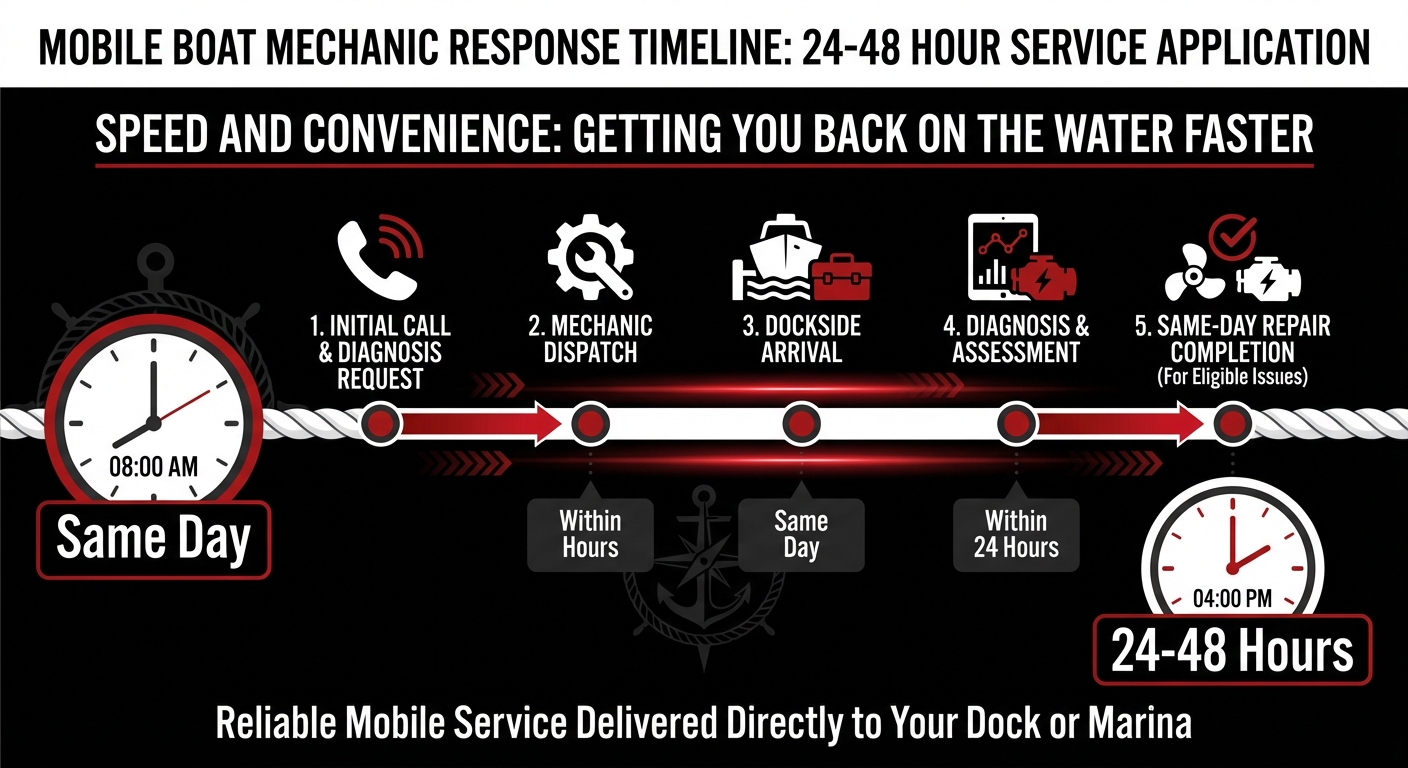
Gather this information before calling:
- Specific symptoms - when the problem started, what changed from normal operation, under what conditions it occurs
- Basic boat information - make, model, year, engine brand and specific model (Yamaha F250, Mercury 300 Verado, etc.), current engine hours if known
- Exact location - marina name and dock number, specific boat ramp name, or address if on a trailer at home (mobile mechanics need accurate location for scheduling and pricing)
- Error codes or warning lights - write down exactly what displays show (fault codes help mechanics diagnose electronically controlled engines faster)
Check obvious items before calling to eliminate simple causes:
- Battery connections tight and charged
- Fuel tank has adequate fuel (vapor locks happen when tanks run too low)
- Kill switch lanyard properly engaged
- Battery switches in the correct position
Five minutes of prep makes diagnosis efficient and shows you're a prepared owner, not someone who panics at the first sign of trouble.
Choosing Mobile vs. Shop-Based Service
Here's how to decide:
Finding a qualified boat mechanic near me for mobile service means considering:
- You need diagnostic work to identify the problem
- Your engine won't start and you're stuck at the dock or ramp
- You're experiencing overheating or performance loss that makes running the boat risky
- Electrical problems prevent safe operation
- You need routine maintenance like oil changes and service intervals
- Minor to moderate mechanical repairs that don't require major disassembly
- Emergency situations where time matters (tournament morning, charter scheduled, family trip planned)
Contact shop-based facilities when:
- Diagnosis reveals major internal engine work requiring removal
- Your boat needs structural fiberglass repairs or transom replacement
- You require haul-out service for bottom work or underwater repairs
- Multiple integrated systems need simultaneous overhaul
- The repair timeline spans multiple days requiring secure indoor storage
Not sure? Call a mobile mechanic first. They can diagnose on-site, handle repairs within their capabilities, and provide honest referrals to shop facilities when the problem exceeds mobile service scope.
Boat Repair Miami provides marine repair and service throughout Florida, bringing factory-certified knowledge directly to your dock, ramp, or marina. Our technicians are trained and certified on Mercury, Yamaha, Suzuki, Honda, and Evinrude engines with over 20 years of combined experience servicing everything from 19-foot center consoles to 60-foot yachts.
We specialize in mobile service that eliminates trailering costs, towing fees, and days of downtime while your boat sits at a shop waiting for attention. Our mobile technicians arrive with manufacturer diagnostic tools, common parts, and expertise to handle repairs other mobile mechanics won't touch - complex fuel injection diagnostics, electrical troubleshooting, emergency repairs that get you back fishing or cruising the same day. When repairs exceed mobile capabilities, we coordinate transportation and provide shop-based service at our facility for major overhauls, structural work, and projects requiring controlled environments.
Requesting Boat Repair or Service
Request boat repair service online or call 305-290-2701 to schedule mobile service or discuss shop-based repair for major work. Most mobile service calls can be scheduled within 24 to 48 hours depending on our current workload and your location. Emergency service is available for urgent situations including tournament morning breakdowns, charter boat failures, and safety-critical problems that prevent you from safely returning to dock. We provide service throughout South Florida including Miami-Dade, Broward, and Palm Beach counties, and travel statewide (all across the state of Florida) for complex repairs, yacht service, and situations requiring specialized experience.
Whether you're in Jacksonville maintaining a fishing boat, Tampa servicing a yacht before an extended cruise, Miami dealing with saltwater corrosion on your center console, Fort Myers preparing a pontoon boat, or Key Largo facing an emergency outboard failure before a Bahamas crossing, we provide expert marine repair when and where you need it. Keep our contact in your phone. When boat problems happen on the water or at the dock, you want a certified mechanic who comes to you, diagnoses accurately with proper manufacturer equipment, and repairs it right the first time.


.png)