



Marine plumbing isn't a place for shortcuts. The hose you choose determines whether your boat's systems run smoothly or fail when you need them most. Saltwater, UV exposure, vibration, and constant movement create conditions that destroy standard hoses in months. The wrong choice leads to leaks, contamination, or worse—flooding that can sink your investment. Right now, the only thing that matters is understanding which hose belongs where and why cutting corners will cost you more than the upgrade ever would.

We've spent years building systems at the intersection of marine operations and practical execution, so we've learned this lesson the hard way. Most boaters think any hose will work if it fits the connection. That assumption has sunk more boats than storms. The marine environment demands materials engineered for specific fluids, pressures, and conditions. Status quo thinking gets you standard hardware store hose. Merit-based thinking gets you systems that last a decade without failure.
The Environment Destroys Everything Eventually
Marine hoses face conditions that would obliterate household plumbing in weeks. Saltwater corrodes. UV rays degrade rubber and plastic. Engine vibration creates friction points that wear through reinforcement. Temperature swings from freezing nights to scorching days stress materials beyond their design limits. Every connection point becomes a potential failure zone when the boat rocks, flexes, and pounds through waves.
The hoses that survive aren't just tougher—they're engineered for this specific battlefield. Marine-grade materials resist permeation, meaning fluids and gases can't seep through the hose walls over time. They maintain flexibility in cold water and don't become brittle under UV bombardment. The difference between a marine hose and a hardware store knockoff isn't marketing—it's chemistry, construction, and certification that actually matters when you're twenty miles offshore.
- Saltwater exposure accelerates degradation in non-marine materials
- UV radiation breaks down standard rubber and PVC compounds within months
- Vibration creates microscopic cracks that expand into catastrophic failures
- Temperature cycling weakens hose walls and connection points
- Permeation allows fuel vapors and waste odors to escape through inferior materials
Freshwater Systems Demand Non-Toxic Materials
Your drinking water system requires hoses that won't poison you. Standard garden hoses leach chemicals, plasticizers, and heavy metals into water. They're designed for watering lawns, not delivering water you'll drink, cook with, or use to brush your teeth. Marine potable water hoses use FDA-approved materials that prevent taste transfer, odor contamination, and chemical leaching.
These hoses are typically white or blue for easy identification, but color alone doesn't guarantee safety. Look for explicit "drinking water safe" or "potable water" ratings. The construction usually involves reinforced PVC or polyethylene with smooth inner liners that resist bacterial growth. We've seen boats where owners used cheap clear vinyl tubing for freshwater lines. Within months, the water tasted like plastic and the hose interior grew biofilm that no amount of sanitizing could eliminate.
- FDA-approved materials prevent chemical leaching into drinking water
- Smooth inner liners resist bacterial colonization and biofilm formation
- Reinforcement layers maintain pressure without collapsing or kinking
- UV-resistant outer layers prevent degradation from sun exposure
- Proper sizing ensures adequate flow without pressure drops
Sanitation Hoses Fight a Losing Battle Against Odor
Waste system hoses face the most disgusting challenge on any boat. Standard hoses allow odor molecules to permeate through the hose walls, turning your cabin into a floating porta-potty. Marine sanitation hoses use specialized compounds and reinforcement layers that block odor transmission, but even the best hoses eventually lose this battle. The question isn't if they'll start smelling—it's when.
Quality sanitation hoses buy you years instead of months. Look for hoses specifically rated for marine sanitation with multiple barrier layers. The best options use proprietary rubber compounds with embedded odor-blocking technology. They're expensive—sometimes five times the cost of standard hose—but the alternative is replacing cheap hose annually while your boat smells like a sewer. We've watched boaters try to save money with automotive heater hose or standard reinforced vinyl. The smell starts within weeks and never leaves.
- Multiple barrier layers block odor molecule permeation
- Specialized rubber compounds resist chemical breakdown from waste and cleaners
- Smooth inner walls prevent waste buildup and clogging
- Heavy-duty reinforcement prevents collapse under vacuum conditions
- Proper installation with minimal bends reduces restriction and odor retention
Fuel Lines Are Where Cheap Kills
Fuel hoses represent the highest-stakes decision in marine plumbing. Use the wrong hose and you're creating a floating bomb. Gasoline and diesel permeate through non-rated hoses, filling your bilge with explosive vapors. Standard automotive fuel line doesn't meet marine standards because cars don't trap fuel vapors in enclosed spaces surrounded by ignition sources. Boats do.
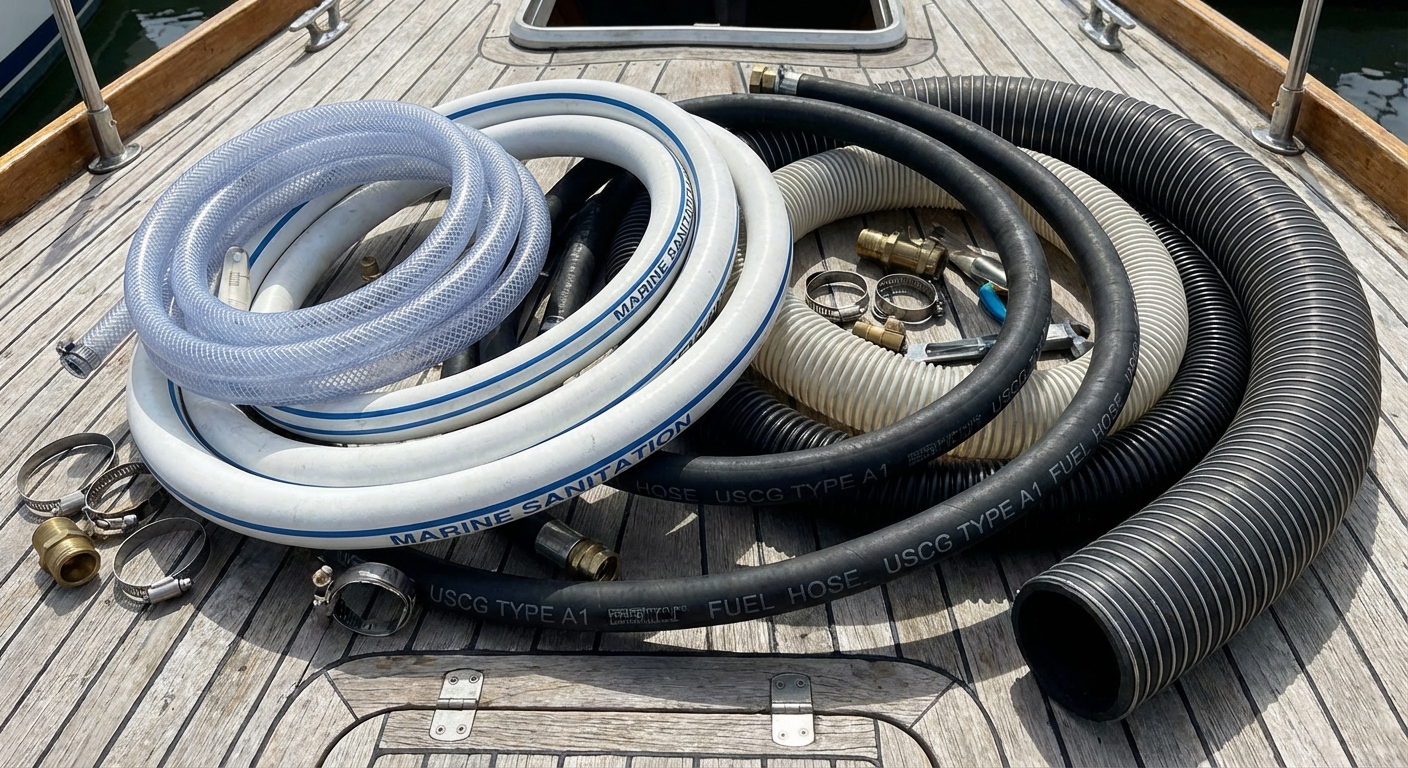
Marine fuel hoses must meet USCG certification standards that test for fire resistance, permeability, and durability under marine conditions. Type A1 and A2 hoses handle fuel fill and vent applications. Type B1 and B2 hoses serve fuel feed lines from tank to engine. The ratings aren't suggestions—they're requirements backed by decades of explosion investigations and safety engineering. We've seen the aftermath of boats that used automotive fuel line. The best-case scenario is discovering the problem during a boat inspection. The worst case makes the news.
- USCG Type A1 hoses resist fire and permeation for fuel fill applications
- Type B1 hoses provide lower permeation rates for pressurized fuel feed lines
- Fire-resistant construction prevents hose failure from becoming an accelerant
- Multiple reinforcement layers maintain integrity under pressure and vibration
- Proper certification markings must be visible and legible on the hose
Bilge and Livewell Systems Need Crush Resistance
Bilge pump hoses get stepped on, crushed under gear, and kinked around tight corners. They need to maintain flow when partially collapsed and spring back to shape when pressure releases. Livewell hoses face similar abuse while also handling continuous water flow and occasional debris. Standard vinyl tubing collapses and stays collapsed, killing flow and leaving your bilge pump useless when you need it most.
Corrugated polyethylene or reinforced PVC hoses resist crushing while maintaining flexibility for installation. The corrugated design allows the hose to bend without kinking while the rigid rings prevent collapse under external pressure. These hoses aren't glamorous, but they're the difference between a bilge pump that works in an emergency and one that fails because the hose is pinched flat under a cooler. We route these lines with protection in mind, securing them away from foot traffic and using proper support to prevent sagging that creates low spots where water sits.
- Corrugated construction resists crushing while maintaining flexibility
- Rigid reinforcement rings prevent collapse under external pressure
- Smooth inner bore maintains flow efficiency despite external corrugation
- UV-resistant materials prevent degradation in exposed installations
- Proper sizing ensures adequate flow for pump capacity
Exhaust Hoses Handle Extreme Temperatures
Marine exhaust systems combine hot gases with cooling water, creating temperature extremes that destroy standard hoses in hours. Exhaust hoses must withstand temperatures exceeding 250°F while also handling saltwater, vibration, and exhaust pressure. The failure mode is catastrophic—a blown exhaust hose floods your engine compartment with hot water and exhaust gases, potentially sinking the boat or asphyxiating the crew.
Quality exhaust hoses use heavy-duty rubber compounds with wire reinforcement that maintains shape under heat and pressure. They're rated for specific temperature ranges and must match your engine's exhaust system requirements. The hose must also resist ozone and UV degradation because exhaust systems often route through exposed areas. We've seen boats where owners replaced failed exhaust hoses with automotive radiator hose or standard marine water hose. Both failed within days because they weren't engineered for exhaust temperatures and pressures.
- Temperature ratings must exceed maximum exhaust system temperatures
- Wire reinforcement prevents collapse and maintains shape under heat
- Specialized rubber compounds resist degradation from heat and exhaust gases
- Proper diameter matching ensures adequate flow and prevents backpressure
- Double-clamping at connections prevents blowouts under pressure
Installation Quality Matters as Much as Hose Quality
The best hose in the world fails if installed incorrectly. Sharp bends create stress points that crack over time. Insufficient clamping allows connections to separate under pressure or vibration. Over-tightening crushes hose walls and creates leak paths. Under-tightening lets connections weep or blow off completely. Every connection point is a potential failure that requires proper technique and quality hardware.
We use stainless steel hose clamps exclusively—never spring clamps or wire ties. Each connection gets two clamps positioned to distribute clamping force evenly. Hoses are cut square with sharp tools to ensure clean mating surfaces. We avoid bends tighter than the hose's minimum bend radius and use proper support every 18 inches to prevent sagging. The installation takes longer than slapping hoses together with whatever clamps are in the junk drawer, but it's the difference between systems that last a decade and systems that fail in a season.
- Stainless steel clamps provide consistent clamping force without corrosion
- Double-clamping critical connections prevents separation under pressure
- Proper bend radius prevents kinking and premature failure
- Regular support intervals prevent sagging and stress concentration
- Clean, square cuts ensure proper sealing at connection points
Inspection Catches Problems Before They Become Disasters
Hoses don't fail without warning. They show signs of distress long before catastrophic failure. Soft spots indicate inner liner degradation. Surface cracking reveals UV damage. Bulging shows reinforcement failure. Discoloration marks chemical attack. Stiffness means the hose has lost flexibility and is approaching failure. Regular inspection catches these warning signs when replacement is convenient instead of urgent.
We inspect every hose connection and run during spring commissioning and again mid-season. The inspection takes thirty minutes and has prevented countless failures. We look for obvious damage, but also for subtle signs like slight weeping at connections or minor surface changes. Any questionable hose gets replaced immediately—the cost of a new hose is trivial compared to the cost of the failure it prevents. Most boaters never inspect hoses until something breaks. By then, they're dealing with flooding, contamination, or fire instead of a simple hose replacement.
- Soft spots indicate inner liner breakdown and imminent failure
- Surface cracking reveals UV damage and loss of structural integrity
- Bulging shows reinforcement failure and pressure containment loss
- Discoloration marks chemical attack or permeation issues
- Stiffness indicates material degradation and reduced flexibility
Certification Isn't Optional
Marine hose certifications exist because people died. USCG standards, ABYC guidelines, and ISO ratings are written in the blood of boaters who used the wrong materials. These certifications test hoses under conditions that simulate years of marine use—temperature cycling, pressure testing, permeation measurement, fire resistance, and durability assessment. Certified hoses have proven they can survive the marine environment. Uncertified hoses are experiments waiting to fail.
The certification markings are printed directly on the hose and include the standard met, the manufacturer, and the date of manufacture. If you can't read the markings, the hose is either too old or wasn't certified to begin with. We won't install hose without visible, legible certification markings. The few dollars saved buying uncertified hose isn't worth the risk of system failure or the liability of non-compliant installation. Insurance companies have denied claims because non-certified hoses caused failures. Surveyors flag uncertified hoses as deficiencies that kill sales. The certification isn't bureaucratic nonsense—it's proof the hose will do what you need it to do.
- USCG certification proves fire resistance and permeation standards compliance
- ABYC standards define proper materials and installation practices
- ISO ratings provide international standardization for marine hoses
- Visible markings allow verification of certification and manufacturing date
- Certified hoses meet insurance and survey requirements for vessel operation
The Meritocracy of Marine Systems
Marine plumbing is a pure meritocracy. The best materials win. The best installation practices win. The best maintenance habits win. There's no faking it—inferior hoses fail regardless of how much you paid for the boat or how experienced you claim to be. The ocean doesn't care about your credentials or your budget. It cares about whether your systems can handle the conditions you're operating in.
We've watched expensive yachts sink because owners cheaped out on hoses. We've seen budget boats run flawlessly for decades because owners installed proper materials and maintained them correctly. The difference isn't money—it's execution. Understanding which hose belongs in which application, installing it correctly, and inspecting it regularly separates boats that are reliable from boats from boats that are liabilities. The knowledge is available. The materials are accessible. The only question is whether you'll execute or make excuses when the system fails.
Marine plumbing rewards those who do it right and punishes those who don't. The punishment isn't immediate, which is why so many boaters get away with inferior installations for a season or two. But eventually, reality catches up. The cheap sanitation hose starts smelling. The automotive fuel line begins weeping vapors. The hardware store water hose taints your drinking water. The corrective action costs ten times what proper installation would have cost, plus the downtime, inconvenience, and potential danger the failure created. Merit compounds in marine systems just like everywhere else. The boats that run reliably year after year are the ones where someone executed correctly from the start and maintained that standard. There's no shortcut, no hack, no way to fake it. The hose either works or it doesn't, and the choice you make today determines which outcome you get tomorrow.
Let’s Keep Your Boat’s Plumbing Reliable
We know how much you rely on your boat, and we’re here to make sure every hose and connection is up to the challenge. If you want peace of mind on the water and systems that won’t let you down, let’s talk about your next upgrade or repair. Call us at 305-290-2701 or Request Boat Repair or Service—we’re ready to help you keep your boat running strong.


.png)