



Boat hinges fail faster than almost any other piece of hardware on your vessel. Most owners assume they've bought quality components, installed them correctly, and can move on. Then six months later, they're staring at orange streaks, frozen pins, and hatches that won't close. The reality? Marine environments don't care about your assumptions. They care about chemistry, exposure, and whether you're running the right materials in the right places.
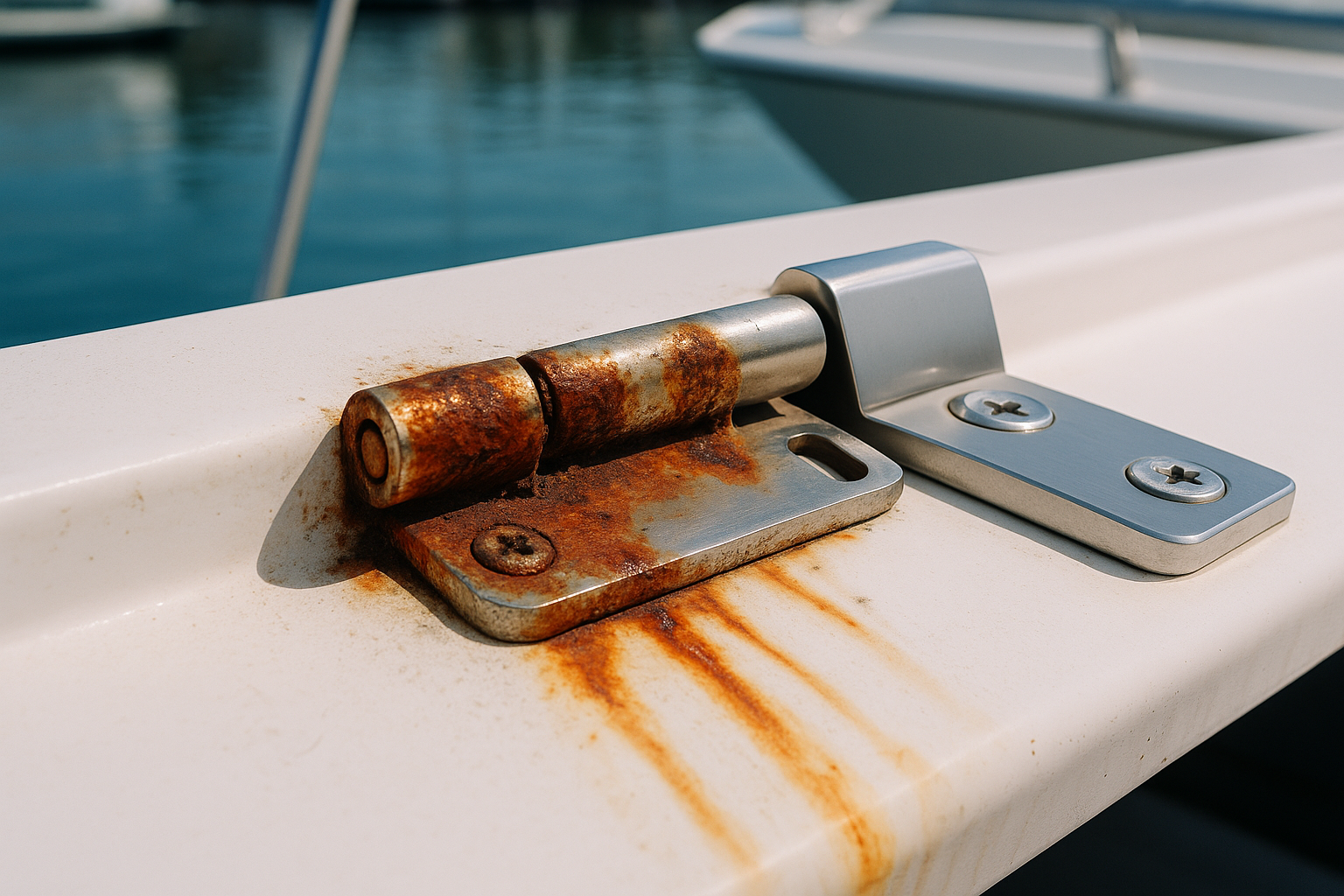
Rust isn't just cosmetic. It's structural failure in slow motion. A corroded hinge compromises access, creates safety hazards, and signals that other systems are probably degrading too. The difference between a hinge that lasts two seasons and one that lasts ten comes down to understanding why corrosion happens so aggressively and what actually holds up when the environment turns hostile.
Saltwater Doesn't Play Fair
Freshwater is forgiving. Saltwater is not. The sodium chloride in seawater acts as an electrolyte, accelerating the electrochemical reactions that cause rust. Even if you boat exclusively in freshwater, salt spray from nearby ocean air can travel miles inland and settle on every exposed surface. That mist you barely notice? It's coating your hardware with a corrosive film that never fully dries.
The problem compounds when water sits in crevices. Hinges have tight tolerances, gaps where the pin meets the barrel, and recessed screw holes that trap moisture. Once saltwater gets in, it stays. Evaporation concentrates the salt, making the remaining solution even more corrosive. This cycle repeats every time your boat gets wet, and most hinges aren't designed to handle that kind of sustained chemical assault.
Not All Stainless Steel Is Actually Stainless
Walk into any marine supply store and you'll see hinges labeled "stainless steel." That label means almost nothing without a grade designation. The most common marine hardware uses 304 stainless, which performs well in mild environments but fails quickly in saltwater. The chromium oxide layer that protects stainless steel breaks down when chlorides are present, and 304 doesn't have the alloying elements needed to rebuild that protection.
Grade 316 stainless contains molybdenum, which dramatically improves resistance to pitting and crevice corrosion. It costs more, but the difference in longevity is measurable. A 304 hinge might show surface rust within months. A 316 hinge can last years under identical conditions. The problem is that many manufacturers don't clearly mark the grade, and retailers often don't know the difference.. If the packaging doesn't explicitly say "316" or "marine grade," assume it's not.
Galvanic Corrosion Eats Hardware From the Inside
When dissimilar metals touch in the presence of an electrolyte, one corrodes faster than it would on its own. This is galvanic corrosion, and it's responsible for more hinge failures than most people realize. Stainless steel hinges mounted with zinc-plated screws? The screws will corrode first, but the reaction accelerates rust on the hinge too. Aluminum hatches with stainless hardware? The aluminum becomes the sacrificial anode, but the hinge still suffers.
The solution isn't just using better hinges. It's matching every component in the assembly. Fasteners, washers, backing plates, and the hinge itself should all be compatible metals. Isolation can help too—nylon washers or marine sealant can break the electrical connection between metals. But most installations skip these steps, and the result is predictable. The hinge looks fine on the surface while corrosion eats away at the mounting points and pin interfaces.
Sitting Still Makes It Worse
Boats that sit unused corrode faster than boats that run regularly. Movement distributes lubricants, shakes off standing water, and prevents corrosion from taking hold in one spot. A hinge that opens and closes frequently stays cleaner than one that's locked in position for months. Stagnant moisture is more corrosive than moving water because it concentrates contaminants and never gets flushed away.
This is why hinges on rarely-used hatches fail first. The anchor locker, the engine compartment access panel, the storage bins you only open twice a season—these are the spots where rust takes over. By the time you notice, the damage is done. The pin is seized, the barrel is pitted, and replacement is the only option. Regular operation isn't just good for engines and pumps. It's good for every moving part on the boat.
Maintenance Gets Skipped Because It's Boring
Nobody gets excited about rinsing hinges. It's not glamorous, it doesn't improve performance, and the consequences of skipping it aren't immediately obvious. So it gets pushed to the bottom of the maintenance list, then forgotten entirely. Meanwhile, salt crystals build up in every joint, moisture stays trapped under mounting flanges, and corrosion progresses unchecked.
The fix is simple but requires discipline. After every outing, especially in saltwater, rinse all hardware with fresh water. Not a quick spray—a thorough rinse that flushes out crevices and washes away salt deposits. Follow up with a light coating of corrosion inhibitor or marine-grade lubricant. This takes minutes. Replacing corroded hinges takes hours and costs significantly more. The math is obvious, but most people don't do the work until the damage forces their hand.
What Actually Needs to Be Replaced
Once rust appears, the clock is ticking. Surface corrosion can sometimes be cleaned and treated, but pitting and structural degradation mean the hinge is compromised. Trying to salvage a failing hinge is false economy. The labor to remove, clean, treat, and reinstall often exceeds the cost of a new component, and you're left with hardware that's already weakened.
Replacement should be comprehensive. Swapping the hinge but reusing corroded fasteners defeats the purpose. The new hinge will fail faster because the old screws are still introducing corrosion into the system. Every component in the assembly should be evaluated and replaced if there's any sign of degradation. This includes backing plates, washers, and any sealant that's dried out or compromised.
- Hinges showing visible rust, pitting, or discoloration need immediate replacement
- Fasteners that are corroded, stripped, or mismatched metals should be swapped for marine-grade equivalents
- Backing plates or mounting surfaces with corrosion need to be cleaned, treated, or replaced
- Sealant that's cracked, dried, or missing should be reapplied to prevent moisture intrusion
- Any hinge that's difficult to operate or makes noise is already failing internally
Material Choices That Actually Hold Up
Grade 316 stainless steel is the baseline for marine hinges. Anything less is a compromise that will cost you later. Some manufacturers offer 316L, which has lower carbon content and even better corrosion resistance in welded applications. For hinges, the difference is marginal, but it's a signal that the manufacturer understands marine environments.
Non-metallic hinges are gaining traction in applications where rust is unacceptable. High-strength polymers and composite materials are immune to corrosion, lighter than metal, and often less expensive. They're not suitable for every application—heavy hatches and high-load situations still require metal—but for lighter doors, access panels, and interior applications, they're worth considering. The tradeoff is durability under UV exposure and impact resistance, but in protected locations, they can outlast stainless steel.
- 316 stainless steel is the minimum acceptable grade for saltwater environments
- 316L offers marginal improvements in corrosion resistance and is worth the upgrade if available
- Composite and polymer hinges eliminate rust entirely but have load and UV limitations
- Titanium hinges are overkill for most applications but offer unmatched corrosion resistance
- Coated hinges (powder coat, anodizing) add a layer of protection but fail if the coating is scratched
Fasteners Matter as Much as the Hinge
A 316 stainless hinge mounted with zinc-plated screws will still fail. The screws corrode, the mounting loosens, and the hinge is compromised even though the hinge itself is fine. Fasteners need to match or exceed the corrosion resistance of the hinge. That means 316 stainless screws, bolts, and washers. It also means avoiding mixed metals wherever possible.
Thread-locking compounds and marine sealant serve double duty. They prevent fasteners from backing out due to vibration, and they seal out moisture that would otherwise accelerate corrosion. A dab of sealant on screw threads before installation can extend the life of the entire assembly by years. It's a small step that most installations skip, and the cost of that shortcut shows up later when you're drilling out seized screws.
Sealed and Lubricated Hinges Are Worth the Premium
Some hinges are designed with internal seals that keep moisture out of the pin and barrel interface. Others come pre-lubricated with corrosion inhibitors that last for years. These features add cost upfront but reduce maintenance and extend service life. In high-exposure areas—hatches on the bow, cockpit doors, anything that takes regular spray—the investment pays off.
The alternative is manual lubrication, which works if you're disciplined about it. A light coating of marine grease or corrosion inhibitor every few months keeps hinges moving freely and prevents moisture from settling in. The problem is that most people forget, and by the time they remember, the hinge is already stiff. Sealed hinges remove that variable. They're not maintenance-free, but they're far more forgiving of neglect.
Inspection Catches Problems Before They Cascade
Hinges don't fail suddenly. They degrade gradually, giving you plenty of warning if you're paying attention. Stiffness, noise, visible corrosion, loose mounting—all of these are early indicators that intervention is needed. Catching a problem at this stage means cleaning, lubrication, and maybe tightening fasteners. Ignoring it means full replacement and possibly damage to the surrounding structure.
A monthly walk-through of all hinges takes less than ten minutes. Open and close every hatch, door, and panel. Feel for resistance. Listen for squeaks or grinding. Look for rust, loose screws, or gaps in the sealant. This isn't complicated, but it's the difference between a minor fix and a major repair. Most people don't do it because it's not urgent. Then it becomes urgent, and the cost multiplies.
Prevention Is Cheaper Than Replacement Every Time
The best hinge is the one that never needs replacing. That means choosing the right materials from the start, installing them correctly, and maintaining them consistently. It means rinsing after every outing, lubricating regularly, and inspecting frequently. It means not cutting corners on fasteners or sealant because those corners cost more later.
Rust is inevitable in marine environments, but catastrophic failure isn't. The boats that run for decades without major hardware issues aren't lucky. They're maintained. The owners understand that prevention is a process, not an event. They don't wait for problems to announce themselves. They stay ahead of corrosion, and their boats reflect that discipline.
The Real Cost of Cheap Hardware
Budget hinges are expensive in the long run. A $15 hinge that lasts two seasons costs more than a $40 hinge that lasts ten. The math is straightforward, but the temptation to save money upfront is strong. The problem is that the true cost isn't just the replacement hinge. It's the labor to remove the old one, the damage to the mounting surface, the downtime while you wait for parts, and the frustration of dealing with a failure at the worst possible time.
Quality hardware is an investment in reliability. It's the difference between a boat that's always ready and one that's always in need of repair. The owners who understand this don't shop by price. They shop by performance, longevity, and total cost of ownership. They buy once, install correctly, and move on. Everyone else buys twice, three times, or more, and wonders why their maintenance costs keep climbing.
Related Issues with Boat Hardware
Hinge corrosion is just one of many hardware issues that can plague boat owners in saltwater environments. Problems like maintenance plan oversights, hidden saltwater damage, and pre-ride hardware checks are all part of keeping your vessel in top shape. Even seemingly minor issues like cracks around cleats or rub rail problems can signal deeper structural concerns if left unaddressed.
Execution Beats Intention on the Water
Knowing what to do doesn't matter if you don't do it. Every boat owner knows they should rinse hardware, inspect regularly, and use quality materials. Most don't. The gap between knowledge and action is where boats deteriorate. The difference between a well-maintained vessel and a neglected one isn't information. It's follow-through.
Hinges are a small detail in the larger picture of boat ownership, but they're a reliable indicator of how seriously someone takes maintenance. If the hinges are rusted, the rest of the boat probably isn't much better. If the hinges are clean, lubricated, and functioning smoothly, chances are the owner is on top of everything else too. Small things reveal big patterns. Execution compounds. The boats that last are the ones where the owner doesn't just know what to do—they actually do it.
Ready to Keep Your Boat in Top Shape?
We know that every detail matters when it comes to keeping your boat reliable and ready for the next run. If you want your hardware to last and your boat to stay trouble-free, let’s make it happen together. Call us at 305-290-2711 or Request Boat Repair or Service—we’re here to help you stay ahead of corrosion and keep your time on the water smooth.


.png)