



Hull resonance isn't just annoying—it's a signal that something in your boat's system is out of sync. That persistent hum or vibration you feel underfoot happens when frequencies align in ways they shouldn't. The engine, propeller, and hull structure all generate their own vibrations, and when these frequencies match the natural resonance of your hull, amplification occurs. What starts as a minor buzz can escalate into a full-body rattle that makes every trip uncomfortable.
The physics behind it are straightforward. Every material has a natural frequency at which it wants to vibrate. When external forces—like engine RPMs or propeller rotation—hit that sweet spot, the hull responds by vibrating more intensely. It's the same principle that lets a singer shatter a wine glass or causes a bridge to sway when soldiers march in step. On a boat, this means noise, discomfort, and in extreme cases, accelerated wear on components that weren't designed to handle constant shaking.
The Engine and Prop Are Usually the Culprits
Most hull resonance traces back to the propulsion system. Your engine operates within a specific RPM range, and at certain points in that range, it generates vibrations that sync perfectly with your hull's natural frequency. This isn't a flaw in the engine itself—it's just how mechanical systems work. The problem emerges when those vibrations transfer through inadequate mounts or worn components directly into the hull structure.
Propellers add another layer of complexity. As they spin, they create pressure differentials in the water. When a blade passes through disturbed water or operates at the wrong pitch, cavitation occurs—tiny bubbles form and collapse rapidly, sending shockwaves through the drivetrain and into the hull. An unbalanced or damaged prop amplifies this effect. Even a small nick or bent blade can throw the entire system out of equilibrium, turning what should be smooth propulsion into a source of constant vibration.
Hull Design and Material Matter More Than You Think
Not all hulls are created equal when it comes to resonance. Fiberglass hulls, while popular and versatile, can act like giant speakers when vibrations hit the right frequency. The material's stiffness and thickness determine how it responds to external forces. Thinner sections of the hull—like the transom or areas around through-hulls—are particularly vulnerable because they flex more easily under stress.
Aluminum hulls face different challenges. Metal conducts vibrations more efficiently than fiberglass, which means resonance can travel farther and affect more of the boat. The upside is that aluminum's rigidity can sometimes work in your favor, depending on how the hull is constructed and reinforced. Wooden hulls, increasingly rare but still beloved by traditionalists, have their own acoustic properties. Wood naturally dampens some frequencies but can develop resonance issues as joints loosen or planks age.
Hull shape plays a role too. Deep-V hulls cut through water differently than flat-bottomed designs, and this affects how impact forces transfer into the structure. A hull that pounds through waves will experience different resonance patterns than one that glides smoothly. The placement of stringers, bulkheads, and other internal supports either reinforces the hull against vibration or creates weak points where resonance can build.
Speed and Water Conditions Change Everything
Resonance isn't constant—it shifts with your operating conditions. At displacement speeds, your hull moves through the water in a relatively stable manner, and vibrations tend to be minimal. Push into the transition zone where the boat starts to climb onto plane, and suddenly everything changes. The hull attitude shifts, water flow becomes turbulent, and the engine works harder. This is prime territory for resonance to emerge.
Once on plane, many boats settle into a smoother ride, but not always. Choppy water introduces random impacts that can excite resonance at unpredictable intervals. Each wave strike sends a pulse through the hull, and if those pulses arrive at the right frequency, they reinforce each other. What feels like a rough sea might actually be your hull amplifying impacts that a better-damped structure would absorb.
Wind and current add variables too. Running into a headwind changes your effective speed through the water, which alters propeller loading and engine RPM. Following seas can cause the prop to ventilate momentarily, creating sudden vibration spikes. Even the weight distribution on your boat—passengers, fuel, gear—affects how the hull sits in the water and responds to forces. A boat that runs quietly when lightly loaded might develop resonance issues when fully provisioned.
Loose Components Amplify the Problem
A hull experiencing resonance will shake everything attached to it. Loose hatches, unsecured panels, and poorly mounted hardware all become noise generators. What starts as a structural vibration turns into a symphony of rattles as every loose piece finds its own frequency to contribute. This secondary noise often bothers people more than the underlying resonance itself.
The fix seems obvious—tighten everything down. But it's not always that simple. Over-tightening can crack fiberglass or strip threads in aluminum. The goal is secure attachment that allows for some flex without creating gaps where components can vibrate against each other. Marine-grade fasteners with nylon lock nuts or thread-locking compound help maintain tension over time as the boat flexes and settles.
Electrical systems deserve special attention. Wiring that's zip-tied too loosely will buzz against bulkheads. Battery boxes that aren't properly secured will slide and bang. Electronics mounted without vibration isolation can develop intermittent failures as connections work loose. We've seen boats where the primary resonance issue was minor, but loose components made it sound like the hull was falling apart.
Sound Deadening Materials Actually Work
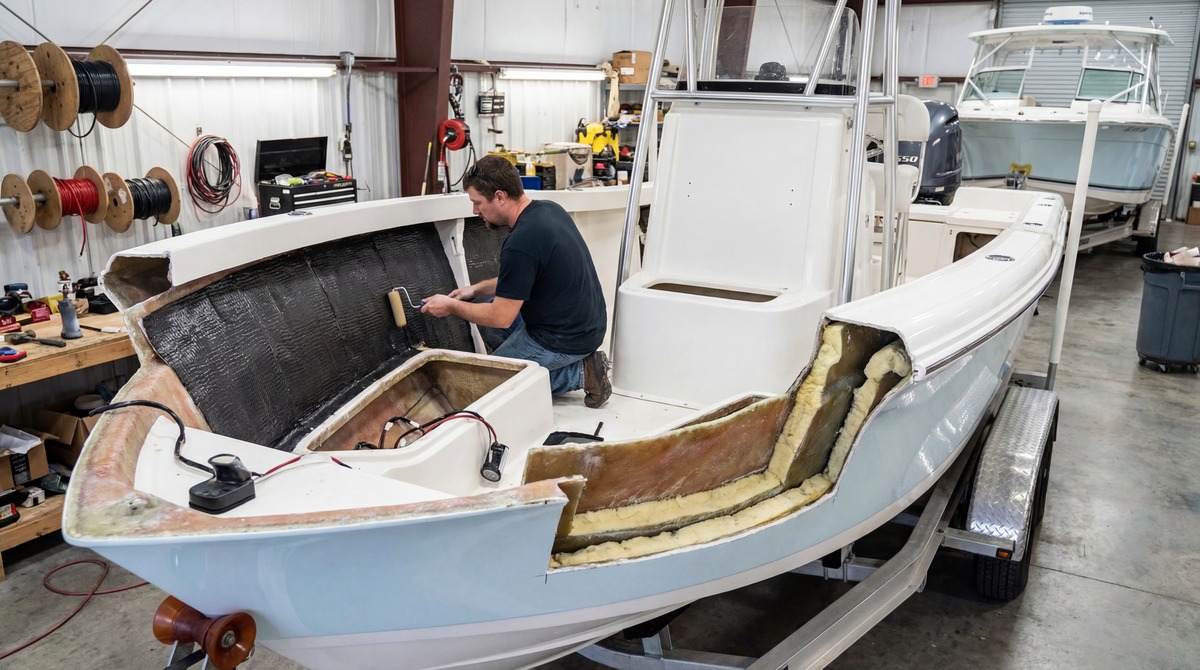
Adding mass and damping material to your hull changes its resonance characteristics. Marine-grade sound deadening products—typically heavy vinyl sheets with adhesive backing or closed-cell foam with mass-loaded layers—absorb vibrations before they can build into audible noise. The material converts mechanical energy into heat, breaking the resonance cycle.
Application matters as much as the product itself. Simply slapping sheets onto random surfaces won't solve the problem. You need to identify where resonance is strongest—usually the engine compartment, transom area, and large unsupported panels—and focus your efforts there. Clean surfaces are essential for adhesion. Any oil, dirt, or moisture will prevent proper bonding and reduce effectiveness.
Coverage doesn't need to be 100% to make a difference. Strategic placement on 30-40% of a resonating surface can reduce noise significantly. The material adds weight, which lowers the hull's natural frequency and makes it less likely to resonate with engine and propeller vibrations. Some products include a foil facing that reflects sound waves, adding another layer of noise reduction.
Installation takes time and patience. Working in a boat's confined spaces while ensuring proper adhesion and avoiding wrinkles or air pockets requires attention to detail. The payoff is substantial—boats treated with quality sound deadening materials can see noise reductions of 10-15 decibels, which translates to a perceived halving of loudness. That's the difference between shouting to be heard and having a normal conversation underway.
Engine Mounts Are Your First Line of Defense
The connection between your engine and hull determines how much vibration transfers into the structure. Factory engine mounts do an adequate job, but they're often chosen for cost rather than optimal vibration isolation. Upgrading to premium mounts with better damping characteristics can eliminate resonance issues without any other modifications.
Engine mounts wear out over time. The rubber or polyurethane material that provides cushioning degrades from heat, oil exposure, and constant flexing. A mount that's lost its elasticity becomes a rigid connection that pipes vibration straight into the hull. Inspecting mounts annually and replacing them at the first sign of cracking, compression, or oil saturation prevents problems before they start.
Alignment matters too. An engine that's not properly aligned with the prop shaft creates uneven loading that generates vibration. Even with perfect mounts, misalignment will cause issues. The coupling between engine and shaft should spin freely without binding or wobbling. Any deviation means forces are being transmitted into the hull at angles that promote resonance.
Propeller Condition Affects More Than Thrust
A damaged or unbalanced propeller is one of the most common causes of hull resonance. Even minor damage—a small ding from hitting debris or a blade tip that's slightly bent—can throw the entire assembly out of balance. At cruising RPMs, this imbalance generates significant vibration that travels up the shaft and into the hull.
Professional propeller balancing involves measuring the prop's static and dynamic balance, then removing material from heavy spots or adding weight to light areas until it spins true. This isn't something you can eyeball or fix with a hammer. Shops that specialize in propeller work have the equipment to measure imbalance down to fractions of an ounce and make precise corrections.
Propeller selection plays a role beyond just performance. A prop with the wrong pitch or diameter for your engine and hull combination will force the engine to work outside its optimal RPM range. This can put you right in the middle of a resonance zone. Sometimes switching to a different prop design—say, from a three-blade to a four-blade—changes the vibration frequency enough to move out of resonance with the hull.
Cavitation damage shows up as pitting or erosion on the blade surfaces. This roughness disrupts water flow and creates turbulence that generates vibration. Polishing out minor cavitation damage can restore smooth operation, but severe cases require professional repair or replacement. Running a cavitation-damaged prop doesn't just create noise—it reduces efficiency and can damage the lower unit over time.
Finding the Resonance Sweet Spot Takes Testing
Identifying exactly where resonance occurs requires systematic testing. Start by running the boat through its entire speed range while noting when vibration appears and disappears. Most resonance issues manifest in specific RPM bands—you might find that 2800-3200 RPM is unbearable, but 3400 RPM is smooth. This tells you the resonance is speed-dependent rather than a constant problem.
Load affects resonance too. Test with different passenger and gear configurations to see if the problem shifts or disappears. A hull that resonates when running light might be fine when properly loaded, or vice versa. This information helps narrow down whether the issue is fundamental to the hull design or related to how weight is distributed.
Water conditions matter for testing. What feels like resonance in choppy water might just be impact noise from waves. Find calm conditions to isolate mechanical vibration from environmental factors. If the problem persists in flat water, you're dealing with true resonance rather than rough-water handling characteristics.
Strategic Modifications Can Shift Frequencies
When basic fixes don't solve the problem, structural modifications might be necessary. Adding stiffeners to large unsupported panels changes their natural frequency, moving them out of resonance with the engine and prop. Fiberglass stringers bonded to the inside of hull panels increase rigidity without adding excessive weight.
Bulkheads serve double duty as structural support and vibration barriers. A well-placed bulkhead can prevent resonance from traveling through the hull by creating a physical break in the structure. This is why some boats have seemingly random internal walls—they're there to manage structural loads and control vibration propagation.
Transom reinforcement addresses resonance at its source. The transom takes the full force of engine and prop vibration, and if it's flexing excessively, it will resonate. Adding backing plates, through-bolting hardware more securely, or laminating additional layers of fiberglass can stiffen the transom enough to eliminate flex-induced resonance.
Professional Assessment Saves Time and Money
Some resonance problems require expert diagnosis. A marine surveyor or experienced mechanic can identify issues that aren't obvious to the average boat owner. They have the tools to measure vibration frequencies, check shaft alignment precisely, and evaluate hull structure for weaknesses that promote resonance.
Bringing in a professional early can prevent expensive mistakes. We've seen boat owners throw money at sound deadening materials, new props, and upgraded mounts without addressing the root cause—a misaligned engine or damaged shaft bearing. An hour of expert diagnosis would have saved thousands in wasted modifications.
Documentation matters if you're dealing with a persistent problem. Keep records of what you've tried, what RPM ranges show issues, and how different conditions affect the resonance. This information helps professionals narrow down the cause faster and recommend targeted solutions rather than generic fixes.
Operating Technique Offers Immediate Relief
While you're working on permanent solutions, adjusting how you operate the boat can minimize resonance. If you know that 3000 RPM causes vibration but 3300 RPM is smooth, simply avoid the problem range. This isn't a fix, but it makes the boat more pleasant to use while you address the underlying issue.
Trim adjustment changes how the hull rides and can shift you out of resonance zones. Trimming the drive up or down alters the propeller's angle of attack and the hull's attitude in the water. Sometimes a small trim change is enough to eliminate vibration at a given speed. Experiment with trim settings throughout your speed range to find the smoothest combinations.
Weight distribution affects hull dynamics and resonance characteristics. Moving heavy items forward or aft changes how the boat sits and responds to forces. If you notice that resonance improves or worsens with different loading, use that information to optimize weight placement for smoother operation.
Maintenance Prevents New Problems
Regular maintenance keeps resonance issues from developing in the first place. Inspect engine mounts, shaft couplings, and prop condition as part of your routine service schedule. Catching wear early means fixing small problems before they turn into major vibration sources.
Lubrication points throughout the drivetrain need attention. Dry or worn bearings create friction and vibration that can excite hull resonance. Keeping everything properly greased and adjusted ensures smooth operation and minimizes vibration generation.
Fastener inspection should be part of every pre-season checkup. Go through the boat systematically, checking that every bolt, screw, and clamp is secure. Pay special attention to items mounted to the hull or transom—these are most likely to work loose from vibration and create secondary noise issues.
The Long Game Pays Off
Solving hull resonance isn't always quick or cheap, but the improvement in comfort and enjoyment makes it worthwhile. A boat that hums and rattles constantly is exhausting to operate and unpleasant for passengers. Eliminating resonance transforms the experience, making longer trips feasible and reducing fatigue for everyone aboard.
The fixes we've covered range from simple and inexpensive—tightening hardware, adjusting trim—to more involved projects like adding sound deadening or upgrading mounts. Start with the easy wins and work your way up to more complex solutions if needed. Many boats see dramatic improvement from basic maintenance and minor upgrades without requiring major modifications.
Hull resonance is a solvable problem. The boats that suffer from it aren't fundamentally flawed—they just need attention to the details that control vibration. Whether you tackle the work yourself or bring in professionals, addressing resonance systematically will get you to a quieter, smoother ride. The water's supposed to be peaceful. Your boat should be too.
Let’s Get Your Boat Back to Quiet
We know how much a smooth, silent ride matters when you’re out on the water. If hull resonance or vibration is taking the fun out of your boating, let’s tackle it together. Call us at 305-290-2705 or Request Boat Repair or Service and we’ll help you enjoy every outing in comfort again.


.png)