



Right now, the only thing standing between your boat's finish and serious damage might be the product you're about to grab off the shelf. Plenty of boat owners look at their garage, see a bottle of car polish, and figure it's close enough. After all, both surfaces shine, both get dirty, and both need protection from the elements. But that logic falls apart the second you understand what's actually happening beneath the surface.
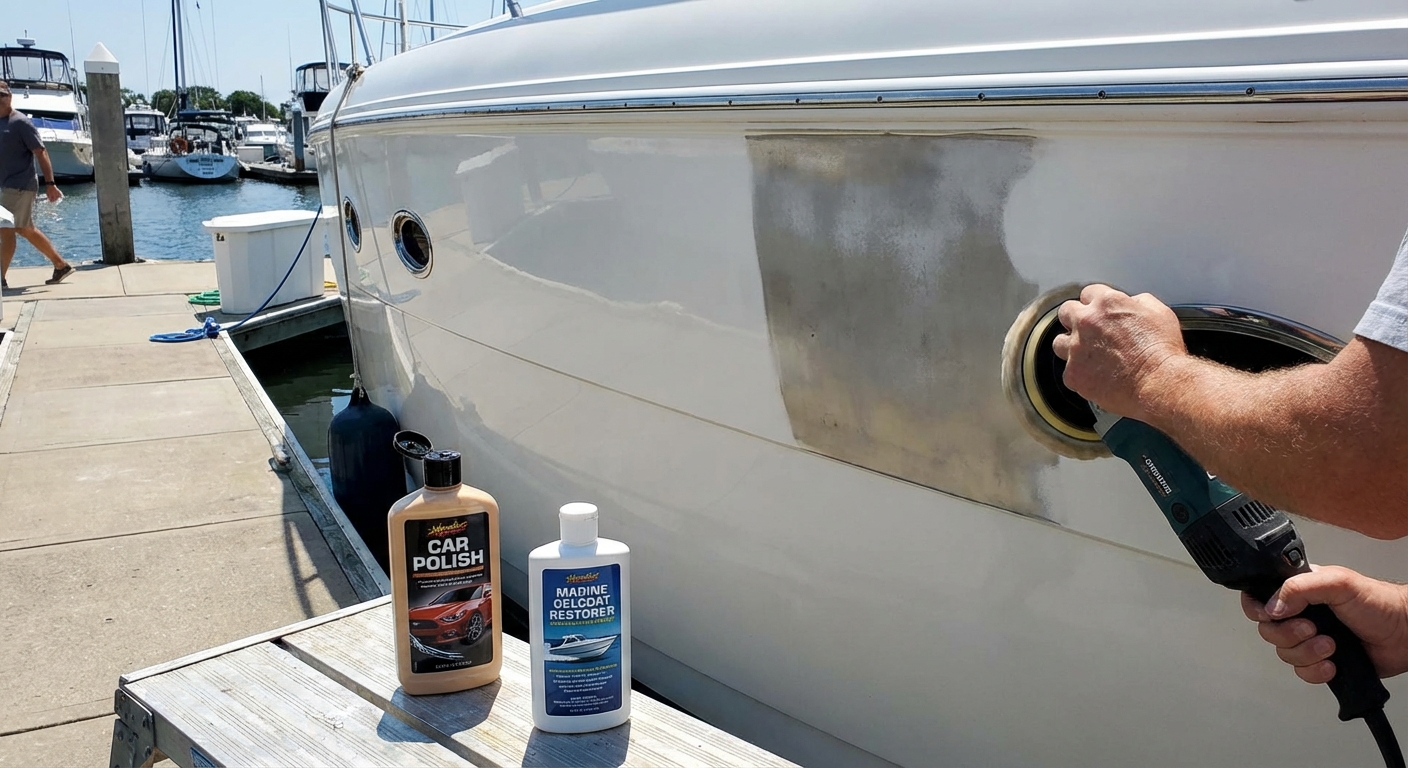
The marine environment doesn't play by the same rules as your driveway. Saltwater corrodes. UV rays beat down harder on open water. Algae, barnacles, and constant moisture create conditions your car will never face. Using car polish on a boat isn't just ineffective—it's a shortcut that compounds problems you won't see until it's too late. We've spent years at the intersection of maintenance, performance, and long-term asset protection, and we've learned this lesson the hard way: the wrong product doesn't just fail to help, it actively works against you.
Gelcoat and Clear Coat Are Not the Same Thing
Most people assume that if a surface is shiny and smooth, the same product will work on it. That assumption costs boat owners thousands every year. Cars are finished with a clear coat over paint—a thin, protective layer designed to handle rain, road salt, and UV exposure. Boats, on the other hand, are covered in gelcoat, a thick resin that's molded directly into the fiberglass structure. Gelcoat isn't just a coating; it's part of the hull itself, and it's engineered to withstand an entirely different set of challenges.
The marine environment is relentless. Saltwater damage doesn't just sit on the surface—it penetrates, corrodes, and breaks down materials that weren't built to resist it. Gelcoat is formulated to handle that abuse, but only if you treat it with products designed for the job. Car polish is built for a different battlefield. It's optimized for automotive paint, not for the oxidation, chalkiness, and deep-set grime that develop on gelcoat after months on the water. The chemistry doesn't match, the abrasives don't cut deep enough, and the protective additives don't address the threats your boat actually faces.
Car Polish Leaves Your Boat Exposed
The problem with car polish isn't just that it doesn't work—it's that it creates a false sense of security. You apply it, the boat looks shinier for a week or two, and you assume you've done your job. But underneath that temporary gloss, the gelcoat is still oxidizing. The UV rays are still breaking down the resin. The saltwater is still doing its damage. Car polish doesn't contain the marine-grade UV inhibitors or water-repellent compounds that actually protect against these threats.
Worse, many car polishes are loaded with silicones and fillers that create a slick, reflective finish on automotive paint but behave differently on gelcoat. These additives can attract dirt and grime in a marine environment, making your boat harder to clean over time. They also interfere with the adhesion of proper marine waxes and sealants down the line. If you ever want to apply a real protective layer, you'll first need to strip off the residue left behind by the wrong product. That's extra work, extra cost, and extra wear on a surface that didn't need the abuse in the first place.
The Damage Compounds Over Time
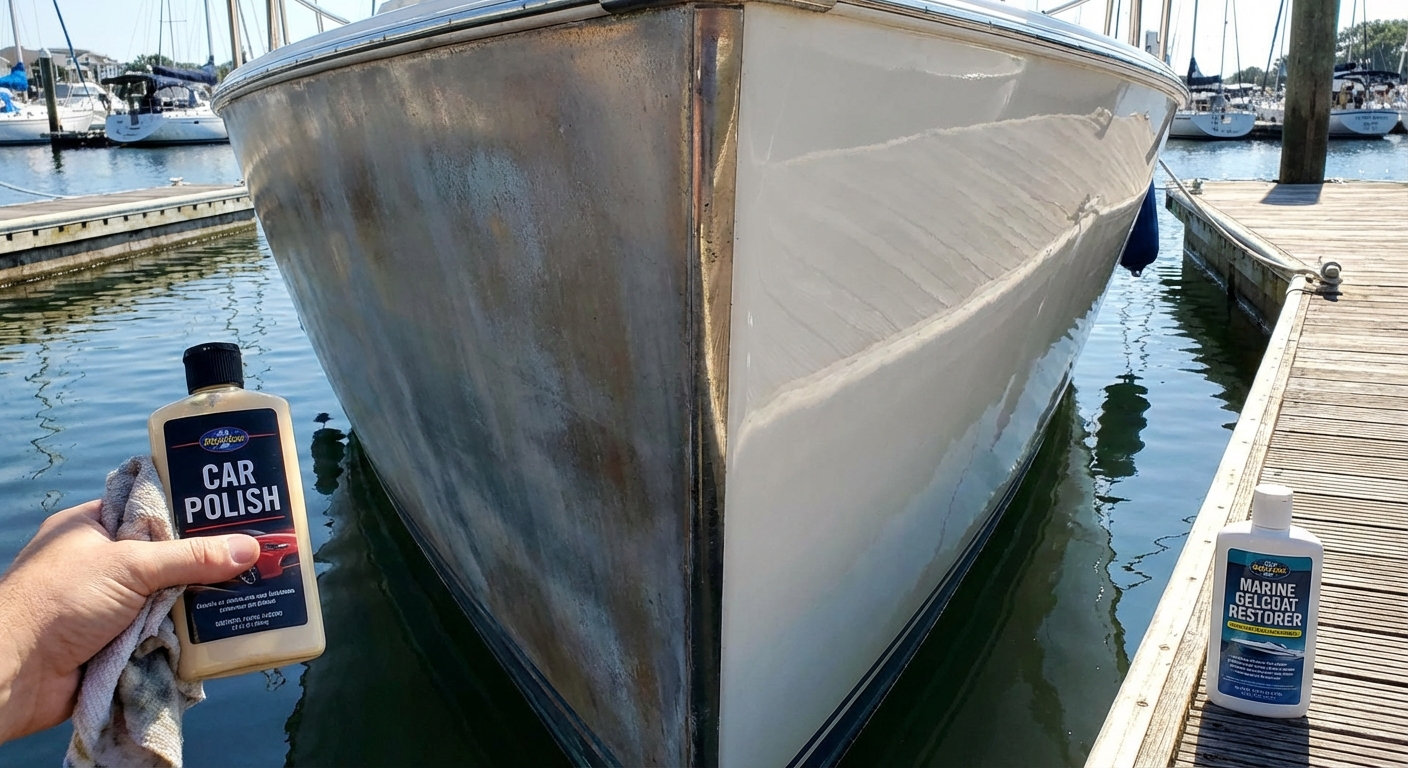
One application of car polish won't sink your boat, but repeated use accelerates the decline. Gelcoat oxidation is a slow burn. It starts with a dull, chalky appearance and progresses to discoloration, fading, and eventually structural weakness. Car polish doesn't stop this process—it just masks it temporarily. Every time you use the wrong product, you're giving oxidation more time to set in, and you're making the eventual restoration more expensive.
We've seen boats that looked fine on the surface but were quietly deteriorating because the owner used automotive products for years. By the time the damage became visible, the gelcoat was too far gone for a simple polish. Professional restoration was the only option, and that's a bill no one wants to pay. The irony? The cost of proper boat maintenance over those same years would have been a fraction of the repair cost. Execution beats shortcuts every time, and in this case, execution means using the right product from the start.
What Actually Works on Gelcoat
Marine polish is built for the job car polish can't handle. It contains stronger abrasives designed to cut through the oxidation and chalkiness that develop on gelcoat. It includes UV inhibitors that protect against sun damage, which is far more intense on open water than it is on a highway. And it's formulated to repel water and resist the buildup of algae, barnacles, and other marine growth that would laugh at a car polish's protective layer.
When you use a product designed for boats, you're not just making the surface look better—you're extending the life of the gelcoat itself. You're preventing the kind of deep oxidation that leads to costly repairs. You're making future cleaning easier because the surface is properly sealed. And you're protecting your investment in a way that actually compounds over time, rather than deteriorating in silence.
Here's what separates marine polish from the automotive stuff sitting in your garage:
- Stronger abrasives that actually remove oxidation from gelcoat, not just surface dirt
- UV inhibitors formulated for the intensity of sun exposure on open water
- Water-repellent compounds that prevent saltwater from penetrating the surface
- Anti-fouling properties that resist algae and marine growth
- Compatibility with gelcoat chemistry, ensuring long-term adhesion and protection
The Cost of Convenience
We get it. You're standing in your garage, you've got a bottle of car polish right there, and the marine store is twenty minutes away. It's tempting to just use what you have and call it a day. But convenience has a price, and in this case, the price is paid in oxidation, fading, and eventual restoration costs that dwarf the cost of the right product.
The best boat owners don't optimize for short-term convenience. They optimize for long-term outcomes. They understand that maintenance is an investment, not an expense. They know that the right product applied consistently will outperform the wrong product every single time, no matter how much cheaper or more convenient the wrong product might be in the moment.
This isn't about being precious or perfectionist. It's about understanding the system you're working with and using the tools that actually move the needle. Car polish on a boat is like hiring house cats to do a cheetah's job. It might look like you're doing something, but the results won't be there when you need them.
What to Look for in Marine Polish
Not all marine polishes are created equal, and the market is full of products that overpromise and underdeliver. The best marine polishes are transparent about what they do and what they're designed for. They're labeled as safe for gelcoat and fiberglass. They list their active ingredients. They come with clear instructions for application and reapplication intervals.
When you're evaluating a marine polish, you're looking for proof, not promises. Does it have a track record with other boat owners? Do marine professionals use it? Can you find independent reviews that confirm it does what it claims? The best products don't need flashy marketing—they have results that speak for themselves.
Here's what we look for when we're selecting a marine polish:
- Explicit labeling for gelcoat and fiberglass surfaces
- UV protection rated for marine environments, not just automotive use
- Water-repellent properties that last through multiple wash cycles
- Abrasive strength appropriate for oxidation removal without damaging the gelcoat
- Compatibility with marine waxes and sealants for layered protection
Wax Is the Second Half of the Equation
Polish removes oxidation and restores the surface. Wax protects it. You need both, and you need them to work together. Marine wax is formulated to bond with gelcoat and create a barrier against UV rays, saltwater, and marine growth. It's not the same as car wax, which is designed for a different surface and a different set of threats.
The best marine waxes contain carnauba or synthetic polymers that create a hard, durable finish. They're designed to last through weeks of saltwater exposure, not just a few rainstorms. They make cleaning easier because dirt and grime can't penetrate the protective layer. And they enhance the shine that marine polish creates, giving your boat that showroom look that actually lasts.
Applying marine wax isn't complicated, but it does require consistency. Most marine waxes need to be reapplied every few months, depending on how much time your boat spends in the water and how harsh the conditions are. That might sound like a hassle, but it's a fraction of the time and cost you'd spend dealing with oxidation damage down the line.
The Execution Gap
Most boat owners know they should be using marine-specific products. They've read the articles, they've heard the advice, and they understand the logic. But knowing and doing are two different things. The execution gap is where most people lose. They buy the right products, but they don't apply them consistently. Or they apply them once and assume the job is done. Or they skip a season because the boat still looks fine, and by the time they notice the damage, it's too late to fix it with a simple polish.
Execution is the only thing that matters. You can have the best marine polish on the market, but if it's sitting in your garage while your boat oxidizes in the sun, it's worthless. The boats that look great year after year aren't owned by people with more money or more time—they're owned by people who execute consistently. They polish and wax on a schedule. They don't wait for the gelcoat to look bad before they act. They treat maintenance as a system, not a reaction.
Here's what consistent execution looks like in practice:
- Polish the boat at the start of the season to remove any oxidation that developed over the winter
- Apply marine wax immediately after polishing to lock in the protection
- Reapply wax every two to three months, or more frequently if the boat is in saltwater
- Inspect the gelcoat regularly for early signs of oxidation or damage
- Address problem areas immediately, before they spread or deepen
Why Shortcuts Fail in the Long Run
The temptation to use car polish on a boat is just one example of a broader pattern: people optimizing for convenience in the short term and paying for it in the long term. It's the same logic that leads people to skip oil changes, ignore warning lights, or put off maintenance until something breaks. It feels like you're saving time or money, but you're actually just deferring the cost—and usually multiplying it in the process.
The marine environment doesn't care about your convenience. It doesn't slow down because you're busy or because you don't feel like making a trip to the marine store. Saltwater corrodes at the same rate whether you're paying attention or not. UV rays break down gelcoat on the same schedule whether you've applied the right protection or not. The system doesn't bend to your preferences—it just runs, and you either keep up or you fall behind.
The boats that hold their value, that look great after years of use, that don't require expensive restoration work—those boats are owned by people who understand this. They don't take shortcuts. They don't assume that "close enough" is good enough. They execute consistently with the right products, and they reap the rewards over time.
The Meritocracy of Maintenance
In the long run, the boats that get the right care outperform the boats that don't. It's not about luck or privilege—it's about execution. You can't fake your way through marine maintenance. You can't charm saltwater into being less corrosive or convince UV rays to be gentler. The only thing that works is doing the right thing, consistently, with the right products.
This is the uncomfortable truth about boat ownership: the system rewards those who execute, and it punishes those who don't. You can have the nicest boat on the dock, but if you're using car polish and skipping wax applications, you're going to lose to the guy with the older boat who uses marine polish and waxes on schedule. Merit compounds. Shortcuts decay.
Here's what separates the boats that last from the boats that don't:
- Owners who use marine-specific products, not automotive substitutes
- Consistent application schedules, not reactive maintenance when damage is already visible
- Attention to early warning signs like dullness or chalkiness, before oxidation sets in deep
- Investment in quality products that actually protect, not cheap alternatives that just look shiny
- Understanding that maintenance is an investment in long-term value, not an expense to minimize
What This Means for Your Boat
Every decision you make about maintenance shifts the trajectory of your boat's condition. Use car polish, and you're choosing short-term convenience over long-term protection. Use marine polish and wax, and you're choosing to protect your investment and extend the life of your gelcoat. The difference might not be visible after one application, but over months and years, the gap becomes undeniable.
We've seen this play out hundreds of times. Two boats, same model, same age, same amount of use. One looks like it just came off the showroom floor. The other looks tired, faded, and oxidized. The difference isn't luck—it's execution. The owner of the first boat used the right products consistently. The owner of the second boat took shortcuts and paid for it in resale value, repair costs, and the simple disappointment of watching their investment deteriorate.
The choice is yours, but the outcome isn't negotiable. The marine environment will do what it does. Saltwater will corrode. UV rays will break down gelcoat. Oxidation will set in. The only variable is whether you're using products that actually fight back or products that just make you feel like you're doing something.
The Verdict from the Water
Car polish on a boat is a losing bet. It doesn't address the threats your boat actually faces. It doesn't provide the protection gelcoat needs. And it creates problems down the line that cost far more to fix than the price of the right product in the first place. The boats that look great, hold their value, and avoid costly restoration work are the boats that get marine-specific care from owners who execute consistently.
This isn't about being precious or perfectionist. It's about understanding the system and using the tools that actually work. Marine polish and wax are designed for the job. They contain the right abrasives, the right UV protection, and the right water-repellent compounds. They're built for saltwater, sun, and the relentless wear of the marine environment. Car polish isn't, and no amount of convenience or cost savings will change that.
The next decade belongs to those who execute. In boat maintenance, that means using the right products, applying them consistently, and refusing to take shortcuts that compound into problems. Your boat is an investment. Treat it like one, and it'll reward you with years of performance and value. Cut corners, and you'll pay for it in ways that make the cost of marine polish look like pocket change.
If you're dealing with fiberglass repair in Miami or need help with boat waxing in South Florida
Let’s Protect Your Boat the Right Way
We know how much your boat means to you, and we’re here to help you keep it looking and performing its best for years to come. If you’re ready to ditch the shortcuts and give your boat the care it deserves, let’s talk. Call us at 305-290-2701 or Request Boat Repair or Service—we’re ready to help you get back on the water with confidence.


.png)